Artificial Photosynthesis: CO₂ to C₂ and C₆ Molecules — NRG-IA
Tehnologie & Inovație Author: Ioana BuzoaicaAn 'artificial leaf' captures light energy to convert CO₂ into high-value molecules, bringing solar fuel production closer to industrial reality.
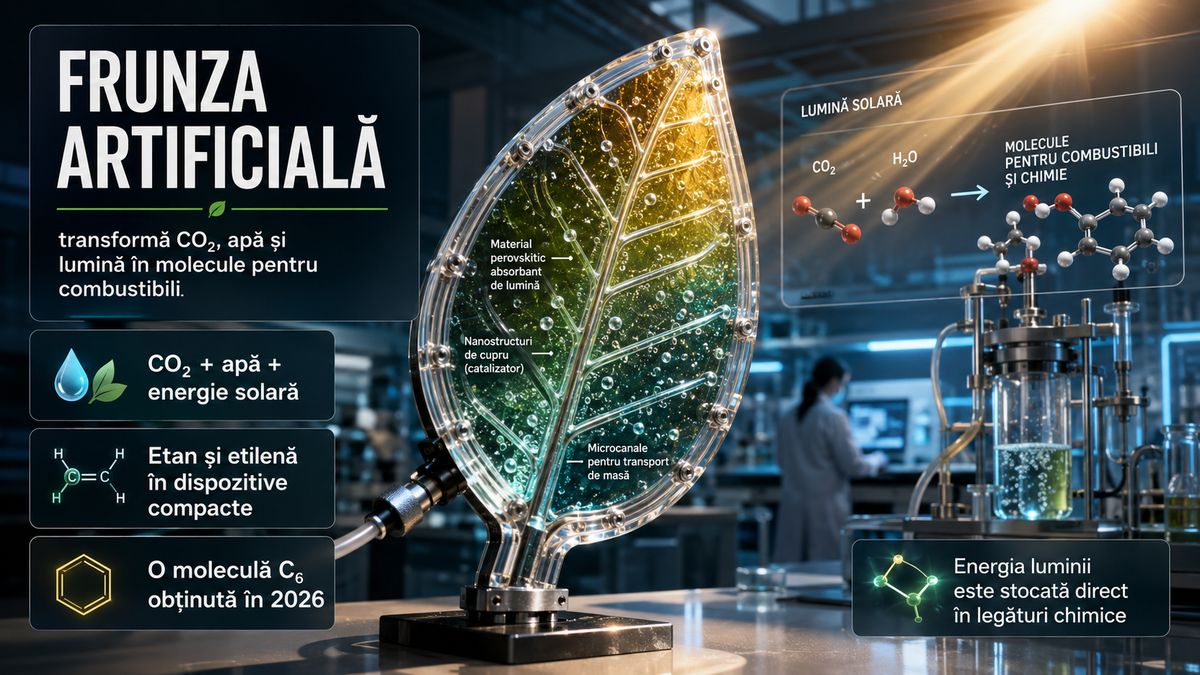
In 2026, researchers in the United States demonstrated an artificial photosynthesis system that uses CO₂, water, and energy supplied by simulated sunlight to build a six-carbon molecule . The product, 2-methyl-2-pentenal, can subsequently be converted into hexane, a liquid hydrocarbon. This result advances a pathway that, just a year prior, had demonstrated the production of ethane and ethylene from CO₂ in a compact device. The breakthrough is significant for what it reveals about the trajectory of the technology. Artificial photosynthesis is beginning to move beyond the stage where CO₂ is converted only into very simple molecules. Research is advancing toward the controlled formation of carbon-carbon bonds and the construction of increasingly complex molecules —precisely the capability required if sunlight is to one day power the production of fuels and chemical feedstocks. In such a system, light is not merely converted into electricity. Photon energy is stored directly in the chemical bonds of the final product . The molecule thus becomes both an industrial product and a carrier of the energy originally captured from light. From a stamp-sized device to building C₂ molecules One of the milestones that brought this pathway to light was published in 2025 in Nature Catalysis by researchers from UC Berkeley, Lawrence Berkeley National Laboratory, the University of Cambridge, and the Liquid Sunlight Alliance. The team built a photoelectrochemical system in which a perovskite material captures light, while copper catalytic structures, described as "nanoflowers", drive the reactions that convert CO₂ into ethane and ethylene —molecules containing two carbon atoms each. Berkeley Lab presented the experimental setup as being roughly the size of a postage stamp. Inside, however, a highly significant chemical operation takes place: two carbon atoms derived from CO₂ end up bonded into a single molecule. This carbon-carbon bond is essential. Most fuels, plastics, and chemical industry products are built from structures containing multiple carbon atoms. The ability to start from CO₂ and selectively form such structures opens a pathway toward using recycled carbon as a feedstock. Ethylene is already one of the foundational molecules of the global chemical industry. It feeds into industrial chains that yield polymers and numerous other compounds. Producing it using light energy and carbon derived from CO₂ would shift the energy source and, potentially, the origin of the carbon used by these industries. Light directly powering chemistry The principle of artificial photosynthesis pursues an idea fundamentally different from the energy pathway of a conventional photovoltaic panel. A panel produces electricity. If the ultimate goal is to obtain a fuel or a chemical substance, that electricity must then be sent to other equipment and other processes. A photoelectrochemical system attempts to integrate light capture and chemical reaction . The photosensitive material generates the necessary electrical charges, and the catalyst uses those charges to break and rebuild molecular bonds. In the Berkeley device, lead halide perovskite acts as the light absorber, while the copper catalyst controls CO₂ reduction. Experiments with carbon-13 confirmed that the carbon atoms in the measured products originated from the CO₂ introduced into the system. The configuration with the highest C₂ production rate coupled CO₂ reduction with glycerol oxidation at the other electrode. This choice reduces the energy required for the anodic reaction and allows the system to achieve a much higher rate of C₂ product formation than the architecture utilizing water oxidation. In the optimized configuration, the partial current density associated with C₂ hydrocarbons reached 155 µA/cm² , approximately 200 times the level obtained in the perovskite–BiVO₄ configuration based on water oxidation. This multiplication measures the electrochemical rate of the C₂ reaction, not the overall energy efficiency. The figure that benchmarks the current state of the technology is the solar-to-chemical efficiency specific to C₂ hydrocarbons: 0.0017% . The gap between these two values highlights both the progress made and the scale of the technological opportunity. Researchers have found a way to massively accelerate the desired reaction. The next threshold is transferring a much larger proportion of light energy into the final chemical product. In 2026, the carbon chain reaches six atoms In February 2026, researchers from the Liquid Sunlight Alliance, including teams from Caltech, Stanford, SLAC, Berkeley Lab, and UC Berkeley, published a further milestone in ACS Energy Letters . The new architecture starts from CO₂ and water and uses energy from simulated sunlight to yield 2-methyl-2-pentenal, a molecule with six carbon atoms . The process is more complex than the compact Berkeley device. Researchers constructed four connected chemical microenvironments. In the first part…
Ioana Buzoaica — Independent Editorial Board
The NRG-IA newsroom continuously monitors Romanian energy markets, ANRE regulatory decisions, and national grid telemetry (SEN/SNT). We deliver independent intelligence anchored exclusively in official primary data.
Editorial Charter, Ethics & Verification Methodology →