Romania Mandates Fixed-Price and Dynamic Power Contracts — NRG-IA
Legislație & Reglementări Author: Ioana BuzoaicaRomania to mandate 1-year fixed-price and dynamic tariffs for major power suppliers while easing long-term sales rules for Hidroelectrica.
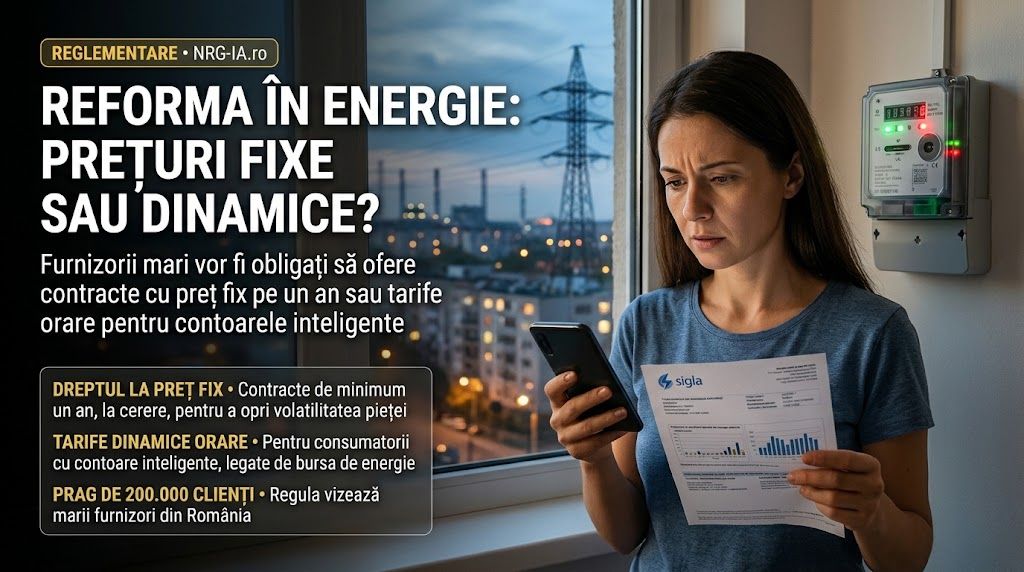
Major electricity suppliers in Romania will be legally required to provide all end-customers, upon request, with fixed-price supply contracts lasting at least one year, according to a comprehensive draft amendment to national energy legislation introduced this week. In parallel, the same suppliers will be required to offer dynamic-price contracts to all consumers with smart metering systems installed at their consumption sites. The dual mandate applies to suppliers with a portfolio exceeding 200,000 customers—a threshold covering all dominant players in the Romanian market, including Hidroelectrica, Electrica Furnizare, PPC Energie, E.ON Energie România, and Premier Energy, which collectively serve over 90% of the country's households and businesses. The reform transposes new European electricity market design rules into national law, coming at a time when Day-Ahead Market (DAM) spot prices surged this week to RON 1,586 per MWh due to the simultaneous unplanned shutdown of Cernavodă Reactor 1 and a temporary outage at the Brazi power plant. 12-Month Fixed Price vs. Hourly Dynamic Tariffs on Consumer Bills Mandating these two types of offers presents residential consumers and companies with two financial instruments based on contrasting logics. In a fixed-price contract lasting at least one year, the supplier fully absorbs the risk of wholesale market volatility for 12 months. The element that remains unchanged throughout the year is the active electricity price—comprising the commodity cost and the supply margin—while ANRE-regulated transmission and distribution tariffs, along with state-set taxes, contributions, and VAT, apply at the prevailing statutory rates. This contract structure acts as an insurance policy for most standard households, whose consumption peaks in the morning between 07:00 and 09:00 and in the evening between 18:00 and 22:00—precisely when exchange power prices peak. Even if spot market prices top RON 1,500 per MWh during winter freezes or summer heatwaves, fixed-price customers pay the exact kilowatt-hour rate agreed upon at signing, with the cost of this predictability baked into the risk premium included in the supplier's annual price calculation. Conversely, dynamic-price contracts pass hourly and 15-minute wholesale fluctuations from the OPCOM power exchange directly onto the customer's bill. This contract can only be signed by consumers with a smart meter integrated into the distribution system operator's remote reading system—the sole device capable of recording the exact hour each kilowatt-hour is consumed. Dynamic pricing becomes highly advantageous for consumers capable of shifting and automating loads away from peak hours. Around midday, between 11:00 and 15:00, when solar farms across Romania and the wider region inject massive volumes of power, active energy spot prices frequently plunge toward zero or sink into negative territory. Electric vehicle owners who schedule charging at noon or overnight, heat pump operators with thermal storage, and households equipped with batteries or smart appliances can significantly lower their bills, whereas conventional consumers using power predominantly in the evening would be directly exposed to peak daily prices. Immediate Exemption for Hidroelectrica Alters Long-Term Pricing Dynamics However, the obligation for major suppliers to guarantee fixed prices for at least one year comes alongside a major overhaul at the generation side of the market. The same legislative package will eliminate, starting in 2028, the requirement for all Romanian power generators to sell at least 50% of their annual output via long-term contracts on forward markets—and the country's largest producer, Hidroelectrica, is granted an immediate exemption. For Hidroelectrica, which reported a net output of 9,328 GWh, the immediate removal of the 50% floor resolves a severe commercial vulnerability. Being highly dependent on rainfall levels and Danube river flow, the hydro generator was previously forced during drought years to buy expensive power on the spot market to fulfill forward delivery commitments. For non-integrated suppliers without captive generation assets, however, Hidroelectrica's exemption shrinks the volume of power mandatory available via one-year bilateral contracts. With suppliers legally obliged to offer 12-month fixed-price contracts to end-users while generators gain greater flexibility to sell short-term, competition among suppliers to secure long-term power hedge cover will intensify, putting upward pressure on fixed-price retail offers. Flexible Grid Connections and a Single Buyer for Network Losses The legislative reform complements supply and generation market changes with two mechanisms aimed at unlocking grid infrastructure and curtailing hikes in regulated transmission and distribution tariffs. The proposal introduces flexible grid connection agreements, allowing new power plants, battery storage systems, and industrial loads to…
Ioana Buzoaica — Independent Editorial Board
The NRG-IA newsroom continuously monitors Romanian energy markets, ANRE regulatory decisions, and national grid telemetry (SEN/SNT). We deliver independent intelligence anchored exclusively in official primary data.
Editorial Charter, Ethics & Verification Methodology →