Laser Fusion: New Capsule Boosts Neutron Yield 2.2x — NRG-IA
Tehnologie & Inovație Author: Ioana BuzoaicaA microscopic tweak to fuel capsules boosted neutron yield up to 2.2x in laser fusion tests, unlocking key progress behind the record 8.6 MJ shot.
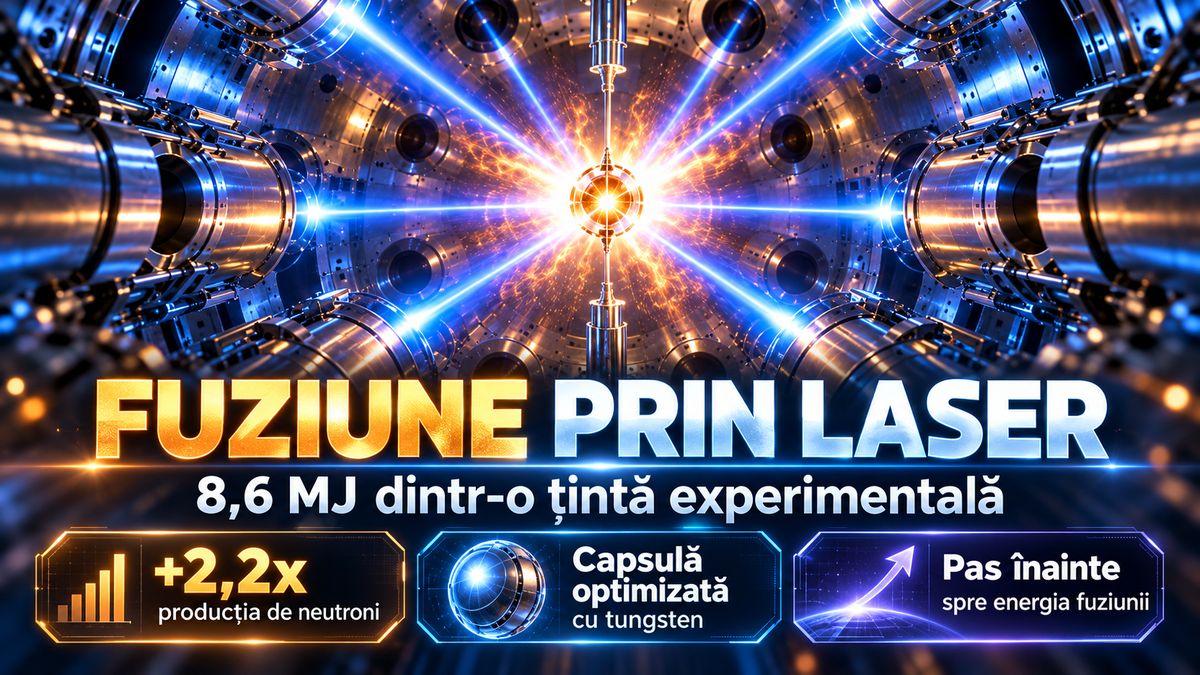
A shift of just a few micrometers in the structure of a fuel capsule has enabled American researchers to boost neutron yield up to 2.2-fold in laser-driven nuclear fusion experiments. The findings, presented in a study accepted on October 16, 2026, in the prestigious journal Physical Review Letters, explain how altering the tungsten distribution within the capsule shell contributed to achieving one of the most significant milestones in the history of experimental nuclear fusion. At the National Ignition Facility (NIF), a research facility at Lawrence Livermore National Laboratory in California, the novel technology was deployed during an April 7, 2025 experiment that generated 8.6 megajoules (MJ) of fusion energy using a 2.08 MJ laser pulse. The nuclear energy released reached 4.13 times the laser energy delivered to the target, with temperatures at the fuel's central core climbing to approximately 233 million degrees Celsius. The achievement represents a major step forward for one of energy research's most ambitious frontiers: generating electricity through light-element fusion—the physical process powering the Sun and stars. Authored by D. S. Clark and collaborators, the study demonstrates that reaction performance can be substantially enhanced by controlling capsule materials without requiring a proportional increase in laser energy to compress the fuel. A tiny capsule contributed to producing 8.6 MJ of energy The National Ignition Facility uses 192 ultra-powerful laser beams directed at a target centered within an experimental chamber. Suspended inside a small metallic cylinder is a spherical capsule, roughly the size of a peppercorn, filled with deuterium and tritium—two hydrogen isotopes serving as fusion fuel. The laser beams heat the interior of the cylinder, generating intense X-rays that compress the capsule at speeds exceeding 400 kilometers per second. Under extreme pressures and temperatures, the deuterium and tritium nuclei fuse, producing helium and releasing energy. This process is known as inertial confinement fusion, as the fuel remains compressed for an extremely brief instant solely due to its own inertia. In December 2022, Livermore researchers achieved net energy gain for the first time, producing 3.15 MJ of fusion energy from 2.05 MJ of laser energy delivered to the target. By April 2025, fusion yield reached 8.6 MJ with only a modest increase in laser energy. This progress reflects cumulative advances in target design, implosion symmetry control, numerical modeling, and laser system performance. An energy gain of 4.13 represents the ratio of fusion energy released to laser energy delivered to the target. For a future commercial power plant, the overall energy balance will also need to account for grid electricity consumed to fire the lasers, power auxiliary systems, and convert thermal output into usable electricity. Nevertheless, NIF’s result sets a vital experimental benchmark: the fuel can release several times the laser energy it absorbs in a single pulse. Tungsten shields the fuel, but risks disrupting compression The capsule shell plays a decisive role in experimental success. Made of high-density synthetic diamond-like carbon, it must ensure highly uniform fuel compression while shielding the fuel from premature heating. Any distortion or contamination can suppress central hot-spot temperatures, compromising nuclear reaction efficiency. To protect the fuel, researchers embed minute quantities of tungsten into specific layers of the shell. This metal absorbs a portion of high-energy X-rays, preventing them from penetrating the fuel prematurely. However, this solution introduces a significant challenge: in earlier capsule designs, tungsten concentration changed abruptly at layer boundaries. These sharp transitions cause localized density variations that trigger hydrodynamic instabilities under violent compression conditions. Shell material can subsequently mix into the nuclear fuel—a phenomenon known in the scientific literature as mix. Fuel contamination degrades hot-spot temperatures and inhibits the reaction's self-amplification capacity. Simulations conducted by the Lawrence Livermore team indicated that this mechanism could cut neutron yields by roughly half in certain experiments. The issue was particularly crucial given that tungsten was introduced specifically to improve capsule performance. Researchers required a profile that maintained X-ray shielding while mitigating instabilities caused by abrupt layer transitions. The solution: tungsten graded over a distance of just 10 micrometers The new design replaces the abrupt tungsten step with a graded concentration profile. Rather than embedding the metal in a discrete layer with sharp boundaries, the concentration increases progressively to a peak before smoothly tapering off. This modification smooths out density discontinuities that fuel instabilities during compression. This graded profile is fabricated into the…
Ioana Buzoaica — Independent Editorial Board
The NRG-IA newsroom continuously monitors Romanian energy markets, ANRE regulatory decisions, and national grid telemetry (SEN/SNT). We deliver independent intelligence anchored exclusively in official primary data.
Editorial Charter, Ethics & Verification Methodology →