Romanian Gas Prices Hit 449 RON/MWh as Production Drops — NRG-IA
Gaze Naturale Author: Ioana BuzoaicaRomanian spot gas hit 449 RON/MWh, the highest since Dec 2022, as production fell to 210 GWh/d due to field maintenance ahead of winter.
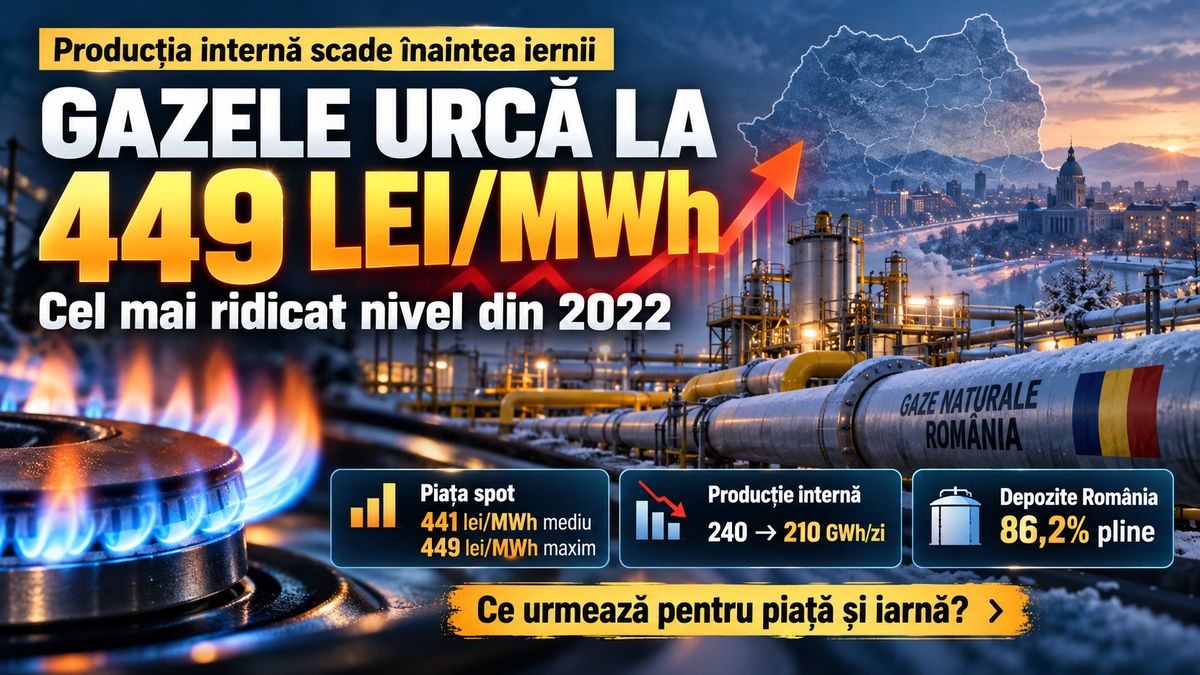
Natural gas prices in Romania have climbed to their highest level since December 2022 following a sharp decline in domestic production just ahead of the cold season. On the spot market, gas for delivery on Thursday, October 15, 2026, traded at an average price of 441 RON/MWh, with peak transactions reaching 449 RON/MWh. The price surge comes at a time when Romania holds lower storage reserves than during the same period last year, making imports increasingly critical to cover domestic demand. According to analyzed data, domestic gas production dropped in just two days from approximately 240 GWh to 210 GWh per day—a 12.5% decline—driven by planned maintenance works at the Hurezani field, operated by OMV Petrom, and the Corunca field, operated by Romgaz. This temporary reduction in domestic supply coincides with the seasonal rise in demand as temperatures drop and space heating requirements intensify. The situation is further complicated by available reserve levels. According to Gas Infrastructure Europe data, as of October 16, Romania held approximately 29.19 TWh of gas in underground storage, representing 86.2% of total capacity. While this exceeds the European Union average of 74.22%, it is roughly 11 percentage points lower than Romania's fill level on the same date in 2025. This shortfall diminishes the cushion available for peak-demand periods, placing greater reliance on daily market supplies. Domestic production falls by 12.5% following Hurezani and Corunca maintenance Romania is one of the largest natural gas producers in the European Union, with domestic output forming a cornerstone of supply for households, industry, and power plants. This provides a structural advantage over countries almost entirely reliant on imports; however, short-term gas availability remains bound to field performance, maintenance schedules, and demand fluctuations. In the days leading up to the price surge, production fell from around 240 GWh/day to 210 GWh/day, representing a daily supply loss of 30 GWh. A significant share of this drop stems from scheduled maintenance at Hurezani, an onshore field operated by OMV Petrom that typically produces about 2.5 million cubic meters per day. Concurrently, works at the Corunca field, part of Romgaz's asset base, further constrained available volumes. Maintenance outages are vital for operational safety and preparing infrastructure for peak winter production. However, their market impact heavily depends on timing. A production drop in summer, when demand is low, can be easily absorbed through imports or adjusted storage injection rates. In October, the same cut hits a market where suppliers must concurrently cover real-time consumption and prepare winter deliverables. A 30 GWh daily drop in production is significant for the balance of the Romanian market. Missing volumes must be replaced via alternative supply sources, rerouted commercial flows, or storage flexibility. When buyers turn to short-term procurement for supplementary volumes, they face increased exposure to elevated spot prices, further accelerating market rallies. Romania ramps up imports as regional flows shift The contraction in domestic supply was accompanied by a surge in gas imports across cross-border interconnectors. Transgaz data indicates entry flows from Bulgaria of approximately 15.9 million cubic meters (mcm) against exit flows of around 4.6 mcm toward Hungary. The net inflow underscores the vital role of southern corridor gas in balancing the domestic market and sustaining storage injections. Regional interconnections allow Romania to tap diversified supply sources, including volumes reaching Southeast Europe via pipeline infrastructure and LNG regasification terminals. While this flexibility offers a crucial buffer when local output dips, import costs remain closely tied to broader regional pricing, supply availability, and cross-border capacity bookings. During the same timeframe, gas exports to the Republic of Moldova were briefly halted due to a seven-to-eight-hour maintenance outage at the Ungheni metering station. Although an operational issue tied to measurement infrastructure, the incident illustrates the complexity of managing a system where Romania must simultaneously balance domestic production, national consumption, storage reserves, and cross-border flows. The role of imports becomes even more critical as the broader European market contends with elevated pricing and lower storage levels. Foreign supplies allow Romania to offset output shortfalls, but import costs are dictated by regional competition for available volumes. Consequently, while domestic production provides a strategic advantage, its protective cushion relies heavily on operational availability during peak demand periods. Storage levels reach 86.2%: Above EU average, but 11 percentage points below 2025 Romania enters the cold season with gas storage levels well above the EU average. As of October 16, Gas Infrastructure Europe…
Ioana Buzoaica — Independent Editorial Board
The NRG-IA newsroom continuously monitors Romanian energy markets, ANRE regulatory decisions, and national grid telemetry (SEN/SNT). We deliver independent intelligence anchored exclusively in official primary data.
Editorial Charter, Ethics & Verification Methodology →