Gas hits €100/MWh as EU weighs power bill cuts — NRG-IA
Piața de Energie Author: Ioana BuzoaicaEurope faces a sharp gas price surge driven by the Middle East conflict. The EC proposes network tariff and tax tweaks as energy costs weigh on industry.
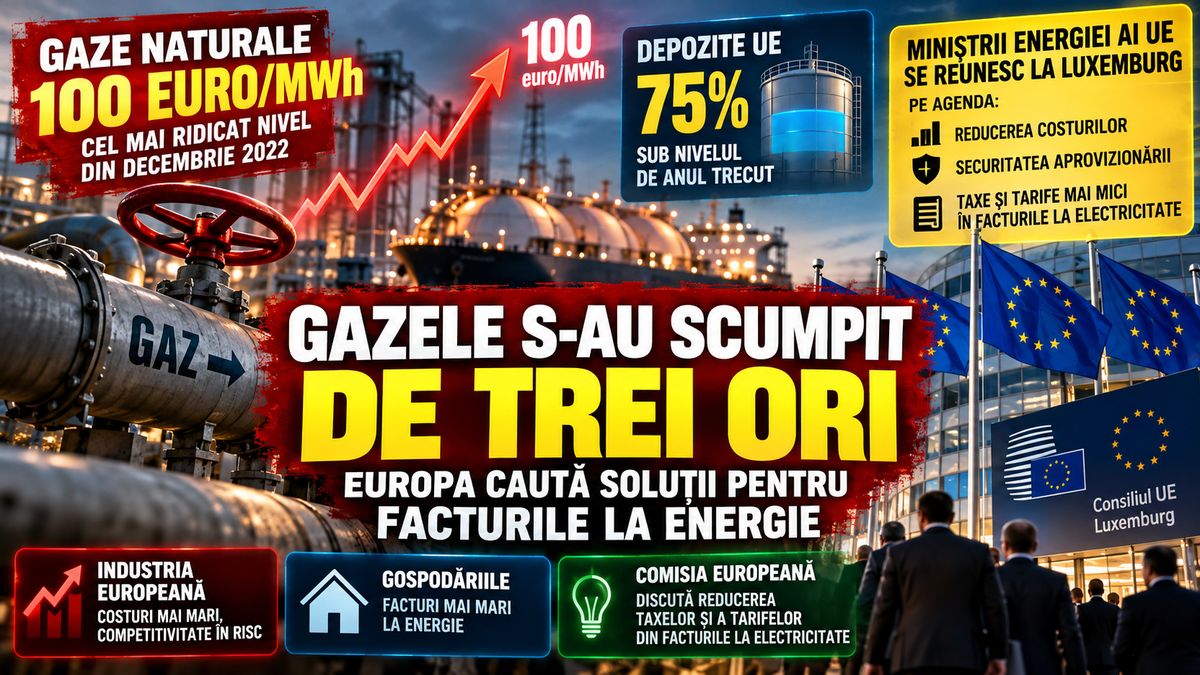
European Union energy ministers meet on Thursday, October 29, 2026, in Luxembourg, at a time when natural gas prices have risen to roughly three times their pre-war levels with Iran, and the onset of winter brings renewed pressure on energy markets. European benchmark gas prices briefly reached €100/MWh on October 28, crossing that threshold for the first time since December 2022. The meeting agenda focuses on reducing electricity costs, safeguarding security of supply, and implementing measures to make Europe less vulnerable to external energy shocks. The situation is compounded by gas storage levels. EU storage facilities are approximately 75% full, compared to 83% at the same point last year. Concurrently, disruptions to Middle Eastern energy shipments are squeezing liquefied natural gas availability and intensifying global competition for supplies. Consequently, Europe enters the cold season with more expensive gas and lower reserves than in the previous autumn. European Commissioner for Energy Dan Jørgensen warned that the situation is grave, stressing that energy affordability is as pressing an issue as supply security. According to statements reported by Reuters, EU institutions do not currently see an immediate threat to energy supply, but high costs are already weighing heavily on households and businesses. The Luxembourg meeting aims to identify solutions that can ease this burden without disrupting energy market mechanisms. Gas Touches €100/MWh as Europe Pays Billions More for Energy Imports The benchmark natural gas price on the Dutch TTF hub hit the €100/MWh threshold during trading on Wednesday, October 28. This marks its highest level since December 2022, a period when Europe was grappling with the loss of most Russian pipeline gas deliveries. Quotes stand at approximately triple the level observed prior to the outbreak of the war with Iran, according to Reuters. The surge reflects supply strains caused by the Middle East conflict, including disruptions to Qatari liquefied natural gas exports and transit through the Strait of Hormuz. These developments are forcing European buyers to compete fiercely for available cargoes from other regions, particularly the United States. Competition with Asian importers is becoming especially critical ahead of the heating season, when demand can spike simultaneously across multiple regional markets. The economic scale of the crisis is highlighted by the European Union Agency for the Cooperation of Energy Regulators (ACER). According to its summer 2026 monitoring report, the Middle East conflict added between €18 billion and €33 billion to the cost of European gas imports for the exact same volume of fuel. The divergence in estimates stems from the price indicators used in the calculation. These figures underscore how severely rising international prices can hit the European economy even when imported volumes remain steady. ACER estimates that refilling European gas storage in 2026 may have cost up to €27 billion. Although below the extraordinary expenditure seen during the 2022 energy crisis, the average cost of gas injected into storage was the second-highest recorded over the past decade. Higher fuel costs are passed on to suppliers, power plants, industrial consumers, and ultimately households, depending on contractual terms and applicable regulatory shields. European Commission Proposes Changes to Network Tariffs and Electricity Taxation In response to these pressures, the European Commission is seeking to lower regulatory components in electricity bills. On Thursday, ministers are discussing a legislative proposal presented on July 17, 2026, aimed at improving the structure of transmission and distribution tariffs, fostering digitalization, and aligning taxation with the broader electrification goals of the European economy. Network tariffs cover the costs associated with transmitting and distributing electricity to end users, funding the operation, maintenance, and expansion of infrastructure. The Commission argues that tariff-setting mechanisms can be improved to ensure more efficient network utilization and curb long-term system costs. The proposal encourages system operators to deploy digital technologies and flexibility solutions that can reduce the need for capital-intensive grid upgrades while optimizing existing infrastructure. A major element concerns taxation. The Commission proposes setting minimum tax rates for electricity below those applied to natural gas, thereby incentivizing electricity use over fossil fuels. The draft does not impose uniform tax rates across all member states; any adjustments to national tax levels will depend on domestic legislation. The ultimate impact on end-user bills will depend on the specific measures adopted and existing national cost structures. The reform also sets targets for smart meter deployment. The proposed text aims to equip at least 50% of final consumers with smart meters by 2030 and at least 75% by…
Ioana Buzoaica — Independent Editorial Board
The NRG-IA newsroom continuously monitors Romanian energy markets, ANRE regulatory decisions, and national grid telemetry (SEN/SNT). We deliver independent intelligence anchored exclusively in official primary data.
Editorial Charter, Ethics & Verification Methodology →