EU approves Transgaz capacity for gas flows to Ukraine — NRG-IA
Gaze Naturale Author: Ioana BuzoaicaThe EC decision allows Transgaz to offer gas transport capacity to Ukraine, boosting Romania's regional role and revenues via the Vertical Corridor.
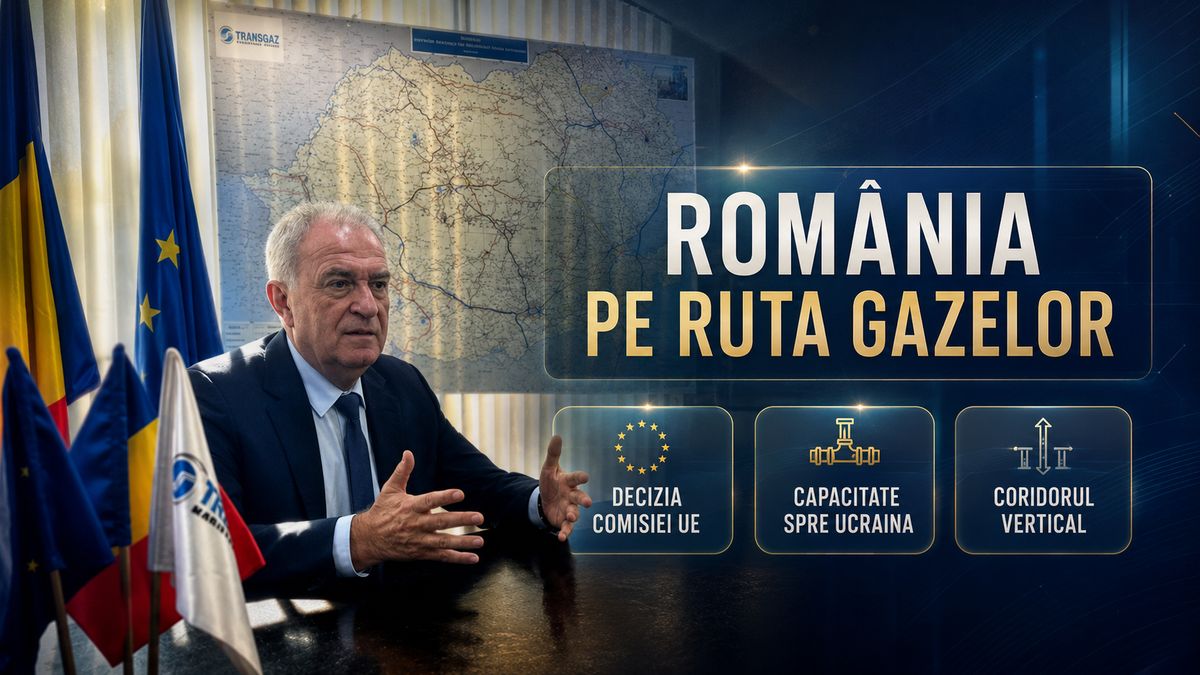
The European Commission has approved amendments to the commitments made by Transgaz in 2020, enabling the Romanian gas transmission system operator to offer export capacity to Ukraine. The decision targets competing capacities between the Romania–Bulgaria interconnection point, Negru Vodă I/Kardam , and the Romania–Ukraine point, Isaccea I/Orlovka , on the same gas transmission infrastructure. This is the core of the matter: the Commission has not authorized Transgaz to sell gas to Ukraine, but has instead allowed Transgaz to market transmission capacity that can be booked for flows toward Ukraine . Gas is bought, sold, and moved by market participants. Transgaz merely provides the infrastructure and transmission capacity under regulated conditions. The decision shifts the relationship between an existing pipeline and its commercial role. Romania already possessed the infrastructure, interconnection points, and geographical position. The amendment approved by the Commission establishes the framework through which this same infrastructure can be used more efficiently toward Ukraine, within the context of the Vertical Corridor and the gradual phase-out of Russian gas from the European market. What the European Commission actually approved In May 2026, Transgaz requested an amendment to its 2020 commitments to offer competing export capacities at two interconnection points located on the same pipeline: one between Romania and Bulgaria, and one between Romania and Ukraine. The Commission accepted the modification after evaluating the review clause in the initial commitments, concluding that there were justified grounds for the change. Competing capacities are network capacities that cannot be fully allocated simultaneously at two different points because they share the same infrastructure or the same critical technical segment. If the market books more capacity at one point, the available capacity at the other point is reduced partially or entirely. Allocation is carried out through auctions and is driven by market demand. In plain terms, the decision means that Transgaz's infrastructure can be made available to the market for two alternative directions: toward Bulgaria, via Negru Vodă I/Kardam, or toward Ukraine, via Isaccea I/Orlovka. The market decides through bookings which direction receives capacity, while the system must respect the network's technical limits. The 2020 case: from suspected export restrictions to capacity obligations The Transgaz case has antitrust origins. In 2020, the European Commission accepted commitments proposed by Transgaz to address concerns regarding potential restrictions on natural gas exports from Romania to neighboring markets. The commitments aimed to increase available export capacity to Hungary and Bulgaria under transparent and non-discriminatory conditions. The 2020 decision established minimum firm capacities at the interconnection points. For Hungary, via Csanádpalota, Transgaz committed to making 1.75 billion cubic meters/year available. For Bulgaria, via Giurgiu/Ruse, the minimum firm capacity was set at 1.5 billion cubic meters/year . For Negru Vodă I/Kardam, the commitment was 2.2 billion cubic meters/year toward Bulgaria. These figures matter because they reveal the nature of the case: we are not discussing a simple political declaration, but measurable transmission capacity obligations. Gas exports do not become a reality just because pipelines exist. They become commercially viable when capacity is firm, bookable, predictable, and available at the relevant interconnection points. The clause that paved the way for the Ukraine route The 2020 decision already included the possibility for Transgaz to request an amendment to its commitments in order to offer up to 2.2 billion cubic meters/year as competing capacities between Negru Vodă I/Kardam and Isaccea I/Orlovka for transit to Ukraine, within the context of the Trans-Balkan Corridor project, subject to obtaining the necessary agreements and approvals. The newly approved modification does not emerge from a legal vacuum. It activates an option built into the architecture of the 2020 case, albeit in a much harsher energy landscape. In 2020, the stakes were the proper functioning of the regional market and mitigating the risk of export restrictions. In 2026, the same infrastructure enters a broader equation: supplying Ukraine, the role of the Republic of Moldova, the Vertical Corridor, and reducing European dependence on Russian gas. The key technical point is that this capacity is not added limitlessly on top of existing infrastructure. It is allocated in competition between points and directions. This rule preserves commercial fairness: the operator does not promise more than the system can transport, nor does it arbitrarily block one direction in favor of another. The Vertical Corridor: the south-north gas route The Vertical Corridor is the regional framework through which gas from southern Europe can flow…