Hormuz LNG Crisis: Europe Enters Winter with Low Stocks — NRG-IA
Gaze Naturale Author: Ioana BuzoaicaThe Gulf crisis hits gas markets. With Hormuz flows down, Europe enters winter with its lowest storage in 15 years, driving up competition with Asia.
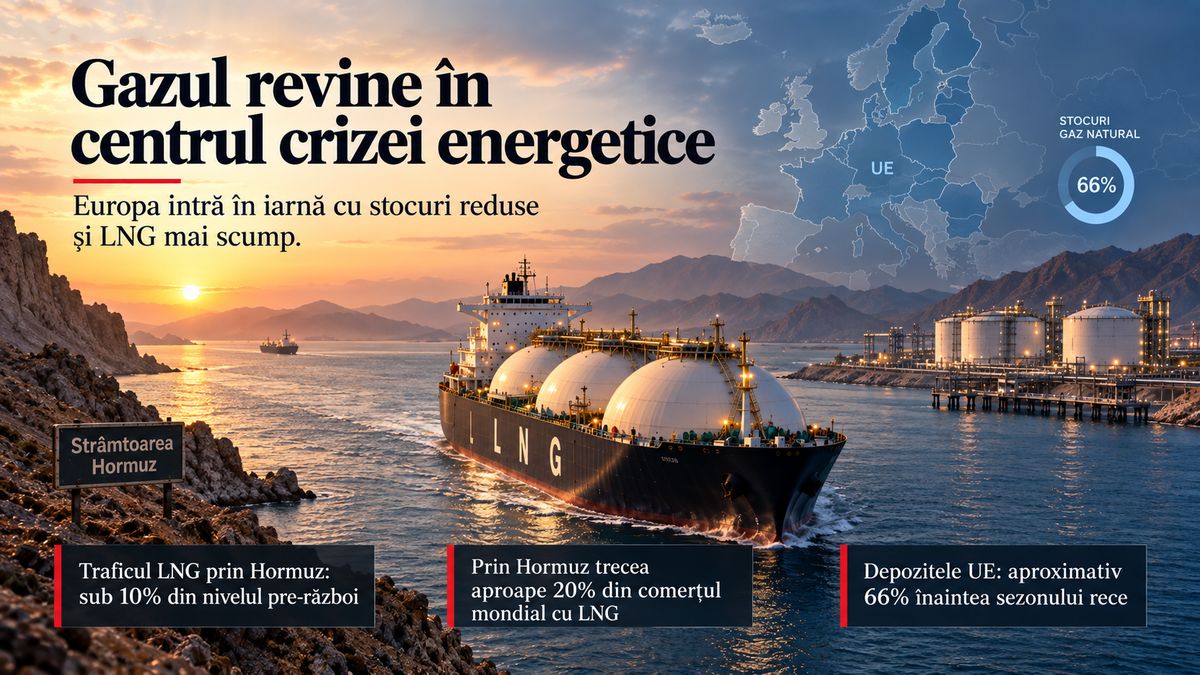
The energy crisis in the Middle East is opening a second front for Europe. After oil and diesel, pressure is shifting toward liquefied natural gas, at a time when European storage facilities are unusually depleted for mid-September and the cold season is fast approaching. The Financial Times reported this morning that LNG carrier traffic through the Strait of Hormuz has dropped to less than 10% of its pre-war level. International LNG is trading around $25/MMBtu , with some options exceeding $30/MMBtu. Based on energy content, $25/MMBtu is roughly equivalent to oil at $150/barrel—a comparison that highlights how expensive gas has become, rather than a direct equivalence between the two markets. For Europe, the vulnerability does not stem from a direct loss of a fifth of its own LNG. The exposure is more subtle and widespread: Asia has lost far more gas from the Gulf and is now competing for the same flexible cargoes from the United States, Africa, and other regions that Europe needs to enter winter with sufficiently filled storage. Hormuz lacks pipeline bypasses for LNG comparable to those for oil In 2025, just over 112 billion cubic meters of LNG passed through Hormuz, equivalent to nearly 20% of global liquefied natural gas trade. Approximately 93% of Qatar's LNG exports and 96% of those from the United Arab Emirates used this route. For oil, partial alternatives exist. Saudi Arabia can send some of its crude to the Red Sea via the East-West Pipeline, even though this route is also currently disrupted. For LNG, there is no bypass of a comparable scale. The Dolphin pipeline can transport gas from Qatar to the UAE and Oman, but its spare capacity is limited, and Oman's LNG infrastructure was already operating near capacity. Gas that would have left Qatar as LNG cannot simply be rerouted via pipeline to another terminal and shipped in the same volumes. This difference makes Hormuz an even more difficult bottleneck to bypass for LNG than for a portion of the Gulf's oil exports. Europe loses primarily through competition with Asia Before the war, nearly 90% of the LNG transiting Hormuz was destined for Asia. For Europe, Gulf volumes represented about 7% of its LNG imports , whereas for Asia, the share reached approximately 27% . This disparity drives the primary transmission mechanism affecting Europe. Asia must replace much larger volumes. To do so, it draws from the same flexible global supply available to Europe. US cargoes that, in a relaxed market, would head to terminals in France, Spain, Italy, or Northwest Europe can be redirected to Asian buyers if they pay a premium. Between March and June, the Asian benchmark JKM averaged a premium of about $2.1/MMBtu over TTF , the European benchmark. This spread provided a commercial incentive to send cargoes eastward precisely during the months when Europe was trying to replenish its storage after the winter. Europe is not, therefore, losing a fifth of its LNG. It is losing the advantage of buying LNG in an abundant and relatively relaxed market. Qatar is no longer treating the issue as a short-term shock The shipping blockade is only part of the problem. Attacks on infrastructure at Ras Laffan have also impacted Qatar's physical LNG production capacity. Two of its 14 liquefaction trains were damaged, knocking out approximately 12.8 million tonnes per annum (mtpa) of LNG capacity . QatarEnergy's management estimated that repairing the affected facilities could take between three and five years. This shift in perspective is visible in the company's strategy. QatarEnergy is seeking agreements to purchase around 2–3 million tonnes of LNG per year from the United States through 2031 , having already entered the spot market to buy cargoes to cover some of its contractual obligations. One of the world's largest LNG exporters has thus ended up buying American liquefied gas to offset its own capacity losses. In Europe, the impact has already been felt. By the end of August, QatarEnergy had canceled 29 cargoes destined for the Italian company Edison , equivalent to approximately 3.8 billion cubic meters of gas , with deliveries suspended until early November. Edison managed to secure 21 alternative cargoes, totaling about 2 billion cubic meters. The gas Italy needed did not simply vanish from the system, but it had to be purchased elsewhere in a market where the same issue is simultaneously affecting multiple importers. US LNG has so far prevented a much larger shock The global market has held up better than the collapse of Gulf flows would suggest because supply from other regions has grown strongly. Between March and June, LNG loadings from Qatar and the UAE fell by approximately 35 billion cubic meters compared to the same period of the previous year . Over the same interval, LNG production outside the Gulf increased by about 27 billion cubic meters, or 18% . Nearly three-quarters of the Gulf's gross loss was thus offset by producers in other regions. Global LNG supply…