Advanced Geothermal in Europe: 20–30 GWth & 60% Lower Costs — NRG-IA
Tehnologie & Inovație Author: Ioana BuzoaicaAdvanced geothermal could unlock 20–30 GWth for European district heating. A 60% drilling cost cut would make power generation competitive.
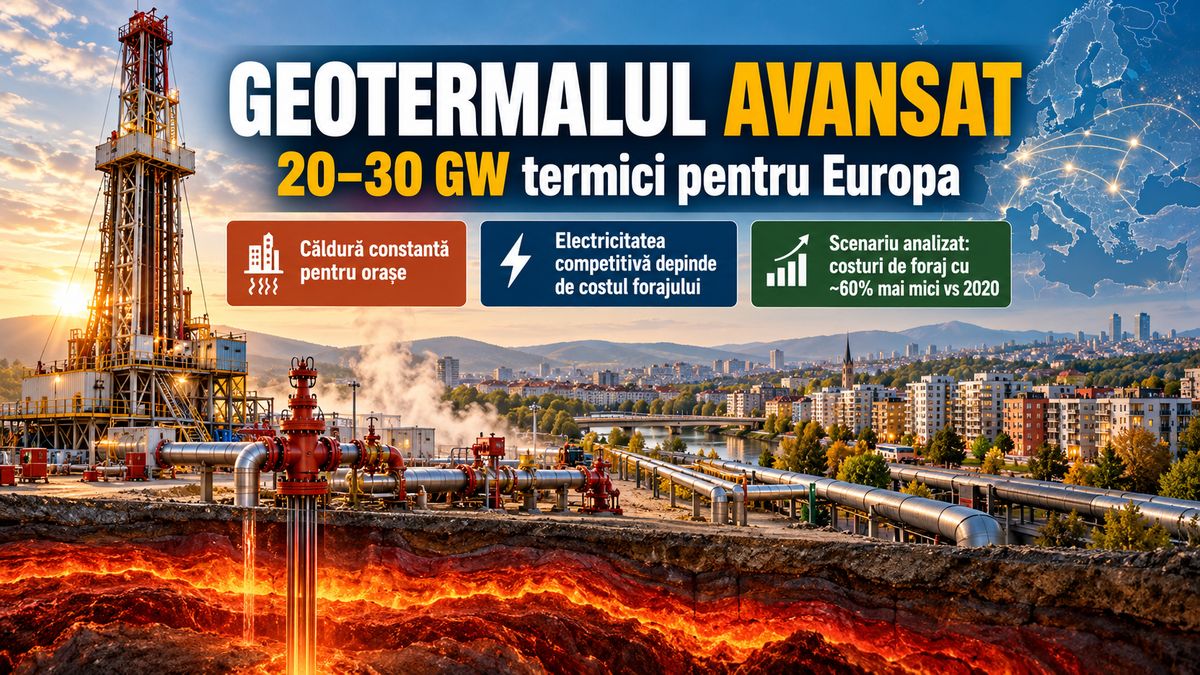
Europe could harness between 20 and 30 GW of thermal capacity through enhanced geothermal systems (EGS), utilizing technologies that extract heat from deep rock formations. A study published on October 16, 2026, in the scientific journal Nature Communications shows that this capacity could be economically competitive at current technology costs within a net-zero European energy system. The primary opportunity lies in urban district heating, where geothermal energy can displace a portion of the heat produced from fossil fuels. The research also identifies the economic prerequisite for a much broader deployment: reducing drilling costs by approximately 60% compared to 2020 levels. In the analyzed scenarios, such a cost decline enables enhanced geothermal systems to compete directly in the electricity generation market, substantially expanding the technology's commercial opportunities. The findings outline two distinct development phases: heat deployment at current cost levels, followed by an expansion into power generation as subterranean resource extraction becomes more affordable. The study, conducted by researchers affiliated with the University of Edinburgh, the Technical University of Berlin, and the University of Glasgow, was accepted for publication in September 2026 following peer review. The paper expands upon research previously available as a preprint and models the integration of advanced geothermal systems within the broader European energy economy, encompassing electricity generation, heating, and other energy uses. Hot-Rock Energy Can Be Exploited Beyond Traditional Geothermal Regions Geothermal energy utilizes heat stored beneath the Earth's surface, a continuously available resource independent of day-night cycles or weather conditions. Unlike solar and wind energy, whose output varies with weather, well-designed geothermal facilities can deliver continuous heat and power within operating constraints and reservoir parameters. Conventional geothermal systems rely heavily on naturally occurring subsurface reservoirs where hot water or steam can be extracted relatively easily. These conditions are primarily found in specific geologically favorable regions, restricting the widespread deployment of traditional geothermal power plants. Enhanced Geothermal Systems (EGS) technology aims to expand resource extraction to hot rock formations that lack sufficient natural fluid circulation. Through deep drilling and methods to enhance rock permeability, engineers can create or expand pathways for fluids to circulate, absorb subterranean heat, and carry it to the surface. The extracted energy can directly feed heating networks, provide industrial process heat, or drive turbines in a power plant to generate electricity. The working fluid is typically reinjected underground, creating a repeatable closed-loop circuit. However, project design requires careful assessment of the thermal resource, flow rates, rock behavior, and potential geological impacts. Expanding into formations previously uneconomic for conventional methods represents one of the most promising avenues for advanced geothermal energy. Accessing high temperatures at depth can significantly broaden the geographic footprint where the technology is viable. Nevertheless, project costs and local geological characteristics continue to dictate where it can be applied efficiently. Urban Heating Could Anchor the First 20–30 GWth of Advanced Geothermal Capacity The core finding of the research is an estimated economic potential of 20–30 GW of thermal capacity for EGS installations dedicated to heat production or combined heat and power (CHP), at current technology costs within a European net-zero scenario. This figure represents the peak thermal power capacity facilities could deliver, rather than annual energy output or electrical generation capacity. The identified potential is driven primarily by demand for district heating. Urban centers with established district heating networks can utilize heat provided by geothermal installations to supply residential units, public buildings, and commercial consumers. In such configurations, thermal energy is utilized directly, bypassing the losses associated with converting heat into electricity when power generation is unnecessary. The economic advantage is significant. Generating electricity requires underground heat to meet specific parameters and undergo thermodynamic conversion. Conversion efficiency depends on resource temperature and power cycle technology. By contrast, district heating networks can directly utilize available heat, provided temperatures and infrastructure align with consumer demand. This dynamic explains why the authors identify district heating as the primary initial market for advanced geothermal systems. In municipalities with established heat distribution infrastructure, a suitable geothermal source can reduce natural gas consumption and shield consumers from fuel price volatility.…
Ioana Buzoaica — Independent Editorial Board
The NRG-IA newsroom continuously monitors Romanian energy markets, ANRE regulatory decisions, and national grid telemetry (SEN/SNT). We deliver independent intelligence anchored exclusively in official primary data.
Editorial Charter, Ethics & Verification Methodology →