Germany Creates 24 TWh Strategic Gas Reserve for Winter — NRG-IA
Gaze Naturale Author: Ioana BuzoaicaGermany approves a 2.3 bcm strategic gas reserve and requires reserve power plants to hold coal and fuel oil stocks amid historic low EU gas inventories.
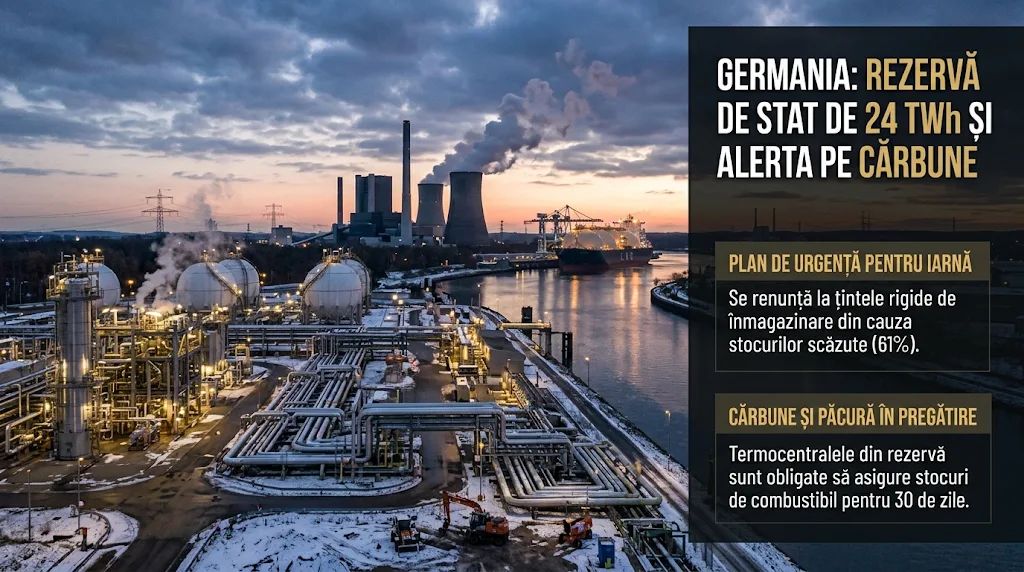
Germany's federal cabinet approved draft legislation on November 11–12, 2026, to establish a 24 TWh strategic state reserve—equivalent to 2.3 billion cubic meters (bcm) of natural gas—designed to cover 30 days of a total import stoppage. In parallel, the government led by Chancellor Friedrich Merz is drafting regulations valid through March 31, 2028, requiring coal- and heavy fuel oil-fired power plants in the grid reserve to maintain physical fuel stocks sufficient for 30 and 10 days of continuous operation at full capacity, respectively, in the event of a gas shortage. Berlin's dual intervention marks the most profound overhaul of German energy security architecture since the 2022 crisis and comes as the continent enters a highly vulnerable winter. Europe's largest economy entered the heating season with underground storage facilities filled to just about 61%, while the European Union average fell below the 73% mark—the lowest level recorded for this time of year since 2013. Under pressure from these figures, Germany is abandoning its post-2022 framework of rigid administrative storage filling mandates for commercial operators, decoupling the open market from national security stocks. The bill submitted to Parliament abolishes the fixed 70% and 30% storage targets as of March 2027 and establishes an annual levy estimated between €247 million and €308 million starting in October 2027 to finance the new strategic state reserve. The Failure of Rigid Storage Mandates and Europe's €27 Billion Bill Berlin's doctrinal shift stems from major market distortions across Europe during 2026. In a functioning commercial environment, utilities buy gas at lower prices during summer to inject into storage and sell it at higher winter prices. This year, conflict in the Middle East and prolonged force majeure declared by state giant QatarEnergy severely constrained global liquefied natural gas (LNG) supplies, upending this market logic and pushing the benchmark European TTF price past €100 per MWh in late October. Against this backdrop of global supply tightness, statutory mandates compelling member states to meet rigid percentage targets on fixed dates left European buyers captive and predictable to international suppliers and speculative funds. The European Union Agency for the Cooperation of Energy Regulators (ACER) estimated the cost of the 2026 European storage injection cycle at approximately €27 billion—a staggering sum that still failed to prevent Germany, home to the EU's largest underground storage capacity, from starting the withdrawal season at just over three-fifths capacity. The transition in 2027 to a fixed 24 TWh strategic reserve mirrors the strategic petroleum reserve mechanism used for decades in oil markets. The 2.3 bcm volume—nearly a quarter of the total annual gas consumption of a country the size of Romania—will be entirely removed from daily commercial arbitrage and earmarked strictly for severe supply emergencies, allowing remaining underground capacity to respond freely to market price signals. Coal and Heavy Fuel Oil Serve as the Safety Net Until Spring 2028 Because the new strategic gas reserve will only be funded and operationalized during the 2027 injection cycle, the German government is leveraging thermal power plants in the grid reserve as an immediate shield for this winter and the next. The regulation being drafted through March 31, 2028, creates a direct fuel-switching mechanism during periods of prolonged freezing cold and low wind output, when heating demand surges alongside the need for baseload power generation. By requiring coal units in the grid reserve to hold 30 days of fuel for full-load operation and heavy fuel oil plants to store 10 days of reserves, German authorities ensure they can curtail gas-fired power generation without risking grid stability. Every megawatt-hour generated during emergencies from coal or liquid fuels preserves gas molecules in storage—currently at 61% capacity—for residential heating and non-curtailable industrial processes. This safety net carries immediate industrial and financial side effects. Energy-intensive German industrial users for whom natural gas is an irreplaceable feedstock, such as fertilizer manufacturer SKW Piesteritz, are already operating on slim margins due to high wholesale prices. On November 12, the German chemical industry openly criticized Chancellor Friedrich Merz's stance on carbon market costs. Over the medium term, the upcoming annual levy of €247–308 million to finance the strategic reserve starting October 2027 will be passed on to grid users. Port Ban on Russian LNG and Price Contagion to Southeast Europe The vulnerability of European storage levels this winter is compounded by the approaching January 2027 deadline, when the EU ban on transshipment and port services for Russian LNG takes effect. Maritime tracking data published on November 12 shows that during the first ten months of 2026, EU member states imported 177…
Ioana Buzoaica — Independent Editorial Board
The NRG-IA newsroom continuously monitors Romanian energy markets, ANRE regulatory decisions, and national grid telemetry (SEN/SNT). We deliver independent intelligence anchored exclusively in official primary data.
Editorial Charter, Ethics & Verification Methodology →