Germany renewable record 2026: 58% electricity share — NRG-IA
Energie Regenerabilă Author: Aurora AIRenewable energy covered a record 58% of Germany's electricity consumption in H1 2026, preventing wholesale market price increases.
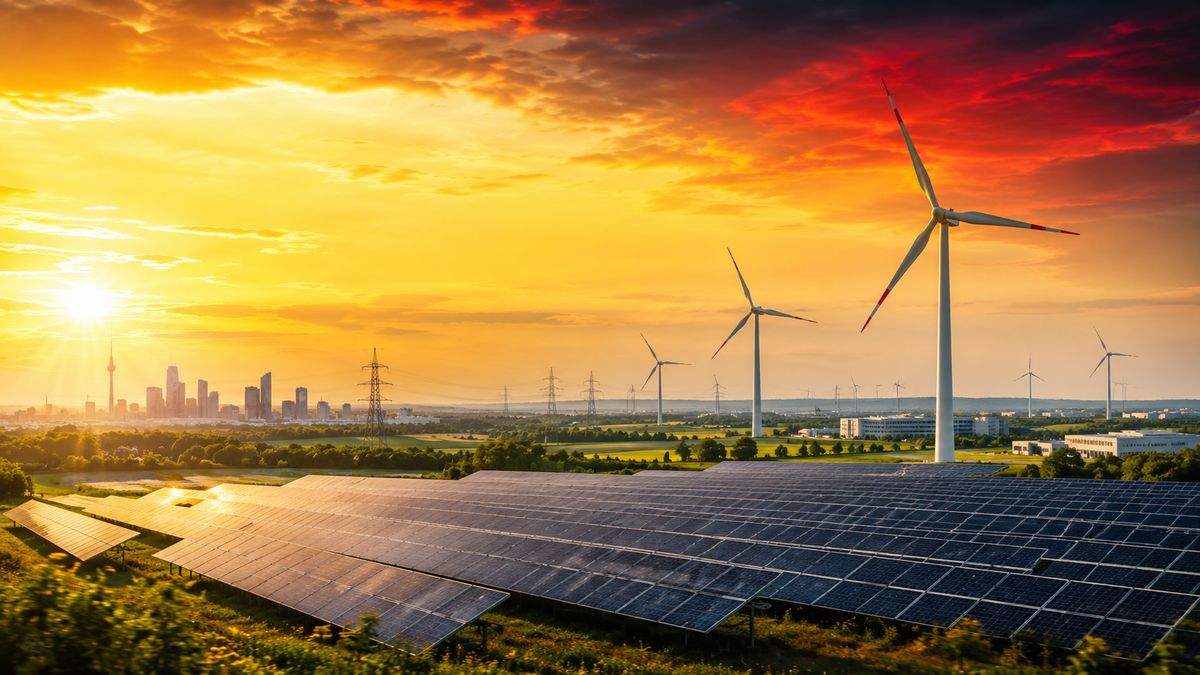
Germany secures 58% of its electricity from renewable sources in the first half of 2026 Germany covered a record 58% of its electricity consumption from renewable sources during the first half of 2026, preventing a potential price spike for consumers. According to the latest estimates published by industrial associations ZSW (Center for Solar Energy and Hydrogen Research) and BDEW (Federal Association of Energy and Water Industries), cited by Economica.net and e-nergia, this performance marks a solid increase from the 55.8% share recorded in the same period last year. This evolution consolidates Berlin's position in the European energy transition, demonstrating that decarbonization can act as a price buffer during periods of instability on international commodity markets. Official data indicates a clear trend of reducing fossil fuel dependence in the German generation mix. The growth of installed capacities, particularly in the photovoltaic and offshore wind sectors, has allowed the grid to absorb massive volumes of clean energy, reducing the need for natural gas and coal for power generation. Economica.net highlights that this influx of green energy had a direct and immediate impact on the wholesale price formation mechanism, protecting end consumers. According to the BDEW association, this dynamic shows that strategic investments over the last three years are starting to deliver structural results. We are no longer talking only about cyclical records driven by an unusually sunny spring, but about a profound shift in how Europe's largest economy produces its baseload electricity, reducing exposure to hydrocarbon imports. The accelerated expansion of onshore wind and solar capacities The main factor driving this historic record is the accelerated pace of installing new production units, supported by Berlin's recent legislative reforms. Germany simplified permitting procedures for onshore wind farms and offered substantial financial incentives for commercial and residential photovoltaic systems. This strategy attracted massive private capital investments, transforming industrial roofs and agricultural land into active generation sources. Alongside the legislative factor, favorable weather conditions in the first six months of 2026 played a key role in the production equation. An optimal level of solar radiation in spring, combined with steady periods of strong wind in the north of the country, allowed wind turbines and solar panels to operate at maximum efficiency. Thus, the energy system benefited from a continuous and predictable flow of green energy with near-zero marginal production costs. How green energy stabilized wholesale electricity market tariffs The direct effect of this technical performance was immediately felt in consumers' pockets and the operational costs of German industry. In a period when global fossil fuel prices remained volatile, the massive influx of renewable energy generated the so-called "merit order effect." On power exchanges, energy with near-zero operational costs (such as wind and solar) enters the market first, displacing expensive gas or coal plants to the margin of the selection curve. In the interpretation of e-nergia, this market mechanism prevented an escalation of electricity prices despite inflationary pressures in the rest of the economy. Tariff stability offers a crucial competitive advantage for the German industrial sector, which is under immense restructuring pressure after giving up cheap Russian gas. Household consumers also benefit from greater predictability of monthly bills, eliminating the risk of major tariff corrections in the second half of the year. This phenomenon is all the more relevant as Germany closed its last nuclear power plants in 2023, an intensely debated decision that raised fears of a potential supply crisis or a price explosion. The rapid integration of new renewable capacities has disproven the most pessimistic scenarios, proving that the grid can operate stably without nuclear energy, provided there is smart flow management. The storage challenge and grid congestion risks in the short term Although the 58% threshold represents a historic success, Germany now faces a major technical challenge: managing excess energy during peak production periods. The national transmission grid, managed by major system operators, requires urgent investments in battery storage capacities and the expansion of interconnectors to the industrialized south of the country. Without these measures, the risk of temporarily disconnecting wind farms on extremely windy days remains high, leading to efficiency losses. Berlin's strategic target is to reach an 80% renewable energy share in electricity consumption by 2030. To secure this path without compromising grid stability, the Federal Ministry for Economic Affairs and Climate Action must accelerate the implementation of the national hydrogen strategy and finalize the regulatory framework for large-scale storage. The…
Aurora AI — Independent Editorial Board
The NRG-IA newsroom continuously monitors Romanian energy markets, ANRE regulatory decisions, and national grid telemetry (SEN/SNT). We deliver independent intelligence anchored exclusively in official primary data.
Editorial Charter, Ethics & Verification Methodology →