Germany's 365m Wind Turbine: 63% More Energy at 300m — NRG-IA
Tehnologie & Inovație Author: Ioana BuzoaicaGermany is building a 365m wind turbine to test high-altitude wind. Modeling shows a 63.4% gross output increase at 300m compared to 150m.
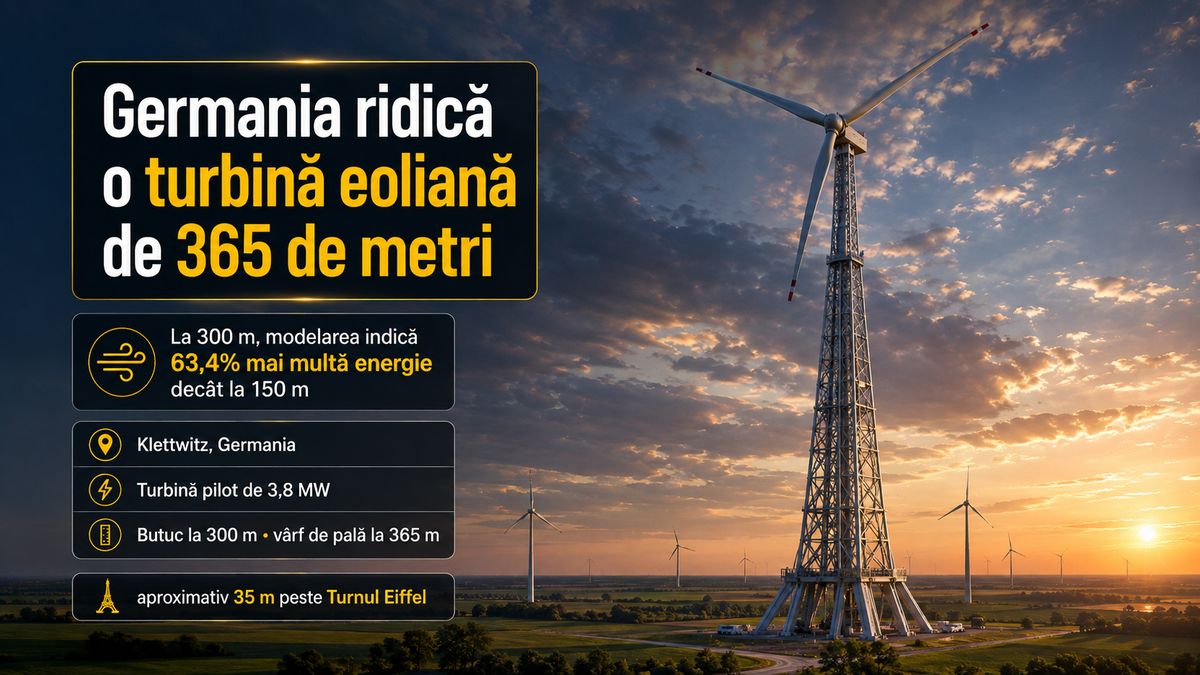
Germany is building a wind turbine in Brandenburg that will reach approximately 365 meters to the tip of the blade , about 35 meters taller than the current height of the Eiffel Tower. While the record is spectacular, the real experiment is taking place lower down, at 300 meters , where the rotor hub will be located. At this altitude, year-long measurements at the Klettwitz site indicated an average wind speed of 8.51 m/s , compared to 6.66 m/s at 150 meters . This is a difference of approximately 28%, but the impact on available energy is much greater, as wind power increases exponentially with speed. When the measured data was fed into a model using the same turbine at different heights, the calculated gross annual production rose from 22.4 GWh at 150 m to 36.6 GWh at 300 m —a difference of 63.4% . This is why GICON is building an unprecedented tower for onshore wind: not to place a giant rotor on the highest possible support, but to reach an atmospheric layer where the wind is stronger and more consistent. A 3.8 MW turbine is raised to where the wind becomes far more valuable The pilot installation in Klettwitz does not use one of the offshore turbines of over 15 or 20 MW that are currently pushing size records. The turbine is a 3.8 MW VENSYS 126 , with a rotor diameter of 126.2 meters and a swept area of approximately 12,509 m² . The primary innovation is the tower that raises it to 300 m. This choice makes the project particularly relevant. If a relatively conventional turbine can produce significantly more simply because the rotor is moved to a more favorable wind layer, the onshore wind industry gains a new optimization variable: height could become just as important as the continuous scaling up of rotors and generators . In German wind projects permitted in 2025, the average hub height exceeded 158 m. GICON is nearly doubling this value. A year of measurements reveals the real advantage of wind at 300 meters Prior to constructing the tower, the developers erected a 300 m meteorological mast at Klettwitz and measured the vertical wind profile between April 2023 and April 2024. The results form the technical foundation of the project. At 150 m, the measured average speed was 6.66 m/s . At 200 m, it rose to 7.38 m/s , and at 300 m, it reached 8.51 m/s . LiDAR systems used in parallel yielded very similar values. More importantly, the advantage is not just about higher average speeds. At higher altitudes, the periods during which the turbine can operate at useful power outputs also increase. During the campaign, the daily average wind speed fell below 4 m/s on 45 days at 150 m , compared to only 28 days at 300 m . For the power system, this difference means more than just a boost in annual generation. It also translates to fewer intervals of very low production . For the same turbine, calculated output increases by 63.4% The technical report applied the measured wind profiles to a 9.5 MW Vestas V164 turbine, used as an identical model at several heights. At 150 m, the estimated gross annual production was 22.4 GWh . At 200 m, it rose to 28.5 GWh , and at 300 m, it reached 36.6 GWh . The calculated gross capacity factor followed a similar trend, rising from approximately 26.8% at 150 m to 43.8% at 300 m . The operational profile also changes: the proportion of time the modeled turbine would operate at over 30% of its rated power increases from about 32.8% at 150 m to 51.3% at 300 m . GICON separately estimates that its high-altitude installations can produce more than double the energy of comparable conventional turbines, depending on the site. This estimate uses a different baseline for comparison. The controlled benchmark provided by the Klettwitz campaign remains the 63.4% increase between 150 and 300 m for the same modeled turbine . The tower is raised telescopically after turbine installation Bringing a rotor to 300 m immediately creates a challenge: the cranes typically used for onshore turbines cannot easily lift assemblies weighing hundreds of tons to such heights. GICON responded with a telescopic architecture. The tower consists of an outer and an inner structure. The turbine and rotor can be mounted while the inner section is low enough to be reached by a high-capacity crane. After assembly, the inner structure carrying the turbine is raised until the hub reaches 300 meters . By July, the steel structure had reached approximately 167 m , and the project was preparing for the installation and final lifting phases. The tower uses over 2,000 tons of steel and approximately 22,000 structural components . At its base, the structure is about 48 m wide. The telescopic mechanism also offers an interesting perspective for maintenance: the upper section can be lowered for servicing, reducing reliance on cranes capable of operating continuously at extreme heights. The 3.8 MW pilot is designed to produce approximately 18 GWh annually GICON estimates an output of approximately 18 GWh per year for the…
Ioana Buzoaica — Independent Editorial Board
The NRG-IA newsroom continuously monitors Romanian energy markets, ANRE regulatory decisions, and national grid telemetry (SEN/SNT). We deliver independent intelligence anchored exclusively in official primary data.
Editorial Charter, Ethics & Verification Methodology →