Germany simplifies V2G: EVs become grid batteries — NRG-IA
Tehnologie & Inovație Author: Ioana BuzoaicaGermany has adopted rules simplifying the use of EV batteries as grid resources, solving a key V2G accounting hurdle for mixed power sources.
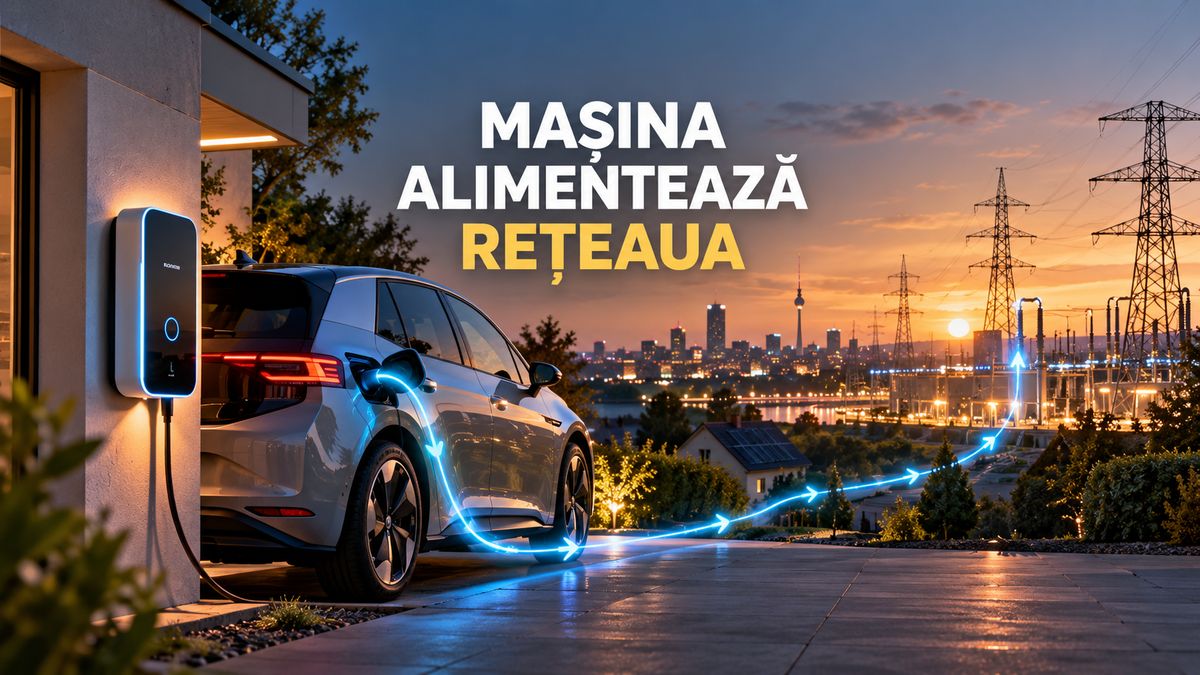
An electric vehicle spends most of its time parked, with a battery capable of storing dozens of kilowatt-hours. In the traditional energy system, this battery is used almost exclusively for driving. Vehicle-to-Grid (V2G) changes this logic: when the car is plugged in at home, energy can flow in both directions—from the grid to the battery and, when conditions warrant, from the battery back to the grid. On October 1, Germany took a major step toward enabling this model to operate at scale. The Federal Network Agency, Bundesnetzagentur, adopted the MiSpeL — Marktintegration von Speichern und Ladepunkten decision, establishing new rules for the market integration of storage systems and charging points. The change may seem technical, but it solves one of the key issues holding V2G back: how do you economically separate solar energy from grid-purchased power when both end up in the same battery? Until now, German regulations imposed a rigid separation. For stored renewable energy to retain its treatment under the EEG (Renewable Energy Sources Act) scheme, the storage system essentially had to remain dedicated solely to renewables. Bidirectional EV charging points, which can receive both grid power and locally generated energy, did not fit easily into this framework. MiSpeL now allows separation through metering and calculation , rather than forcing the user to physically keep the two energy sources in separate systems. This is the shift that can transform V2G from a technology proven in pilot projects into a product that is far easier to integrate into the energy market. The vehicle can charge when energy is cheap and feed it back later The principle is simple. An electric vehicle arrives home at 6:00 PM and is plugged into a bidirectional charger. The owner specifies in the app that they need, for example, at least a 70% state of charge by 7:00 AM. Between these two points, the system can decide when it is most advantageous to charge the vehicle and whether a portion of the available energy can be sent back to the grid. If there is high solar or wind generation and electricity prices are low, the battery can be charged. If demand rises later, renewable generation drops, and electricity becomes more expensive, a portion of the stored energy can be fed back into the grid. Before departure, the system must respect the state of charge requested by the owner. The vehicle remains primarily a means of transport, and any energy available beyond the user's set requirement becomes market flexibility. Volkswagen describes exactly this logic for the system developed with Elli: the driver sets the departure time and the minimum battery level, and the rest of the process is automated. Vehicle-to-Grid should not be confused with other forms of bidirectional charging. V2L (Vehicle-to-Load) allows the car to power electrical appliances directly. V2H (Vehicle-to-Home) uses the battery to power the household. V2G (Vehicle-to-Grid) means energy is delivered to the public grid and can participate in the electricity market. MiSpeL targets precisely this more complex economic integration. The issue was mixing solar energy with grid power Suppose a home has solar panels and an electric vehicle. During the day, the battery receives 20 kWh generated by the panels. In the evening or at night, it receives another 10 kWh from the grid. Inside the battery, energy cannot be physically separated into "solar electricity" and "grid electricity." The battery simply holds stored energy. But for billing and energy taxation, the distinction matters. It must be determined what portion of the energy fed back into the grid is accounted for as renewable energy, and what portion represents previously purchased grid power that was temporarily stored and then returned. MiSpeL introduces a mechanism to calculate these volumes separately. Stored renewable energy can continue, under the conditions set by the rules, to benefit from EEG treatment, while for grid-purchased energy that is later returned, certain volumes can be offset when calculating taxes and tariffs, avoiding double taxation of the same energy as final consumption. For the user, the core benefit is much simpler: the battery can be used flexibly without the mixing of energy sources automatically compromising the system's economic model. Germany introduces two calculation methods MiSpeL establishes two options. The first, called the Abgrenzungsoption (delimitation option), tracks energy flows more precisely. It typically uses 15-minute interval metering and two meters, though a single meter is sufficient for certain configurations. The system calculates which energy comes from renewable generation, which was drawn from the grid, and how much is subsequently fed back. The second option, the Pauschaloption (flat-rate option), simplifies the process for certain households with solar installations of up to 30 kWp . In this setup, a single meter is generally sufficient, and the separation of flows…
Ioana Buzoaica — Independent Editorial Board
The NRG-IA newsroom continuously monitors Romanian energy markets, ANRE regulatory decisions, and national grid telemetry (SEN/SNT). We deliver independent intelligence anchored exclusively in official primary data.
Editorial Charter, Ethics & Verification Methodology →