Romania Winter Import Risk: 3,500 MW Needed as Hydro Hits 40% — NRG-IA
Piața de Energie Author: Ioana BuzoaicaRomania enters winter 2026–2027 with low hydro reserves. Under severe cold, power imports could hit 3,500 MW, testing grid interconnection limits.
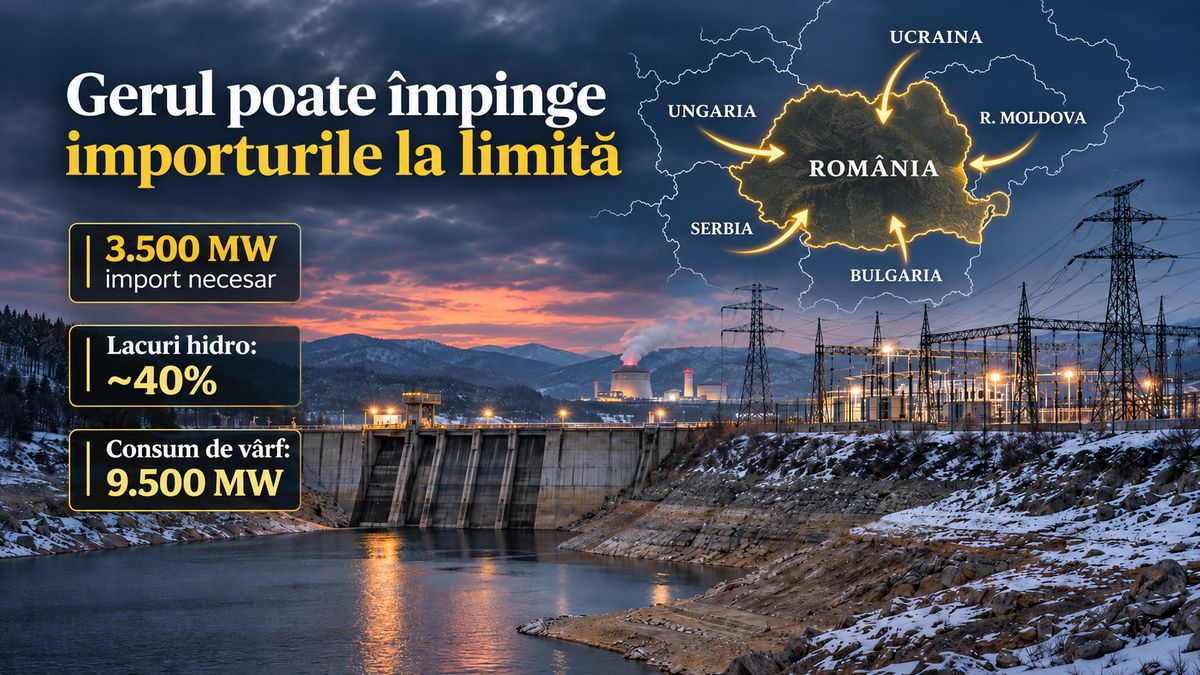
Romania could need to import up to 3,500 MW of electricity under a severe cold snap scenario , equivalent to nearly 37% of instantaneous national demand. The figure stems from Transelectrica’s winter 2026–2027 preparedness calculations and approaches the lower bound of the estimated maximum import capacity for November, around 3,600 MW. A margin of just 100 MW underscores how tightly balanced the power system becomes when demand spikes while domestic generation simultaneously falls. This vulnerability is compounded by prolonged drought. As of November 8, key reservoirs used for hydropower generation were at roughly 40% capacity, representing an energy reserve of about 1,100 GWh. Concurrently, constrained availability at certain coal- and gas-fired power plants diminishes Romania's ability to swiftly offset dips in wind generation or spikes in demand. The data, released by Transelectrica and reported by Economedia on November 23, outline stress conditions for the grid rather than a permanent power deficit. In the interim, both reactors at the Cernavodă Nuclear Power Plant have returned online, and Danube River flow rates have improved. However, the core challenge remains unchanged: Romania must be able to cover consumption even during hours when renewable output is low, hydro reserves are constrained, and imports become indispensable. Peak Demand of 9,500 MW Would Require 3,500 MW in Imports The winter outlook includes two distinct operational scenarios. Under the favorable scenario, national demand reaches 9,100 MW, while domestic generation and energy storage discharge total approximately 7,800 MW. The remaining 1,300 MW deficit is covered by imports. In this setup, the grid operates with relatively moderate reliance on cross-border electricity purchases, with imports accounting for roughly 14.3% of instantaneous consumption. Under the severe scenario, baseline assumptions deteriorate across the board. Demand rises to 9,500 MW, hydropower output drops to 1,500 MW, gas-fired plants supply 1,920 MW, coal facilities generate 680 MW, and nuclear power contributes 1,400 MW. Zero generation from wind and solar is assumed, while battery systems discharge 500 MW. Total domestic resources, including storage discharge, thus amount to just 6,000 MW. The 3,500 MW shortfall must be covered via imports , which would account for 36.8% of instantaneous demand. Compared to the favorable scenario, import requirements increase by 2,200 MW. Of this increase, 400 MW stems from higher load, while 1,800 MW results from reduced domestic output and lower battery contribution. According to figures attributed to Transelectrica, the estimated maximum import capacity for November ranges between 3,600 MW and 4,100 MW, depending on grid topology and availability. At the lower limit, the 3,500 MW required under the severe scenario would utilize 97.2% of estimated available capacity. The remaining arithmetic buffer would stand at just 100 MW, prior to accounting for operational reserves and potential grid constraints. This distinction is crucial for power system security. Technical cross-border transfer capacity does not guarantee commercial power availability at all times, and a narrow arithmetic margin between required imports and available capacity cannot be equated with a true operational safety reserve for the transmission system. Hydro Reservoirs at 40% Deplete Romania's Main Flexible Reserve Romania has a substantial hydropower fleet with an installed capacity exceeding 6,000 MW. However, peak output potential and available energy storage are distinct metrics. A hydro facility can deliver high capacity output for several hours, but sustained operation rapidly depletes stored water, which relies on precipitation and river inflow for replenishment. Severe drought throughout the summer and autumn of 2026 heavily eroded these reserves. State generator Hidroelectrica relied extensively on reservoir hydro to cover demand peaks and compensate for nuclear outages earlier in the year. Consequently, energy reserves are diminished at the onset of the cold season—precisely when the system requires maximum operational flexibility to manage high winter loads. Data published for early November showed approximately 1,100 GWh in hydro reserves as of November 8, compared to roughly 1,800 GWh entering the previous winter. This ~700 GWh deficit is critical: reservoir energy is vital not only for baseline power generation, but also for grid balancing and frequency regulation during high-stress hours. ENTSO-E’s Winter Outlook 2026–2027 confirms that storage levels in Romania’s main hydro reservoirs have dropped below 50%, highlighting the need for prudent management of available hydro flexibility. ENTSO-E projects national winter electricity consumption at approximately 24.9 TWh under average conditions (+1.3% year-on-year), rising to 25.7 TWh with a peak load of 9,500 MW under a cold snap scenario. There is, however, a positive development. According…
Ioana Buzoaica — Independent Editorial Board
The NRG-IA newsroom continuously monitors Romanian energy markets, ANRE regulatory decisions, and national grid telemetry (SEN/SNT). We deliver independent intelligence anchored exclusively in official primary data.
Editorial Charter, Ethics & Verification Methodology →