Goldman Sachs: Brent $140, EU Gas €150 Amid Hormuz Crisis — NRG-IA
Geopolitică & Energie Author: Ioana BuzoaicaGoldman Sachs warns persistent Persian Gulf blockades and a cold winter could push Brent to $140/bbl and European gas to €150/MWh, reviving EU inflation.
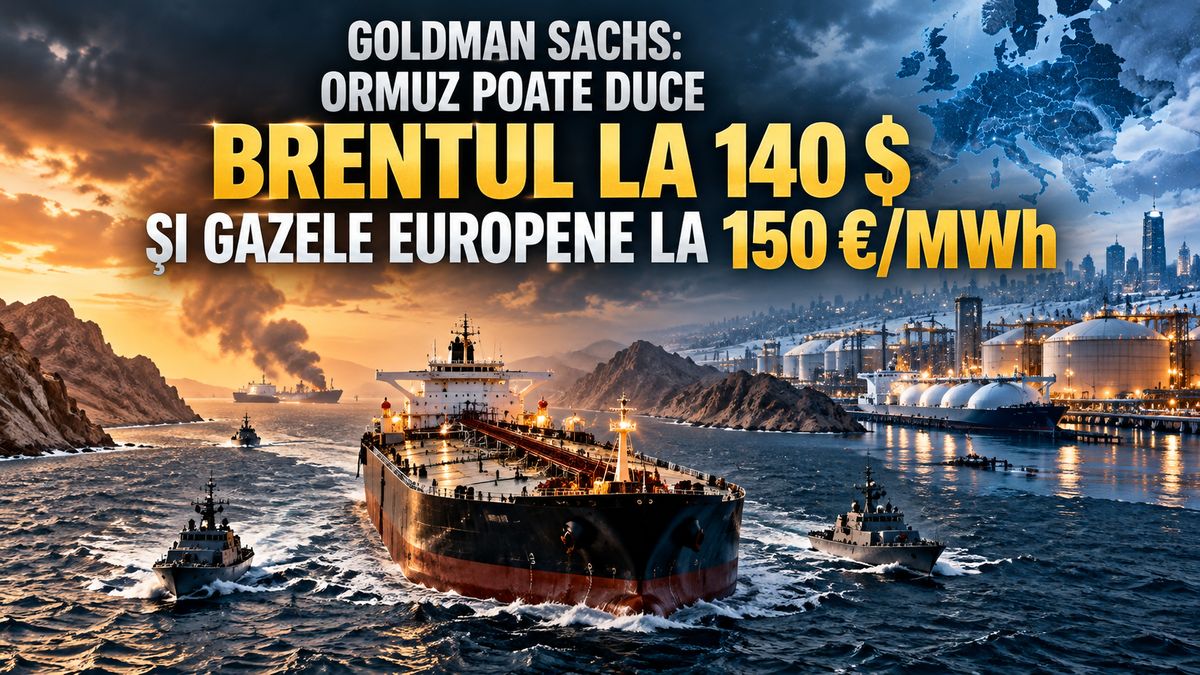
American investment bank Goldman Sachs warns, in an analytical report published on October 20, 2026, that Brent crude prices could rise from the current level of approximately $110 per barrel to $140 per barrel by early 2027 if Persian Gulf supply disruptions are not halted. In the same severe risk scenario—fueled by the blockage of liquefied natural gas exports through the Strait of Hormuz and a cold winter in the Northern Hemisphere—European wholesale natural gas prices could surge from the baseline forecast of €70/MWh to €150/MWh before the end of 2026. The financial institution's assessment establishes quantitative benchmarks for energy risk during the 2026–2027 winter, demonstrating that the European economy is dangerously close to a new supply-cost shock. International benchmarks already reflect physical supply losses, not merely a geopolitical risk premium: crude deliveries from the Persian Gulf basin have dropped by 5 million barrels per day below levels recorded in February 2026, when the military conflict in Iran broke out. This massive contraction in globally available volumes has already pushed wholesale diesel prices in Europe and the United States to a peak of $220 per barrel equivalent—double the level seen at the start of the year. Compounding this shortfall with a crude barrel at $140 and natural gas at €150/MWh would pass pressure directly onto transport costs, the competitiveness of European heavy industry, and national budgets that are still funding bill cap and compensation schemes. Twenty-Three Ships Attacked in Two Weeks and a 5 Million bpd Loss Data compiled by Bloomberg confirms that maritime navigation security in the Strait of Hormuz deteriorated rapidly this autumn, with 23 commercial vessels attacked in the first two weeks of October alone. This frequency of strikes on oil tankers and cargo ships has transformed the world’s primary energy artery into an extreme-risk zone, forcing shipowners and maritime insurers to restrict transit or charge prohibitive fees. The immediate impact on the physical balance of the oil market is the absence of 5 million barrels per day from the region's exports compared to the February 2026 baseline. In a global market where daily demand exceeds 100 million barrels, the loss of roughly 5% of global supply from a single geographic choke point cannot be rapidly offset by spare capacity outside the Gulf, as a significant portion of that spare capacity sits inside the perimeter blocked by conflict. In addition to the Middle Eastern deficit, the European market is simultaneously feeling the squeeze of reduced shipments from the Russian Federation. Vessel-tracking data for the period ending October 18 indicates a fall in Russian seaborne crude exports to an average of 3.59 million barrels per day—a one-month low—following the temporary shutdown of the Baltic terminal at Primorsk and damage to a primary processing unit at the Ryazan refinery. The overlap of these two hotspots narrows the operational margin for European refiners right before the cold season. Two Divergent Trajectories for Winter: From De-escalation to $90 to a $140/bbl Shock The macroeconomic model developed by Goldman Sachs analysts divides the outlook for the coming months into two scenarios strictly dependent on military and diplomatic developments between the United States and Iran. In the baseline scenario, the bank assumes that diplomatic negotiations and international pressure will allow a gradual de-escalation of transit through the Strait of Hormuz, bringing Brent crude down from $110 toward $90 per barrel, while European natural gas benchmark prices stabilize around €70/MWh. Even this moderate outcome implies elevated energy costs for the European economy. A natural gas price of €70/MWh is more than twice the pre-2021–2022 crisis historical average, maintaining a structural competitive disadvantage for European Union chemical, metallurgical, and fertilizer plants relative to peers in North America or Asia. The severe risk scenario is triggered if talks between Washington and Tehran fail and the de facto Persian Gulf blockade persists throughout the winter. Under such conditions, combined with below-average temperatures accelerating drawdowns from underground storage facilities, the market would be forced to adjust consumption through demand destruction. This is the mechanism that drives Brent crude to $140 per barrel by early 2027 and European natural gas to €150/MWh by the end of December 2026. Acute Diesel Crisis and Vulnerability of European LNG Imports The strain between crude benchmarks and the real economy is most evident in the refined products market, particularly for diesel—the key fuel for road freight, agriculture, and industry. The International Energy Agency has already warned that the global diesel deficit could extend into the second half of 2027, while wholesale prices reaching $220 per barrel in October show that refining margins have surged due to a shortage of…
Ioana Buzoaica — Independent Editorial Board
The NRG-IA newsroom continuously monitors Romanian energy markets, ANRE regulatory decisions, and national grid telemetry (SEN/SNT). We deliver independent intelligence anchored exclusively in official primary data.
Editorial Charter, Ethics & Verification Methodology →