Goldman Sachs Cuts 2027 Brent Forecast to $80/bbl — NRG-IA
Geopolitică & Energie Author: Ioana BuzoaicaGoldman Sachs cuts its 2027 Brent forecast to $80/bbl, signaling that rising supply and weaker demand could push prices down after the Gulf shock.
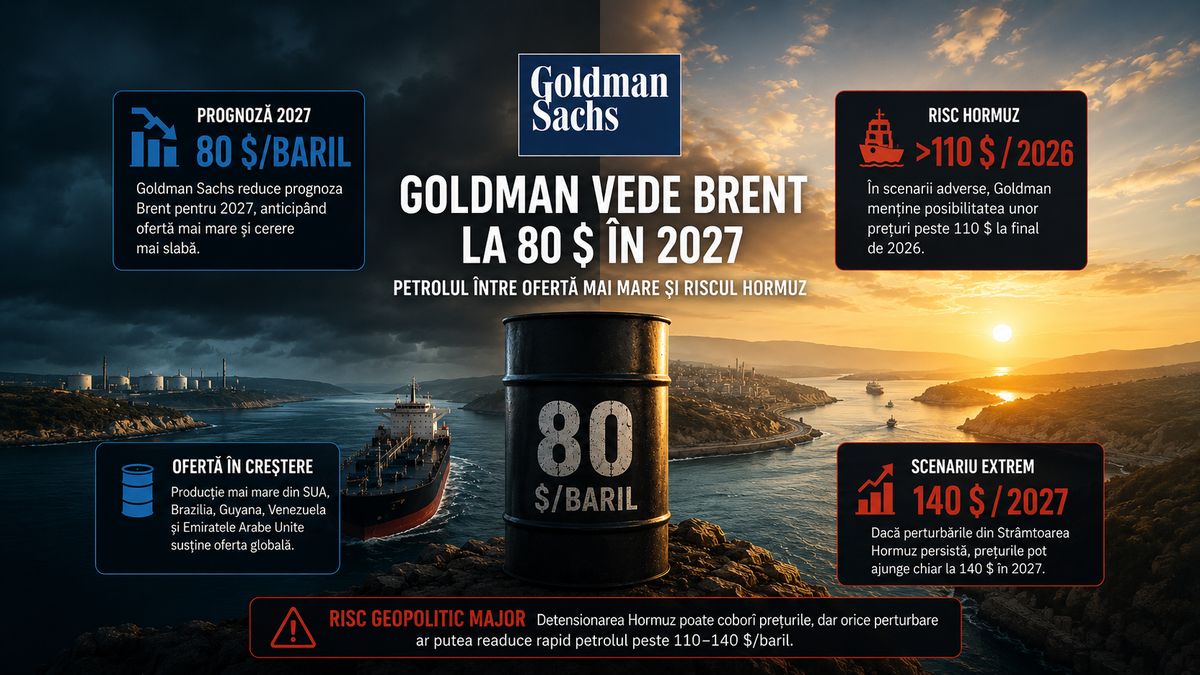
Goldman Sachs has cut its forecast for the average price of Brent crude in 2027 to $80/barrel, citing rising global supply and persistent demand weakness. The move comes at a time when the oil market is caught between two opposing forces: the gradual easing of Gulf flows, which could lower prices, and the risk that the Strait of Hormuz remains a critical bottleneck for global supply. Goldman's forecast shifts the angle of the debate. After weeks in which oil was dominated by the geopolitical premium, the bank brings market fundamentals back to the forefront: higher production outside the Middle East, demand hit by high prices, and structural transformations in China's consumption, including the rise of electric vehicles. Supply rises outside the risk zone Goldman points to stronger supply from the United States, Brazil, Guyana, Venezuela, and the United Arab Emirates. While these sources do not eliminate the vulnerability created by Hormuz, they can cushion some of the shock from reduced Gulf exports. Herein lies the difference between a market completely blocked by geopolitics and a tight market that is still supported by alternative production. If Atlantic Basin producers and other non-OPEC suppliers can deliver additional volumes, the global deficit becomes smaller than the simple loss of Middle Eastern production would suggest. Goldman estimates that the global deficit in the second quarter was limited to around 5–6 million barrels per day (bpd), even though the initial disruption in the Gulf was much more severe. The bank's explanation is straightforward: weaker demand and the oversupply existing before the shock absorbed some of the pressure. Weaker demand weighs on 2027 forecasts On the demand side, the signal is becoming clearer. High prices, reduced availability of certain volumes, and government measures curbed global consumption in 2026. The EIA now estimates a 1.1 million bpd drop in global oil demand in 2026, compared to consumption of 104 million bpd in 2025. For 2027, the US agency anticipates a demand recovery of 2.5 million bpd, reaching 105.3 million bpd, as flows normalize. Goldman also includes a structural component: part of China's demand weakness may persist amid the acceleration of alternatives to the internal combustion engine, particularly electric vehicles. The IEA shows that global EV sales exceeded 20 million units in 2025, and about 5% of the global car fleet was electrified, with an estimated displacement effect of 1.2 million bpd of oil. China weighs disproportionately in this calculation. The country saw over 13 million electric cars sold in 2025, representing nearly 55% of new passenger car sales. For the oil market, this shift does not mean an instantaneous collapse in demand, but rather a gradual reduction in the structural growth that has supported consumption over the past two decades. Hormuz remains the difference between $80, $110, and $140 Goldman's base case assumes a normalization of Gulf exports by the end of August, with flows through Hormuz returning to approximately 70% of pre-conflict levels under current rerouting conditions. In this scenario, Brent could slide toward $80/barrel in 2027, close to the EIA's forecast of $79/barrel for next year. The major risk remains the duration of the disruptions. Goldman maintains an adverse scenario where Brent could reach over $110/barrel by late 2026 if export disruptions persist longer. In a more severe scenario, with extended disruptions through Hormuz throughout 2027, the price could climb to $140/barrel. This wide range of forecasts highlights the current nature of the oil market. Supply-demand fundamentals push the base case downward, but geopolitical risk can rapidly alter the marginal price. For traders, airlines, refiners, shippers, and governments, the gap between $80 and $140 is not a theoretical difference. It is the difference between energy disinflation and a new cost shock. EIA sees the same direction, but with tight inventories in 2026 EIA data supports the idea of a decline in 2027, but also shows why the transition to that point remains difficult. The US administration estimates that global oil inventories will fall by an average of 6.3 million bpd in the second quarter of 2026 and by 7.6 million bpd in the third quarter. In the EIA's forecast, OECD inventories reach their lowest levels since 2003. This factor explains why prices do not decline linearly, even if the 2027 outlook appears more relaxed. The market could face a highly tight 2026 with low inventories, high prices, and high volatility, followed by a decline in 2027 if production recovers and flows through Hormuz normalize. The EIA estimates Brent at $105/barrel in June and July, assuming Hormuz remains largely closed to traffic in the short term. Subsequently, as flows gradually return and producers restart shut-in production, the price is expected to slide toward $79/barrel in 2027. OPEC remains more optimistic on demand OPEC has once again…