Google & Quaise Sign $500M+ Deal for 50 MW Geothermal — NRG-IA
Tehnologie & Inovație Author: Ioana BuzoaicaGoogle signed a $500M+ deal for 50 MW of Oregon geothermal power, unlocking new continuous electricity for data centers via advanced drilling.
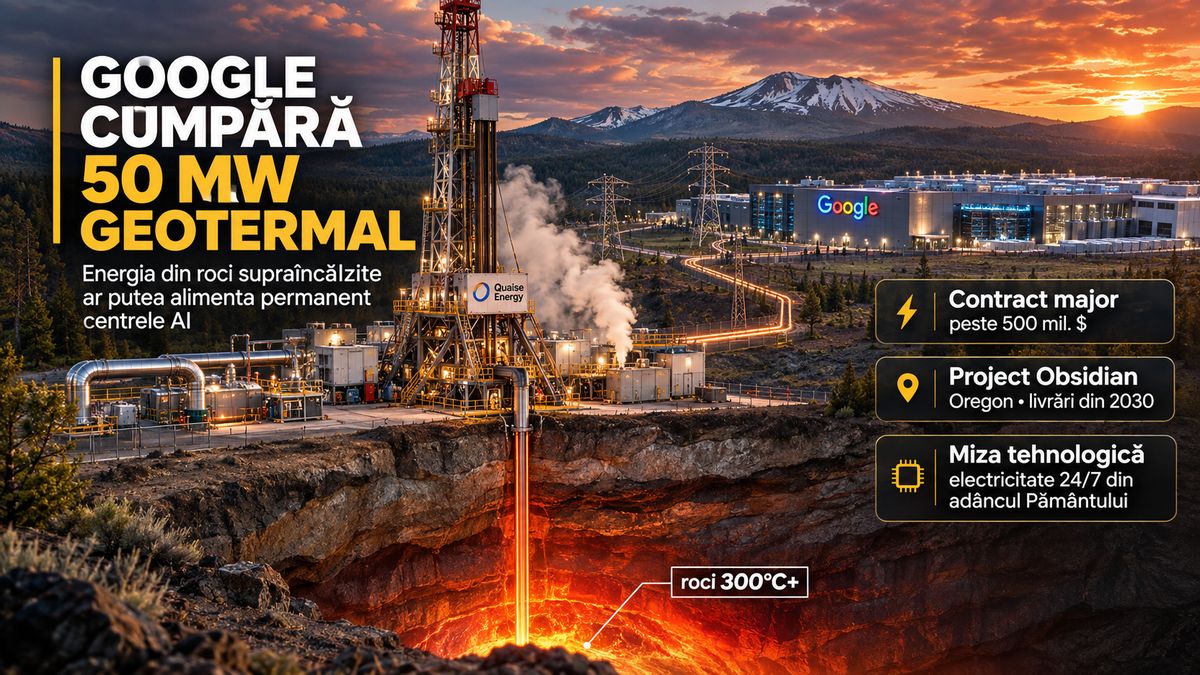
Google has signed a power purchase agreement valued at over $500 million with US company Quaise Energy, which is developing a geothermal power plant capable of harnessing heat from rocks exceeding 300°C. Announced on November 17, 2026, the deal covers 50 MW of capacity from Project Obsidian in Oregon, with initial deliveries expected no earlier than 2030. The electricity will support Google’s data center operations in The Dalles as well as regional power demand. The significance of the agreement extends far beyond its commercial value. The project aims to convert heat trapped several kilometers beneath the Earth's surface into a continuous source of firm electricity, independent of solar radiation, wind conditions, or the time of day. If scaled to industrial capacity, high-temperature geothermal plants could become a vital component of power systems and a reliable alternative for baseload consumers, including digital infrastructure and AI data centers. Quaise estimates the initial capital expenditure for Project Obsidian at approximately $350 million, while the commercial off-take deal with Google exceeds $500 million, according to reports by Canary Media and The Wall Street Journal. The agreement secures an off-taker for the project's initial phase and establishes a commercial foundation for further investment. Quaise plans to subsequently expand the facility to 250 MW and eventually develop over 1 GW of total capacity in the region. Google seeks 24/7 firm power for data centers The surge in artificial intelligence workload is placing unprecedented pressure on power grids. Data centers require uninterrupted electricity for processors, storage systems, cooling equipment, and communications networks, driving growing interest in dispatchable and firm clean energy sources. While solar and wind power remain central to tech companies' sustainability strategies, their intermittent nature highlights the need for complementary baseload generation. Geothermal energy offers a clear distinct advantage: it taps subterranean heat—a resource immune to weather shifts or day-night cycles. A well-engineered geothermal facility operates at high capacity factors, providing reliable baseload generation for extended periods. For data center operators, this delivery profile carries significant economic value by minimizing the need for costly firming power during periods of low renewable output. At a constant capacity of 50 MW, maximum theoretical generation reaches 438 GWh annually. Operating at a 90% capacity factor would yield roughly 394 GWh per year, underscoring the scale of the facility. Actual output will depend on reservoir thermal performance, plant availability, and net grid export capacity. This is not Google's first venture into advanced geothermal power. In September 2026, Fervo Energy announced a separate 396 MW agreement with Google for its Cape Station project in Utah, which began generating power earlier that year. The defining distinction of Project Obsidian lies in its target temperatures and the development of breakthrough drilling technology that could unlock resources significantly deeper within the Earth's crust. Rocks above 300°C yield exponentially higher energy per well Conventional geothermal power relies on rare hydro-thermal reservoirs where hot water or steam occurs naturally near the surface. To overcome these geographical limits, Project Obsidian employs Enhanced Geothermal Systems (EGS) technology, engineered to circulate fluids through hot, impermeable rock formations at depth. The process utilizes injection and production wells linked by hydraulic fractures through hot bedrock. Water injected from the surface absorbs heat as it circulates through the subterranean reservoir, ascends via production wells, and drives power generation equipment before being reinjected into the loop. Overall thermal efficiency depends on reservoir temperature, fluid flow rates, heat transfer mechanics, and power plant cycle design. Accessing higher temperatures dramatically increases energy density, allowing substantially more power to be extracted per unit of circulating fluid. Quaise projects that tapping superheated rocks could boost electrical output per well by up to tenfold compared to conventional EGS installations, drastically reducing the number of costly wells required per megawatt—a claim that must now be validated at commercial scale. Technical modeling presented by Quaise at the 2026 Stanford Geothermal Workshop supports delivering a net 50 MW in Project Obsidian’s initial phase using two loop systems and six total injection and production wells. The twin reservoirs target average temperatures of 315°C and 365°C at depths between 4 and 5 kilometers, allowing engineers to test EGS performance across varying thermal and mechanical stress environments. The economic implications are significant. Drilling accounts for a major portion of geothermal capital expenditures; delivering higher output per well…
Ioana Buzoaica — Independent Editorial Board
The NRG-IA newsroom continuously monitors Romanian energy markets, ANRE regulatory decisions, and national grid telemetry (SEN/SNT). We deliver independent intelligence anchored exclusively in official primary data.
Editorial Charter, Ethics & Verification Methodology →