Google, NVIDIA Launch AI Energy Management Alliance — NRG-IA
Tehnologie & Inovație Author: Ioana BuzoaicaAs AI strains power grids, the industry is reshaping how data centers consume energy, shifting non-urgent computing loads to off-peak hours.
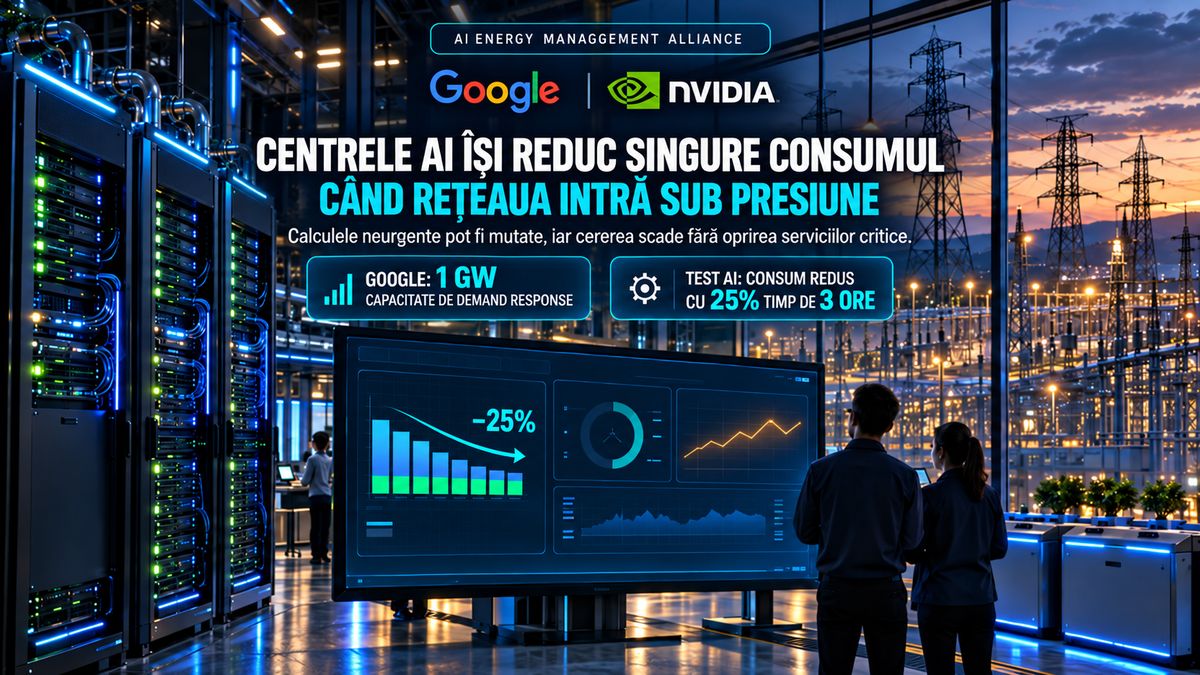
On September 16, Google, NVIDIA, and Emerald AI launched the AI Energy Management Alliance, an initiative addressing one of the biggest challenges created by the expansion of artificial intelligence: data centers require ever-increasing amounts of electricity, but grids, power plants, and new grid connections cannot keep pace. The proposed solution, however, reframes the question. Instead of every AI center constantly demanding the full capacity it was designed for, a portion of its consumption can become controllable, dropping precisely during the hours of peak grid stress. This mechanism leverages a key characteristic of artificial intelligence: not all computations need to run at the exact same second. While some services are critical and must remain continuously available, certain training processes, batch computations, or other delay-tolerant tasks can be slowed down or shifted to other times. Rather than shutting down the data center, software can decide which activities continue at full power and which computations can wait until grid pressure eases. For the power system, this difference can be major. An infrastructure designed to continuously supply 1,000 MW to a single consumer is built very differently from one that knows that consumer can rapidly and predictably shed a portion of its load during the most challenging hours of the year. Flexibility does not generate new electricity, but it can create operational headroom within the existing grid. AI Computing Emerges as a New Form of Energy Flexibility Demand response is not an invention of the AI industry. Large industrial consumers have been reducing their consumption for years when the grid needs support. The novelty lies in the ability of high-power digital infrastructure to turn computational scheduling itself into an energy tool. A data center can respond to a grid operator's signal through several mechanisms. Delay-tolerant computing tasks can be shifted in time, on-site batteries can temporarily power a portion of the equipment, and local generation can reduce the amount of electricity drawn from the grid. Services requiring immediate availability can continue to run. For the user, this means critical services remain active while invisible, less urgent operations are rescheduled in the background. From the grid's perspective, the data center is no longer just a massive consumer demanding electricity, but also a consumer capable of responding in a controlled manner to system constraints. This distinction becomes increasingly important as the scale of AI centers grows. The Lawrence Berkeley National Laboratory estimates that in its reference scenario, data centers could account for approximately 11.8% of total U.S. electricity consumption by 2030 , with scenarios ranging between 9.5% and 15.3%. At this scale, the issue is no longer just a concern for tech companies. The power plants, transmission lines, transformers, and reserves needed to power these centers are factored into the overall system costs. Google Already Has 1 GW of Flexibility Integrated into Energy Contracts Google announced in March 2026 that it had integrated a total of 1 GW of demand response capacity into its long-term energy contracts with several U.S. utilities. This figure does not represent a gigawatt of consumption reduced simultaneously in a single event. Rather, it represents contractually secured demand response capacity, through which Google can limit or shift a portion of its machine learning workloads when grid conditions require it. The distinction is important, but the achievement remains significant: AI computing flexibility is beginning to transition from experimental phases into the contractual relationships between data centers and electric utilities. Google has previously tested reducing machine learning workloads in collaboration with utilities, and this new phase demonstrates how access to energy can be negotiated not just by asking "how many megawatts are needed?" but also "how many of those megawatts can be shed when the system needs it?". For everyday consumers, this shift can have a very concrete impact. If a major consumer can reduce its demand during the few hours when the grid is pushed to its limits, it can decrease the need for capital investments built solely to meet those peaks. While the exact effect depends on the region, infrastructure, and tariff regulations, flexibility can ease the pressure on costs that ultimately trickle down into consumer rates. A 256-GPU Test Demonstrates the Mechanism Works The concept already has a technical demonstration published in a scientific journal. A study published in Nature Energy tested the mechanism at a hyperscale cloud facility in Phoenix, Arizona, on a cluster of 256 GPUs running representative AI workloads. The system reduced power consumption by 25% for three hours during peak times while maintaining the quality-of-service guarantees of the AI applications. The reduction was achieved through…