Greece Breaks Export Record, Bulgaria Adds 14 GWh Storage — NRG-IA
Piața de Energie Author: Ioana BuzoaicaGreece set a record 53.9 GWh net export on Aug 14, while Bulgaria exports via 14+ GWh of storage, boosting regional security amid Romanian outages.
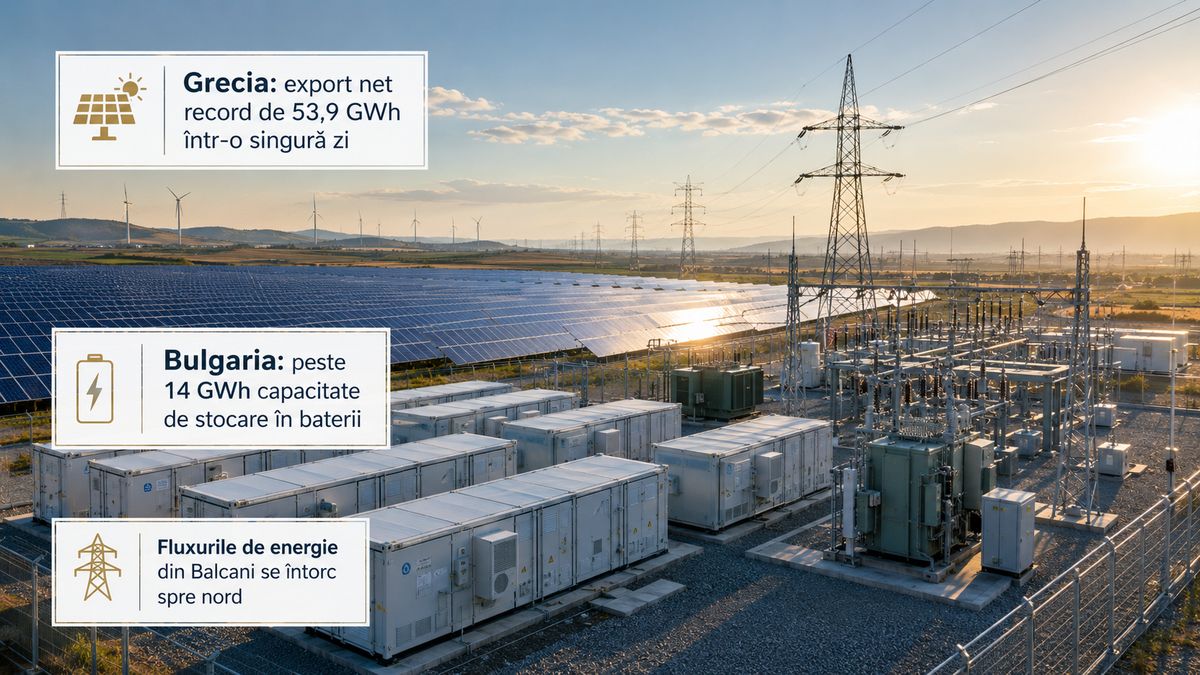
Electricity flows in Southeast Europe have shifted heavily northward at a time of unusual stress for the region's power systems. On August 14, Greece set an all-time record for net exports, reaching 53.9 GWh in a single day , after the previous record of 52.3 GWh was set just 24 hours earlier. Bulgaria is also exporting around 32–33 GWh per day , supported by a mix where nuclear, renewables, conventional generation, and a battery fleet of over 14 GWh provide the necessary flexibility to meet regional demand. This timing is all the more critical as Romania has both units at Cernavodă offline, and Hungary's Paks nuclear power plant is operating at a fraction of its normal capacity due to extremely low Danube water levels. Drought is simultaneously impacting hydropower and the cooling of thermal and nuclear plants, while European interconnections are shifting power from surplus systems to those where supply has tightened. Greece and Bulgaria are not "powering Vienna" via a direct electrical route. Electricity flows through an interconnected European system, via coupled markets and successive grids. The key shift lies elsewhere: the southern Balkans, long associated with deficits and imports, have recently become a major source of supply for Romania, Hungary, and Central European markets. Greece sent nearly half of its record exports to Bulgaria Out of the 53.9 GWh of net exports from Greece on August 14, approximately 25 GWh went directly to Bulgaria , according to data analyzed by the publication EnergyPress. Another 12 GWh or so was exported to Italy, over 11 GWh to North Macedonia, around 5 GWh to Albania, and 0.5 GWh to Turkey. The volume sent to Bulgaria represents nearly half of Greece's net exports for the day and is highly relevant precisely because of the Bulgarian system's position. Bulgaria is further connected to Romania, and Romania and Hungary are part of the European market and transmission infrastructure that allows regional surpluses and deficits to be balanced. However, this August record is not a temporary anomaly of just a few days. Greece had already shifted its position in the regional market. In the first half of 2026, the positive balance of Greek interconnections reached approximately 5.12 TWh , about nine times the level of the corresponding period in 2025. The relationship with Bulgaria has shifted even more spectacularly: from a net Greek import of around 470 GWh in the first half of last year to a net export of approximately 3.15 TWh in the first six months of 2026. Greece is thus becoming a more structurally significant exporter in Southeast Europe. Renewables generate the surplus, gas extends export capacity On August 14, Greece's renewable generation rose to approximately 145 GWh , representing 65.5% of the reported generation for that day, with hydropower adding around 11 GWh. This large solar and wind capacity explains the surpluses during favorable hours, but not the entire export performance. The element enabling Greece to continue delivering even after solar generation drops is its fleet of gas-fired power plants. Renewables provide massive volumes during sunny and windy hours, and flexible plants can sustain production when solar output declines. This combination alters the systemic value of renewables. A country with high solar output may have a massive surplus at noon, but its ability to support the regional market drops rapidly after sunset unless it has storage, flexible generation, or other resources to compensate for the volatility. Greece is currently relying primarily on renewables and flexible gas to extend its export window. Bulgaria has built over 14 GWh of storage Bulgaria brings a different and highly relevant element to the regional equation for Romania: batteries. By mid-July, Bulgarian storage capacity had reached approximately 4.8 GW of power and over 14 GWh of energy capacity , while installed solar capacity had surpassed 6.6 GW. These two figures describe different functions. The roughly 4.8 GW represents the power rate at which installations can charge or discharge electricity at any given moment. The 14+ GWh indicates the volume of energy they can store. This infrastructure allows the Bulgarian system to absorb energy during periods of abundant production and low prices, and then feed it back into the grid during hours when solar output drops and demand becomes more valuable. The absorbed energy can come from both domestic production and the regional balance. There is no traceability to track a specific MWh produced in a Greek solar park through a Bulgarian battery and then identify it as electricity exported to Romania. At the system level, however, storage allows Bulgaria to turn available surpluses into a reserve that can support both domestic consumption and subsequent exports. During this period, Bulgaria is exporting approximately 32–33 GWh of electricity per day , equivalent to an average power of about 1.3–1.4 GW if the volume were distributed…
Ioana Buzoaica — Independent Editorial Board
The NRG-IA newsroom continuously monitors Romanian energy markets, ANRE regulatory decisions, and national grid telemetry (SEN/SNT). We deliver independent intelligence anchored exclusively in official primary data.
Editorial Charter, Ethics & Verification Methodology →