Romania Prepares 3.1 GW Black Sea Offshore Wind Concessions — NRG-IA
Energie Regenerabilă Author: Ioana BuzoaicaRomania aims to tender three Black Sea zones for offshore wind projects totaling 3.1 GW, setting its first concrete targets under Law 121/2024.
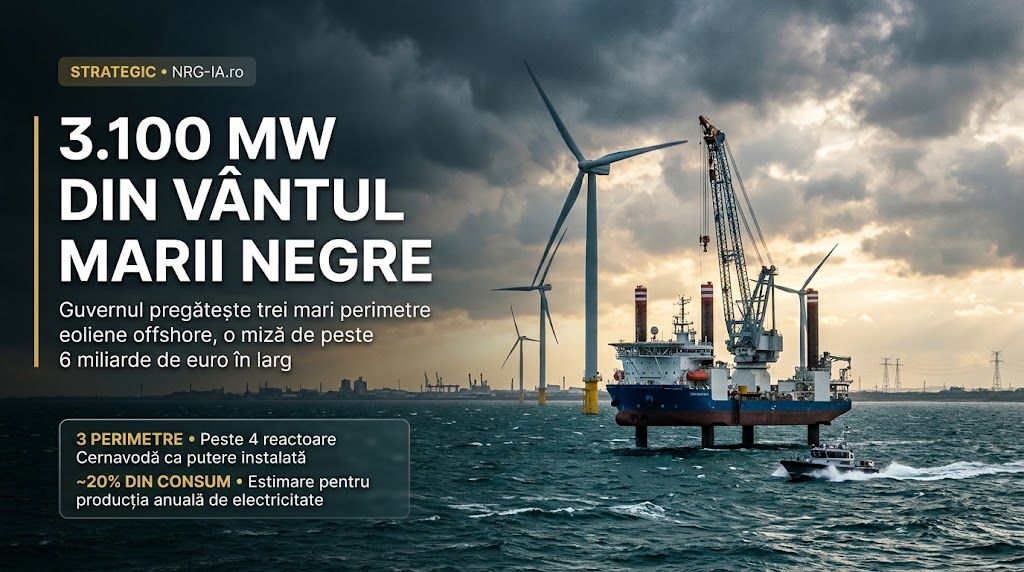
The Romanian government is preparing to tender concessions for three maritime zones in the Black Sea dedicated to developing the country's first offshore wind farms, with a potential cumulative installed capacity estimated at approximately 3,100 MW, according to an announcement on November 4 by the Minister of Energy. Included in the government program, this provision marks Romania's transition from a theoretical legislative framework to the first concrete commercial and spatial sizing of the concessions to be offered to energy investors under Law No. 121/2024 on offshore wind energy. The targeted capacity of 3,100 MW exceeds the combined installed capacity of four CANDU nuclear reactors at Cernavodă, where the two operational units currently total 1,400 MW. Dividing this volume across three distinct zones yields an average size of around 1,000 MW per perimeter—a scale considered the benchmark for operational efficiency in the European offshore wind industry to amortize high capital expenditures on subsea cables and offshore substations. From a Theoretical 76 GW Potential to a Commercial Target of 3,100 MW Prior to establishing this official benchmark, discussions on harnessing wind resources in Romania's Black Sea sector revolved around a theoretical technical potential of 76,000 MW (76 GW), calculated in a roadmap prepared by the World Bank in partnership with the Ministry of Energy and the European Commission. Out of that technical maximum, 22,000 MW corresponds to shallow waters under 50 meters, where fixed-bottom foundations installed on the continental shelf are feasible, while 54,000 MW lies in deep waters requiring far more costly floating platforms. By establishing a 3,100 MW target for the first three perimeter zones, the executive is aligning directly with the high-growth scenario recommended by the World Bank for 2035, which envisioned 3,000 MW of installed capacity during the initial phase of market development. This calibration focuses early buildout on the shallow waters of the continental shelf, where fixed-bottom technology is commercially mature, supply chains are proven in the North Sea, and the leveled cost of energy (LCOE) is significantly lower. The advantage of offshore over onshore capacity is directly reflected in actual power generation. While solar PV plants in Romania operate at an average annual capacity factor of 14–16% and onshore wind farms achieve 25–30%, the stronger and more consistent offshore wind regime in the Black Sea delivers capacity factors of 40–45% for marine turbines. At these technical parameters, an installed capacity of 3,100 MW can generate between 10.8 and 12.2 million MWh (10.8–12.2 TWh) annually—equivalent to more than one-fifth of Romania's total national electricity consumption. Furthermore, the seasonal profile of offshore wind offers a structural benefit for balancing the National Power System. Wind speeds in the Black Sea peak during autumn and winter—precisely when solar generation reaches annual lows, domestic demand surges, and Romania frequently relies on expensive spot market power imports. Concession Framework and the €6 Billion to €9 Billion Industrial Opportunity Operationalizing the three blocks will follow the procedure established under Law No. 121/2024. As the granting authority, the Ministry of Energy will define the geographic coordinates of the maritime zones based on a specialized study. This assessment excludes commercial shipping lanes to the ports of Constanța and Sulina, military training areas used by the Ministry of National Defence and NATO, marine protected areas, and existing oil and gas blocks such as Neptun Deep. Following government approval of the block list and royalty rates via a Government Decision, competitive auctions will be launched. Winning bidders will secure exploration, construction, and operational rights for an initial period of up to 30 years, extendable by an additional 10 years. Developers will pay both an annual seabed lease fee and power production royalties to the state budget. In return, they will be eligible for a 15-year Contracts for Difference (CfD) support mechanism designed to ensure project bankability for lenders. Given current European industry cost benchmarks of €2 million to €3 million per megawatt of offshore capacity, developing 3,100 MW will require direct capital investments ranging from €6 billion to €9 billion. Major companies operating in Romania—including Hidroelectrica, OMV Petrom, and PPC—alongside major international developers, have already voiced strategic interest in Black Sea projects, positioning the sector as Romania's second major offshore investment pillar after the Neptun Deep gas project. The geography of the Black Sea ensures that a significant portion of these capital expenditures will stay within the domestic economy. As a semi-enclosed sea, entry for giant wind turbine installation vessels (WTIVs) is severely constrained by air draft limitations under the Bosphorus…
Ioana Buzoaica — Independent Editorial Board
The NRG-IA newsroom continuously monitors Romanian energy markets, ANRE regulatory decisions, and national grid telemetry (SEN/SNT). We deliver independent intelligence anchored exclusively in official primary data.
Editorial Charter, Ethics & Verification Methodology →