Romania Keeps Oil & Gas Turnover Surtax in 2027: Impact — NRG-IA
Legislație & Reglementări Author: Ioana BuzoaicaRomania plans to extend the oil & gas turnover surtax into 2027, despite phasing it out elsewhere, pressuring key energy investors and offshore funding.
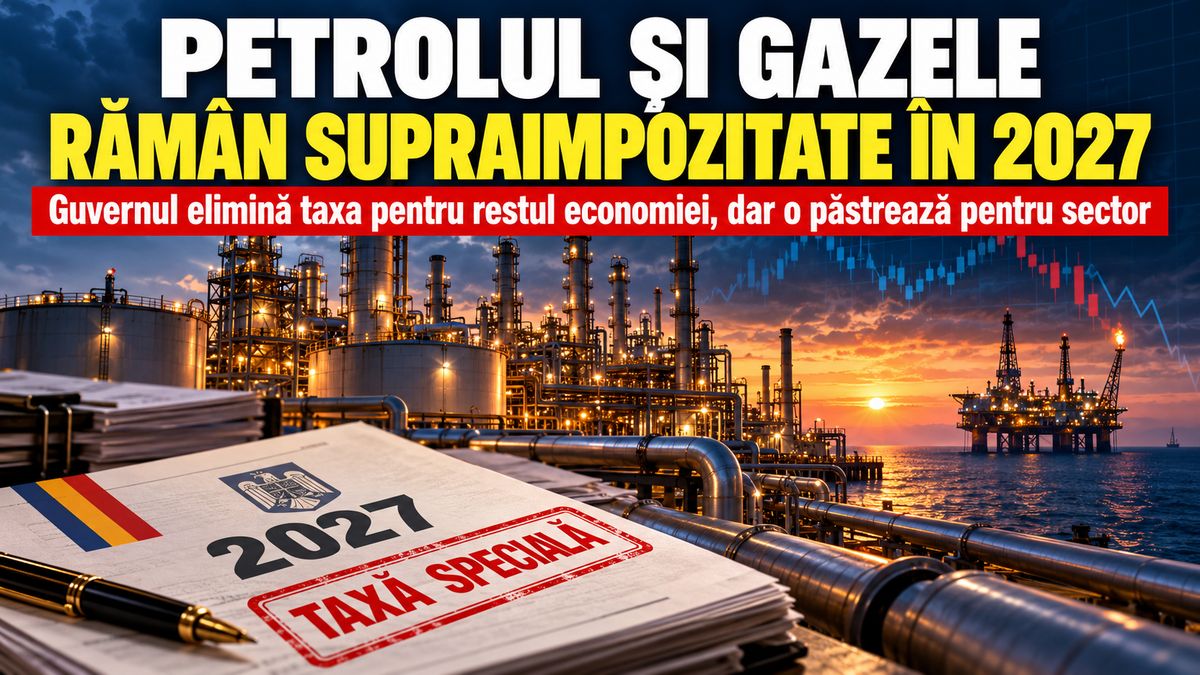
The Romanian government plans to extend the additional turnover tax on oil and gas companies through 2027, even as the minimum turnover tax is set to be abolished for most other business sectors. Information emerging on October 22, 2026, from negotiations over the upcoming fiscal-budgetary package indicates a very low probability that hydrocarbon producers, refiners, and distributors will be exempted next year from this surtax, which will also continue to apply to banking institutions. This fiscal policy direction solidifies differential treatment for two of the economy’s most liquid and profitable sectors, turning a budgetary tool initially introduced as an exceptional, temporary measure into a quasi-permanent fixture of the tax regime. For the oil and gas industry, the decision means that direct levies on gross revenue will continue to be stacked on top of standard corporate income tax, petroleum royalties, and energy-specific regulatory contributions. The stakes extend well beyond mere revenue collection to curb the state budget deficit. The targeted operators—led by OMV Petrom and Romgaz—are simultaneously the country's largest taxpayers, key issuers supporting liquidity on the Bucharest Stock Exchange, and the developers of strategic projects critical to Romania's energy security over the coming decade. Why phasing out the minimum turnover tax for the broader economy leaves hydrocarbons in an exceptional fiscal regime Phasing out the minimum turnover tax for retail, manufacturing, and services has been consistently demanded by the business community, as taxing gross revenue penalizes companies with high turnover and thin operating margins, often exceeding actual net profits. The government acknowledged the loss of competitiveness for the broader economy, yet decided to retain the fiscal exception precisely where financial volumes are massive and physically locked in place. By its nature, the oil and gas sector operates with revenues in the tens of billions of lei, generated from domestic crude oil and natural gas extraction, as well as refining, trading, and fuel retail activities. Applying a direct levy on top-line revenue guarantees the Ministry of Finance a predictable revenue stream—one immune to fluctuations in deductible expenses, accelerated asset depreciation, or capital expenditure cycles that would otherwise compress the net taxable income base. For the refining and distribution chain, where retail margins per liter at the pump are structurally tighter than in upstream exploration and production, turnover taxation acts as a fixed levy attached to every transaction. In a competitive market already exposed to high international crude benchmarks, a top-line tax directly compresses the return on capital employed. Financial impact on OMV Petrom and Romgaz and the knock-on effect on the Bucharest Stock Exchange The most visible consequences of extending the surtax through 2027 fall on the two blue-chip energy pillars listed on the Bucharest Stock Exchange, OMV Petrom and Romgaz. Any additional levy applied directly to the top line of the income statement automatically reduces net earnings distributable to shareholders and squeezes free cash flow available to companies after covering operational costs. This fiscal pressure comes at a moment when OMV Petrom was considering an 11% increase in its capex budget during a decisive phase for major energy developments. When the state siphons off an additional share of top-line revenue, executive management at energy companies is forced to choose between shielding capital programs by curbing dividends, or turning to bank debt and bond issuances at elevated interest rates. For institutional investors, Pillar II private pension funds, and hundreds of thousands of retail investors on the Bucharest Stock Exchange, extending the special tax alters valuation models for 2027. Although the Romanian state is the majority shareholder in Romgaz and holds a significant stake in OMV Petrom, the government's preference for upfront collection via turnover taxes—rather than downstream dividend distributions from net income—disadvantages minority shareholders, who suffer earnings dilution without benefiting from the direct budgetary inflows. The contradiction between extended turnover taxation and financing the offshore Neptun Deep project Beyond short-term accounting considerations, maintaining the surtax through 2027 highlights a structural conflict between fiscal policy and national energy strategy. The years 2026 and 2027 represent the peak financial and technical effort required to complete offshore infrastructure in the Black Sea's Neptun Deep perimeter—a multi-billion-euro investment developed equally by OMV Petrom and Romgaz. Deepwater natural gas developments, alongside investments in solar parks, EV charging networks, and battery storage units currently deployed by oil companies, require legislative stability and predictability across ten- to fifteen-year…
Ioana Buzoaica — Independent Editorial Board
The NRG-IA newsroom continuously monitors Romanian energy markets, ANRE regulatory decisions, and national grid telemetry (SEN/SNT). We deliver independent intelligence anchored exclusively in official primary data.
Editorial Charter, Ethics & Verification Methodology →