Cernavodă: Romania Prioritizes Bala II After 1B Lei Losses — NRG-IA
Piața de Energie Author: Ioana BuzoaicaRomania prioritizes Cernavodă NPP water supply upgrades after drought caused shutdowns and 1B lei losses. The Bala II project is set to secure long-term supply.
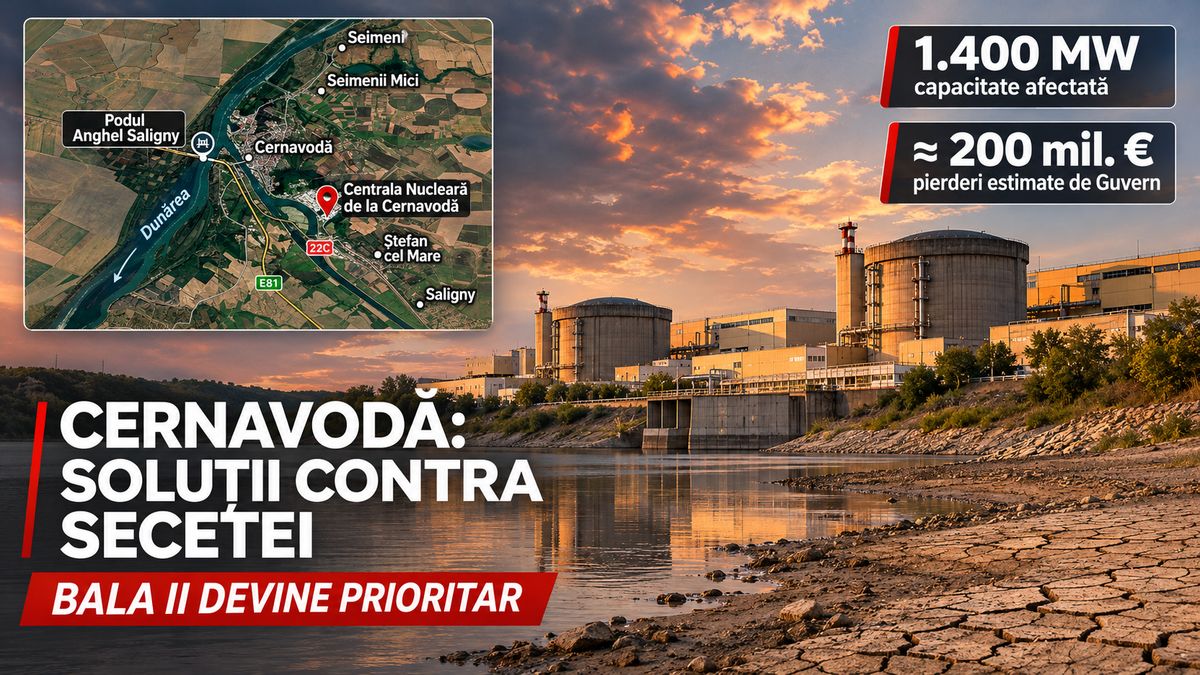
Romania is preparing infrastructure modifications to the water supply system of the Cernavodă nuclear power plant following an extreme drought that forced the shutdown of both reactors, representing a total capacity of approximately 1,400 MW. On November 7, 2026, Energy Minister Dumitru Chisăliță announced that he had requested Nuclearelectrica's management to prioritize technical solutions to mitigate the risk of a recurrence in summer 2027. Concurrently, the government declared the Bala II hydrotechnical project a priority initiative aimed at improving flow conditions along the Danube and securing the plant's water supply. The urgency of the intervention is underscored by the magnitude of the economic losses. Prime Minister Luca Niculescu estimated the total losses resulting from the recent nuclear power unavailability at approximately one billion lei (around €200 million). The Prime Minister drew a direct comparison between this sum and the scale of investment required to secure the plant's long-term water intake. The outage forced the national power system to compensate for the supply deficit through alternative generation sources and power imports during a period already marked by constrained energy availability. The first step toward recovery occurred on November 6, when Unit 1 was resynchronized to the National Power Grid following its controlled shutdown on July 28. Unit 2 remained offline as of November 8, with authorities scheduling a fresh evaluation of hydrological conditions for Monday, November 9. Beyond restarting the reactors, the crisis has highlighted a strategic challenge: the capacity of Danube infrastructure to sustain both existing nuclear generation and the future expansion of the plant. Approximately 1,400 MW of Nuclear Capacity Affected by Danube Drought Cernavodă Unit 1 underwent a controlled shutdown on July 28, 2026, as Danube water levels fell below safe operational thresholds. On August 13, Unit 2 was also disconnected, leaving Romania with zero nuclear output from Cernavodă until the first unit was reconnected on November 6. The period during which both reactors were simultaneously unavailable totaled approximately 85 days, while Unit 1's outage lasted roughly 101 days. The scale of the energy deficit is substantial. A single 700 MW reactor theoretically generates 16.8 GWh of electricity per day under continuous operation at nominal capacity. For both units combined, baseline full-load production would reach 33.6 GWh daily. Actual lost generation depends on planned operating levels, maintenance schedules, and specific technical parameters over the period. Nuclear power is a cornerstone of Romania's baseload generation. Its absence disrupts the balance between domestic production and demand, leaving the system reliant on hydropower, gas- and coal-fired plants, renewables, and electricity imports. During peak periods, replacing large-scale nuclear generation can increase power system exposure to volatile wholesale market prices and cross-border interconnection constraints. Nuclearelectrica maintained both units in a safe shutdown state in strict accordance with operating procedures and nuclear safety requirements. The operator stated in public updates that safety systems operated properly throughout, with hydrological constraints affecting power generation exclusively. The controlled shutdown ensured plant systems remained fully protected pending the recovery of suitable operating conditions. Danube Flows Dropped to Extreme Lows; Plant Cooling Critically Dependent on Water Levels The core technical bottleneck was the availability of cooling water. The CANDU reactors at Cernavodă rely on specialized cooling circuits and heat removal systems drawn from the Danube water system. Safe operation hinges on hydraulic conditions at the water intakes, suction basin levels, and stringent operational safety margins. On November 7, plant director Romeo Urjan reported a local water level of 2.08 meters above the local datum at Cernavodă. While sufficient to operate Unit 1, restarting Unit 2 required an additional increase of at least 10–15 centimeters alongside meeting all other technical criteria. The operation of Unit 1's three large cooling pumps impacts local water drawdown, necessitating a separate evaluation for simultaneous dual-reactor operation. Data from the National Institute of Hydrology and Water Management illustrates the severity of the drought. On November 7, Danube flow at the entrance into Romania (Baziaș section) measured 1,750 m³/s, compared to a multi-year November average of 4,700 m³/s. The observed discharge stood at just 37% of the seasonal benchmark, with forecasts projecting flows remaining far below normal. This deficit explains why regaining sufficient water for Unit 1 does not automatically solve the overall system issue. Operational parameters must be continuously evaluated against local discharge, water consumption from active units, and forward hydrological…
Ioana Buzoaica — Independent Editorial Board
The NRG-IA newsroom continuously monitors Romanian energy markets, ANRE regulatory decisions, and national grid telemetry (SEN/SNT). We deliver independent intelligence anchored exclusively in official primary data.
Editorial Charter, Ethics & Verification Methodology →