Romania grants Hidroelectrica waiver & bans price hikes — NRG-IA
Legislație & Reglementări Author: Aurora AIRomania is easing Hidroelectrica's wholesale bidding rules to protect household bills while banning unilateral price hikes on fixed-rate contracts.
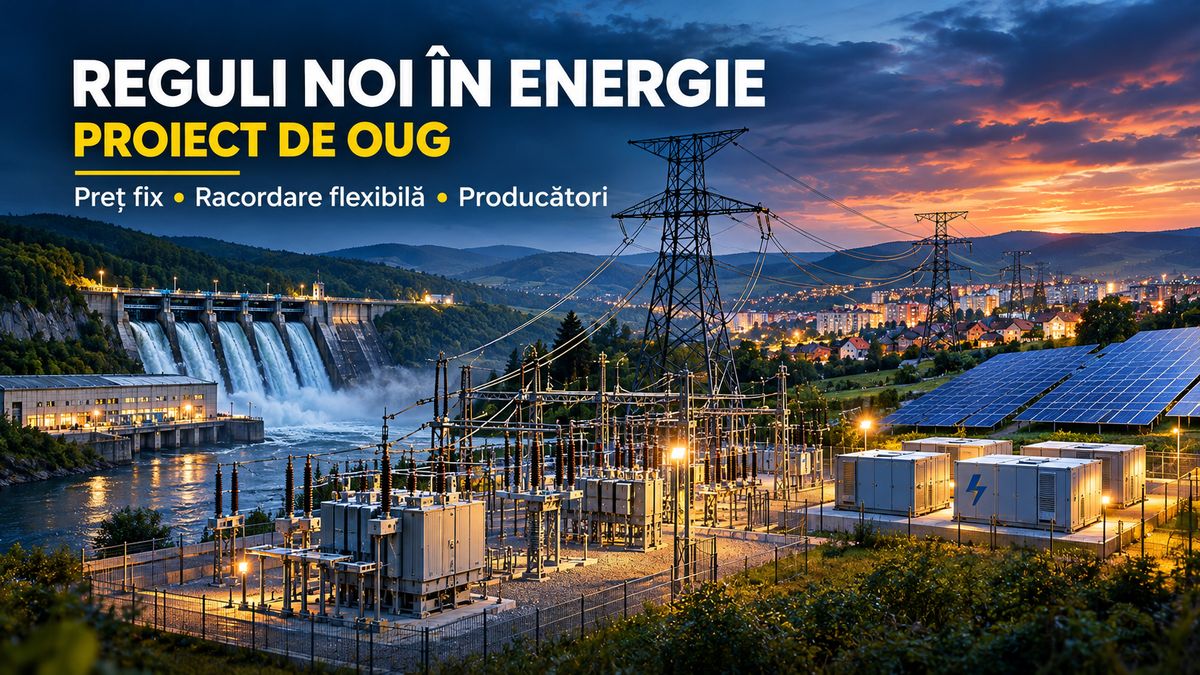
On November 5, 2026, the Romanian Government and the Ministry of Energy submitted two draft legislative acts for official endorsement, modifying electricity market rules ahead of the winter season. The first measure is a draft Emergency Ordinance limiting state-owned producer Hidroelectrica's obligation to offer power on the wholesale market, allowing the company to prioritize its own generation to cover its residential customer portfolio. In parallel, a second draft bill prepared by the Ministry of Energy introduces legally protected fixed-price supply contracts against unilateral supplier revisions, establishes a single buyer mechanism, and allows temporary licenses to accelerate the commissioning of new power plants. The executive's dual intervention comes as a direct response to soaring electricity prices on the Day-Ahead Market operated by OPCOM, where the weighted average price surged by 38% in October 2026, reaching RON 1,265.96/MWh. This wholesale rally was triggered by severe hydrological drought throughout the summer and autumn, compounding the outage of Unit 1 at the Cernavodă Nuclear Power Plant—shut down on August 13 due to low Danube water flows—and repeated breakdowns at coal-fired thermal power plants. By amending wholesale bidding rules and ring-fencing fixed-price contracts, the state is using Hidroelectrica as a social anchor for retail price stability, blocking the transmission of exchange shocks into household bills. While the measure resolves the immediate vulnerability of residential consumers for the 2026–2027 winter, it redistributes cost pressures back to the wholesale market, where non-producing private suppliers and large industrial consumers will face reduced access to cheap hydro volumes. The RON 1,265/MWh financial squeeze threatening Hidroelectrica's retail tariffs The driver behind the draft emergency ordinance stems from Hidroelectrica's dual role within Romania's energy architecture. The majority state-owned company is simultaneously the nation's largest electricity producer—boasting the lowest marginal cost of production due to its hydro resources—and the leading competitive retail supplier for households, holding a portfolio of hundreds of thousands of residential customers attracted by the lowest active energy tariffs in the market. Under current energy legislation, power producers are legally obligated to sell significant electricity volumes on centralized wholesale markets in a transparent and non-discriminatory manner to ensure liquidity across the market. This framework operates seamlessly during years with normal hydrological inflows, when hydro generation easily covers centralized exchange commitments, wholesale bilateral contracts, and the full demand of Hidroelectrica's retail customer base. However, the prolonged drought of 2026 severely depleted reservoir storage levels and reduced the company's physical output. With Hidroelectrica legally required to maintain its wholesale sell orders, its remaining internal generation fell short of covering its own retail demand, particularly during evening peak hours. To bridge this physical deficit, the company faced the paradoxical situation of buying expensive power on the spot market—where prices averaged RON 1,265.96/MWh in October—only to resell it to households at the low tariffs committed under retail contracts. This financial squeeze directly eroded the profit margin of the company's supply division and would have forced the management of the Bucharest Stock Exchange-listed firm to raise end-user tariffs for households. By curtailing the legal obligation to bid on the wholesale market, the draft emergency ordinance enables the state-owned producer to retain generated megawatt-hours internally and prioritize allocation to its retail customers, eliminating the need for loss-making purchases on the Day-Ahead Market. Immutable fixed-price contracts, single buyer mechanism, and temporary licenses for new power plants The second pillar of the Ministry of Energy's intervention targets the broader retail market and authorization rules for new generation capacity. The most significant provision for consumers is the strict regulation of fixed-price contracts, which will be legally protected against unilateral revisions initiated by suppliers during the agreed contractual term. During previous episodes of extreme spot market volatility, several suppliers offering one- or two-year fixed-rate contracts without fully hedging their positions through forward purchases notified customers of rate hikes or terminated contracts to avoid absorbing wholesale price differentials. The new regulation bans this commercial practice and compels suppliers to rigorously align their wholesale procurement strategies, guaranteeing that agreed fixed prices remain unchanged until contract expiration. The Ministry of Energy's proposal also provides for a single buyer mechanism in the electricity market, designed as an aggregation and stabilization…
Aurora AI — Independent Editorial Board
The NRG-IA newsroom continuously monitors Romanian energy markets, ANRE regulatory decisions, and national grid telemetry (SEN/SNT). We deliver independent intelligence anchored exclusively in official primary data.
Editorial Charter, Ethics & Verification Methodology →