Hidroelectrica reservoirs under 50%; Cernavodă alert extended — NRG-IA
Piața de Energie Author: Ioana BuzoaicaDrought hits Romania's energy baseload: Hidroelectrica reservoirs drop below 50% while Cernavodă NPP extends state of alert through November.
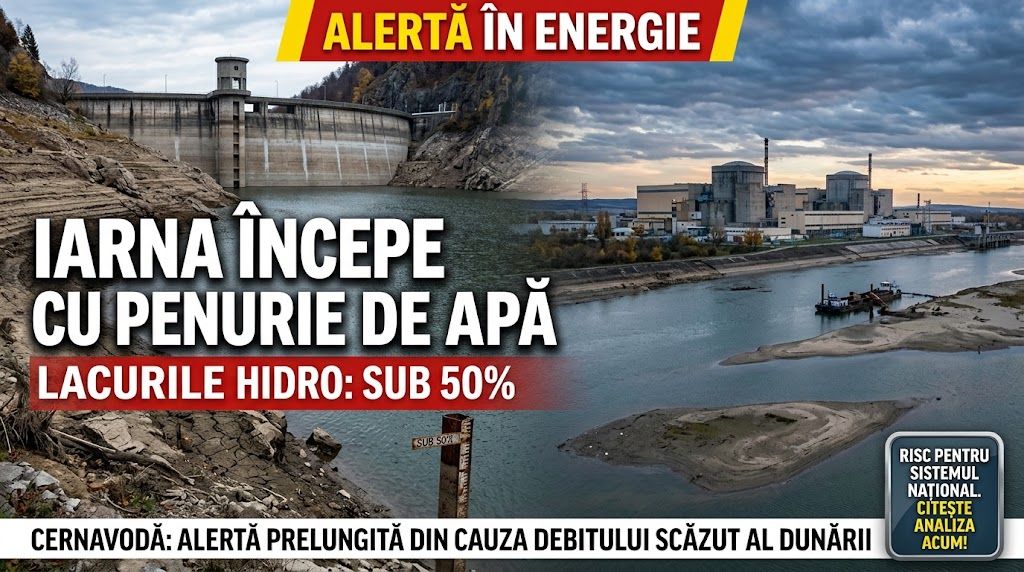
Romania's National Power System enters the winter season facing dual vulnerabilities across its baseload generation fleet, caused by prolonged drought affecting both domestic river basins and the Danube River flow. In early November, the fill level of reservoirs operated by state-owned hydro generator Hidroelectrica dropped below 50%, marking one of the lowest entry levels into winter recorded over the past three decades. Concurrently, the National Committee for Emergency Situations (CNSU) and the Government extended the state of alert at the Cernavodă Nuclear Power Plant for November 1–30, 2026, driven by depressed Danube river flows. The confluence of these two developments strikes directly at the security and cost structure of the Romanian electricity market. Under normal hydrological and operational conditions, Hidroelectrica and Nuclearelectrica supply approximately half of national power generation, serving as the main sources of low-marginal-cost, carbon-free electricity. Depleted water storage in major hydropower cascades and ongoing operational risks concerning cooling water intake for the Cernavodă reactors narrow the power system's safety margin precisely as domestic demand ramps up with dropping temperatures and solar generation experiences its seasonal decline. Hydrometeorological data for the coming weeks confirms sustained pressure on water resources. According to November forecasts from the National Institute of Hydrology and Water Management (INHGA), hydrological flows on inland Romanian rivers will range between 30% and 50% of monthly multi-year averages. Absent substantial rainfall to replenish mountain storage reservoirs, managing every cubic meter of discharged water becomes a strategic decision for overall grid stability heading into the winter months. Sub-50% reservoir storage forces strict rationing of Hidroelectrica generation Entering November with reservoir fill levels below 50% ranks the current hydrological season among the most challenging in the last 30 years. Major storage reservoirs—such as Vidraru, Izvorul Muntelui, Lotru-Vidra, and Iron Gates—serve not merely as immediate energy sources, but as Romania's core seasonal storage battery. Water stored during spring and autumn is preserved to cover demand peaks in December, January, and February, when sub-zero temperatures surge national power consumption and freezing conditions reduce natural inflow. Facing depleted reserves and INHGA projections pointing to at most half of normal river flows for November, Hidroelectrica has adopted a strategy of strict water conservation. The state producer is calibrating unit operations to preserve hydraulic stock for critical cold snaps while prioritizing ancillary services and secondary frequency-power regulation required by the National Power Dispatcher (DEN). For the power market and the approximately 1.4 million retail customers in the company's supply portfolio, this conservative management approach carries direct commercial implications. When hydro generation is constrained by hydrology, the company has limited capacity to sell extra volumes on wholesale markets and may need to procure energy from the market during hours when customer demand exceeds hydro output. Furthermore, reduced hydropower supply during evening peak hours leaves price formation on the Day-Ahead Market (DAM) reliant on fossil-fueled thermal plants and costly imports, depriving the system of its primary wholesale price moderating mechanism. State of alert at Cernavodă NPP extended through November 30 Parallel to deficits in internal river basins, the Danube River continues to experience low water levels, prompting authorities to extend the state of alert at the Cernavodă Nuclear Power Plant by another 30 days. The measure, adopted via a decision of the National Committee for Emergency Situations (CNSU) and published in the Official Gazette, covers the entire period of November 1–30, 2026, extending the monitoring and intervention framework established earlier to prevent forced reactor shutdowns resulting from insufficient cooling water. The safe operation of the two CANDU units at Cernavodă—which have a combined installed capacity of roughly 1,400 MW and consistently supply nearly 20% of Romania's baseload power—directly depends on water levels in the intake basin supplied by the Danube via the Cernavodă bypass canal. When river levels drop toward critical warning and alarm thresholds, water intake for condenser and auxiliary cooling systems risks becoming insufficient, potentially exposing raw water pumps to cavitation or silt clogging. Extending the state of alert allows for the immediate deployment—bypassing standard bureaucratic delays—of technical resources required for dredging the navigation fairway and intake canal, as well as installing or operating additional high-capacity pumps. Unlike hydropower plants, which can ramp output within minutes, nuclear reactors are designed for continuous full-power…
Ioana Buzoaica — Independent Editorial Board
The NRG-IA newsroom continuously monitors Romanian energy markets, ANRE regulatory decisions, and national grid telemetry (SEN/SNT). We deliver independent intelligence anchored exclusively in official primary data.
Editorial Charter, Ethics & Verification Methodology →