Hidroelectrica: 2026 Estimated Profit Down 16.5% on Drought — NRG-IA
Piața de Energie Author: Ioana BuzoaiocaHidroelectrica cuts 2026 profit forecast to RON 3B as drought reduces output and boosts market purchases for its growing portfolio of 1.4M supply points.
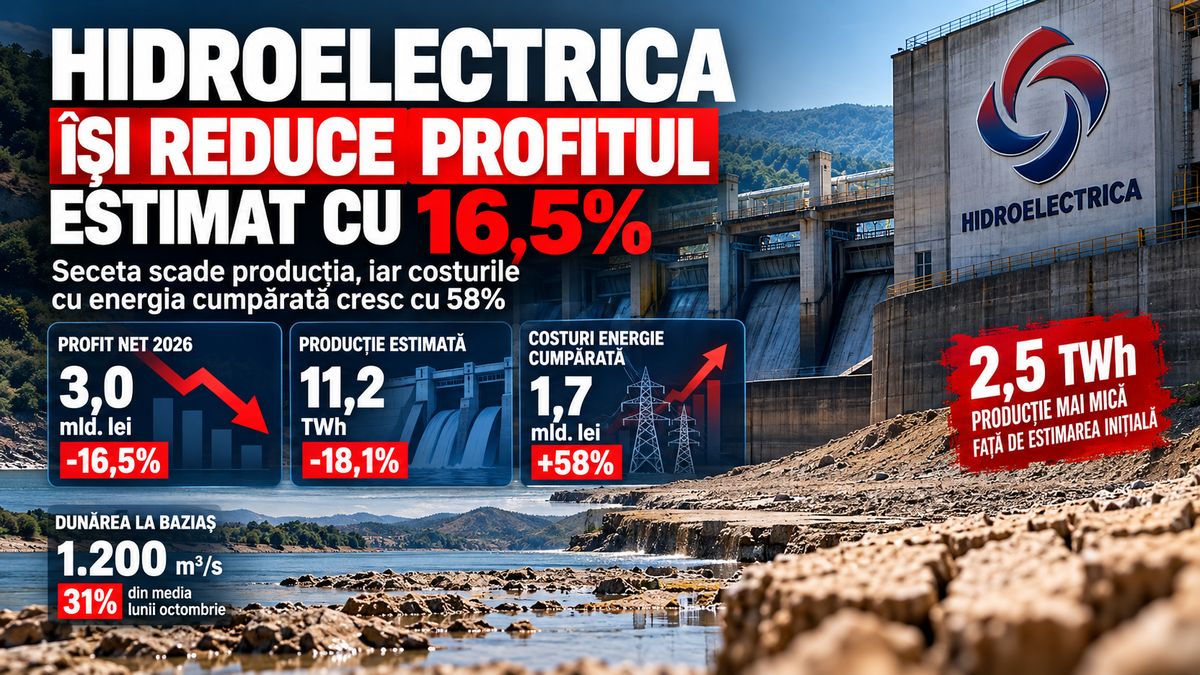
Hidroelectrica, Romania's largest electricity producer, is cutting its 2026 net profit forecast by 16.5% to approximately RON 3 billion, after a prolonged drought reduced hydro generation and forced the company to purchase additional electricity from the market. The budget revision, approved by the Supervisory Board on October 8, indicates a significant deterioration in the company's operating conditions: estimated own production drops by 18.1%, while expenses for purchased energy surge by 58%. The new estimates come at a time when hydrological conditions continue to worsen. According to the National Institute of Hydrology and Water Management (INHGA), on October 8, the Danube's flow at the entry point into Romania, in the Baziaș section, had dropped to just 1,200 cubic meters per second, compared to the multi-annual October average of 3,900 cubic meters per second. The river was thus recording less than a third of its usual flow for this period. For Hidroelectrica, the reduction in water resources translates to less energy generated in its own power plants, larger volumes of electricity purchased from other producers, and increased exposure to wholesale price fluctuations. These effects are all the more significant as the company has rapidly expanded its supply business to household consumers and corporate clients. Estimated profit drops by nearly RON 600 million The revised budget for 2026 forecasts a net profit of RON 3.004 billion, down from approximately RON 3.6 billion in the initial estimate. This adjustment represents a reduction of nearly RON 600 million. Forecasted gross profit falls by 18.2% to RON 3.538 billion, while total revenues are revised downward by 3.8% to RON 11.483 billion. However, the most significant change concerns the volume of energy Hidroelectrica estimates it will produce and sell from its own sources. The annual projection has been cut from approximately 13.7 TWh to 11.2 TWh, representing 2.5 TWh less than initially budgeted. This reduction has direct financial consequences. Energy generated in the company's own hydropower plants benefits from a significant cost advantage compared to the energy it must purchase from the market. When hydro generation drops, Hidroelectrica has smaller volumes available for sale, and a larger portion of its supply requirements must be covered through market purchases. According to the revised figures, annual energy purchases are estimated to increase by 26.3% to 3.2 TWh. At the same time, the associated expenses will reach RON 1.697 billion, 58% above the initially budgeted level. The discrepancy between the growth rate of purchased volumes and that of expenses indicates that Hidroelectrica also anticipates a higher average procurement cost. Comparing the budgeted values to the estimated volumes, the implicit average cost rises from approximately RON 424/MWh to RON 530/MWh, an increase of about 25%. The company is thus simultaneously affected by the reduction in its own generation and the increase in costs for the energy required to meet its commercial obligations. The rise in procurement expenses, up by approximately RON 623 million compared to the initial budget, illustrates the scale of the pressure on profitability. Drought worsens: Danube drops to 31% of normal monthly flow Current hydrological data indicates that pressure on hydropower generation persists into October. In the substantiation of the revision, Hidroelectrica points out that the deterioration of hydrological conditions became significant starting in June 2026, amid deficient rainfall and reduced flows in major watercourses. Between July and September, the flows of numerous rivers in Romania stood at only 30–50% of their multi-annual averages, affecting the generation potential of hydropower developments. On the Danube, the situation proved particularly challenging. In August, the flow at the entry point into the country had dropped to approximately 1,500 m³/s. By October 8, it had reached 1,200 m³/s, nearly 69% below the multi-annual monthly average. The issues are not limited to the river. The INHGA hydrological bulletin from October 8 shows that river flows were generally below 30% of their monthly averages, with values between 30% and 70% of normal in certain river basins. For the October 8–15 period, the INHGA forecast indicated that the Danube's flow would remain around 1,200 m³/s for the first five days, followed by a potential modest increase toward 1,300 m³/s. The volume of available water is decisive for hydroelectric generation, alongside reservoir levels and the technical specifications of the plants. The persistence of low flows limits the possibilities for recovering production in the latter part of the year and explains the revision of the company's forecasts. From a first half with profit up 62% to lowered annual estimates The October revision contrasts sharply with the very strong results reported by Hidroelectrica for the first six months of 2026. According to…
Ioana Buzoaioca — Independent Editorial Board
The NRG-IA newsroom continuously monitors Romanian energy markets, ANRE regulatory decisions, and national grid telemetry (SEN/SNT). We deliver independent intelligence anchored exclusively in official primary data.
Editorial Charter, Ethics & Verification Methodology →