Hidroelectrica Tests Pumped Storage at Frunzaru — NRG-IA
Energie Regenerabilă Author: Ioana BuzoaicaHidroelectrica tests pumped storage on the Lower Olt, eyeing four reversible plants to boost grid flexibility as storage regulations improve.
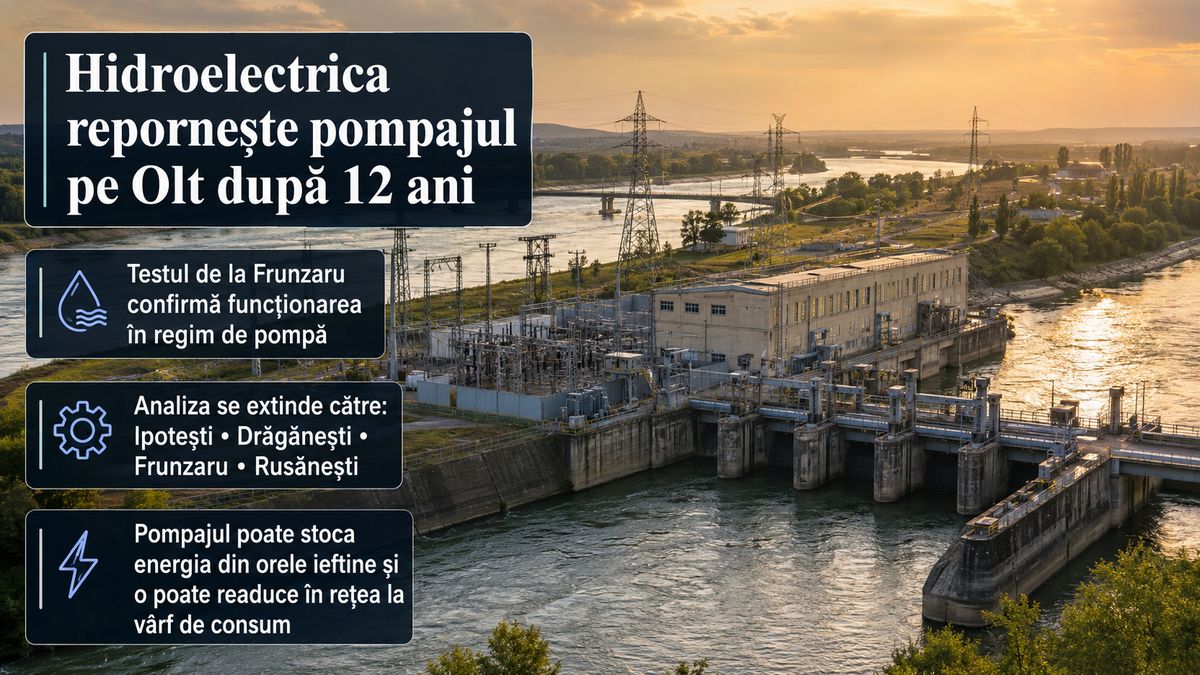
After more than a decade, Hidroelectrica has resumed testing the pumping function of its reversible hydropower plants on the Lower Olt River. Technological trials conducted at the Frunzaru plant, in collaboration with Transelectrica and Distribuție Energie Oltenia, confirmed that the hydro-aggregates can operate in pumping mode under normal conditions. This reopens the possibility of utilizing previously built and retrofitted infrastructure for energy storage and enhancing the flexibility of the National Power System. The company is analyzing the application of the experience gained at Frunzaru across four hydropower plants: Ipotești, Drăgănești, Frunzaru, and Rusănești. The decisive phase is now shifting from technical feasibility to economic viability: Hidroelectrica must determine the conditions under which pumped storage can be commercially viable and provide valuable services to the power grid. The mechanism essentially turns water into a storage medium. During periods of low-cost electricity, the hydro-units consume power to pump water from the downstream reservoir to the upstream one. This water can then be run through turbines in reverse, recovering energy during periods when electricity prices and grid demand are higher. An infrastructure worth approximately €400 million returns to the center of the power system The reversible capability on the Lower Olt is not a new investment. The historical project aimed to retrofit 20 bulb hydro-aggregates across five plants—Ipotești, Drăgănești, Frunzaru, Rusănești, and Izbiceni—to operate in both generation (turbining) and pumping modes. Hidroelectrica's documents indicate a total program value of approximately €400 million . In the historical configuration, the five plants had a combined installed capacity of approximately 285 MW in generation mode , while company documents indicated around 200 MW of installed capacity in pumping mode , with some subsequent reports mentioning approximately 210 MW of absorbed power. However, these figures describe the historical technical configuration of the entire five-plant complex. For the 2026 tests, Hidroelectrica has not disclosed the capacity that could be commercially available for pumping at the four plants currently under review, nor the amount of energy, expressed in MWh, that could be shifted between reservoirs. The distinction between these two metrics is essential. MW represents the instantaneous capacity at which the facility can consume or generate electricity, whereas MWh represents the amount of energy that can be stored and recovered in a cycle. Without this second metric, the Olt infrastructure cannot be rigorously compared to modern battery storage systems. Frunzaru had already demonstrated pumping in 2014. Economics halted the project back then The test on August 20, 2026, is not the first technical demonstration of pumping at Frunzaru. As early as May 2014, Hidroelectrica launched an experimental program to operate the reversible hydropower plants on the Lower Olt and evaluate both their technical and commercial performance. The issue back then was not the physical capability to pump water. The issue was the economics of the operation. In 2015, Hidroelectrica's management explained the suspension of regular operations by pointing out that pumping was unprofitable under the existing market and regulatory conditions. At the time, the company indicated a cost of approximately 300 RON for energy recovered through the pumping-turbining cycle, while the market price for selling that energy was around 160 RON/MWh. Twelve years later, the same infrastructure is being evaluated in a fundamentally different market. Variable renewable generation has a much higher share, the spreads between periods of abundant energy and intervals of high grid stress are more significant, and storage has acquired a much clearer economic and operational value. Storage regulations have shifted in favor of pumped storage A decisive change came in 2025, when ANRE (the National Energy Regulatory Authority) eliminated part of the double taxation applied to stored energy that is subsequently reinjected into the grid. The rules explicitly include energy used for the pumping operation of pumped-storage hydropower plants. Under the conditions established by the regulation, the grid extraction tariff, system service tariff, and distribution tariffs associated with the reinjected energy no longer apply to energy drawn from the grid, stored, and then reinjected. The energy actually consumed by the facility and technological losses remain subject to applicable costs, but eliminating double taxation changes one of the economic components that had previously hindered the competitiveness of storage. This does not automatically guarantee the profitability of the reversible plants on the Olt. However, it removes some of the regulatory costs that made the model more challenging during previous trials. Profitability will depend on the price of…
Ioana Buzoaica — Independent Editorial Board
The NRG-IA newsroom continuously monitors Romanian energy markets, ANRE regulatory decisions, and national grid telemetry (SEN/SNT). We deliver independent intelligence anchored exclusively in official primary data.
Editorial Charter, Ethics & Verification Methodology →