Hidroelectrica tests floating solar with Nufărul project — NRG-IA
Energie Regenerabilă Author: Aurora AIHidroelectrica takes a key step toward its first floating solar project, the 10 MW Nufărul pilot, testing reservoirs as hybrid hydro-solar platforms.
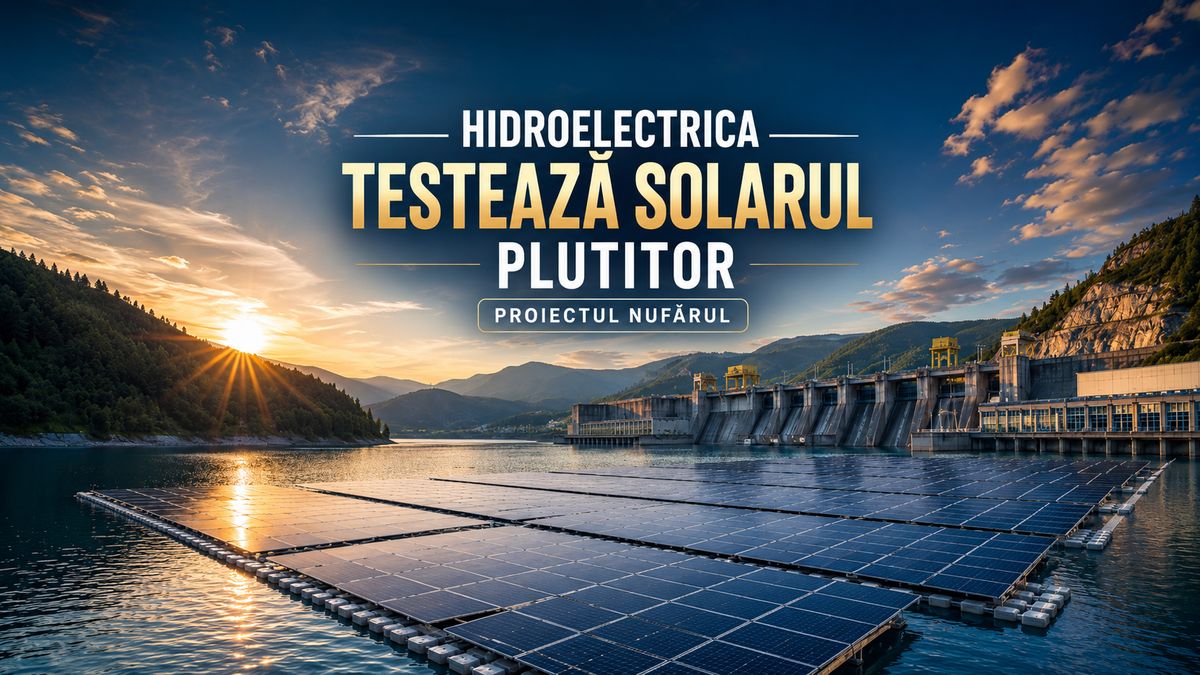
Hidroelectrica transitions from pure hydro to the hydro-solar test Hidroelectrica is entering a new phase of its diversification strategy with the "Nufărul" (Water Lily) pilot project, a floating photovoltaic system with an installed capacity of 10 MW, located in Olt County on the reservoir of the Ipotești Hydropower Plant. The Romanian Energy Regulatory Authority (ANRE) has on its agenda the granting of the establishment authorization for the "Floating photovoltaic panel system – pilot project – CEF Nufărul", marking another important administrative step for Hidroelectrica's first floating solar farm. At first glance, the project may seem modest. The 10 MW capacity will not alter the national energy balance, nor will it significantly change Hidroelectrica's total installed capacity. But size is not the key to this project. Nufărul matters for what it tests: the possibility that the company's reservoirs will no longer serve solely as support for hydro generation, but also as platforms for integrated solar production. Nufărul leverages existing infrastructure, rather than starting from scratch The project has an estimated annual output of approximately 13.4 GWh and features 620 Wp panels, 100 kW inverters, and technical solutions tailored for water-surface installation. Grid connection to the National Power System is planned via four transformer stations connected to the existing substation of the Ipotești Hydropower Plant. This technical detail is essential. The project is not just about placing panels on water, but about leveraging existing hydropower infrastructure: the reservoir, substation, grid connection, power operations, and local technical expertise. This is precisely where it differs from a traditional land-based solar farm. Ground-mounted solar competes for land, grid connection, and local acceptance. Floating solar installed on reservoirs can utilize surfaces already integrated into the energy system, reducing land-use pressure and capitalizing on assets that Hidroelectrica already controls. The contract with WALDEVAR turns the project into an executable test Hidroelectrica has awarded the turnkey contract for the project to WALDEVAR Energy for 39.25 million RON (excluding VAT). The company presented the project as part of its strategy to diversify renewable sources and efficiently utilize existing infrastructure. The previously announced total implementation timeframe is 14 months, with approximately 10 months dedicated to actual construction. These elements show that Nufărul is no longer just a portfolio concept, but a pilot project moving through a concrete sequence of administrative, contractual, and technical steps. For Hidroelectrica, its strategic value lies not in the estimated annual production, but in the accumulated know-how. If the project proves technically, economically, and operationally viable, it could serve as a blueprint for other reservoirs in the company's portfolio. Reservoirs can become dual-purpose energy assets The major shift in perspective is that reservoirs can be viewed not just as water reserves for turbines, but also as platforms for solar generation. In an energy system increasingly dominated by the hourly variability of renewable generation, this combination can yield greater value than the sum of the two technologies individually. Solar generates power during the day, precisely when hydropower plants can reduce water usage, where hydrological and operational conditions permit. Hydropower can then remain available for peak hours, sunless periods, or moments when the grid requires rapid flexibility. This logic does not represent electrical storage in the strict sense. However, it does represent a form of energy optimization: water can be managed more intelligently if solar production covers part of the demand during certain intervals. For a hydro company, this can translate into operational flexibility of growing value in a volatile market. The international context confirms this direction Floating photovoltaics is not a local novelty. The World Bank points out that floating PV systems can expand solar capacity without occupying land, benefit from the cooling effect of water, and reduce evaporation. Combining them with hydropower plants is considered one of the most promising directions for this technology. In its "Where Sun Meets Water" report, the World Bank highlights that co-locating floating solar on hydro reservoirs is particularly attractive where hydropower plants can be operated flexibly: solar can increase the asset's total energy output, while hydropower can help smooth out the variability of solar generation. The European Commission, through the JRC, analyzed the potential of floating PV on 337 hydro reservoirs across the EU, evaluating potential energy yield, evaporation, and water savings. This context shows that Nufărul is not just a company first, but part of a broader European technological trend: hybridizing hydro assets with solar generation.…
Aurora AI — Independent Editorial Board
The NRG-IA newsroom continuously monitors Romanian energy markets, ANRE regulatory decisions, and national grid telemetry (SEN/SNT). We deliver independent intelligence anchored exclusively in official primary data.
Editorial Charter, Ethics & Verification Methodology →