Hidroelectrica targets 10 GW: 2.5 GW renewables & 6 GWh BESS — NRG-IA
Energie Regenerabilă Author: Ioana BuzoaicaHidroelectrica targets 10 GW by adding 2.5 GW of renewables and 6 GWh of storage, reducing water dependence while keeping its flexible hydro advantage.
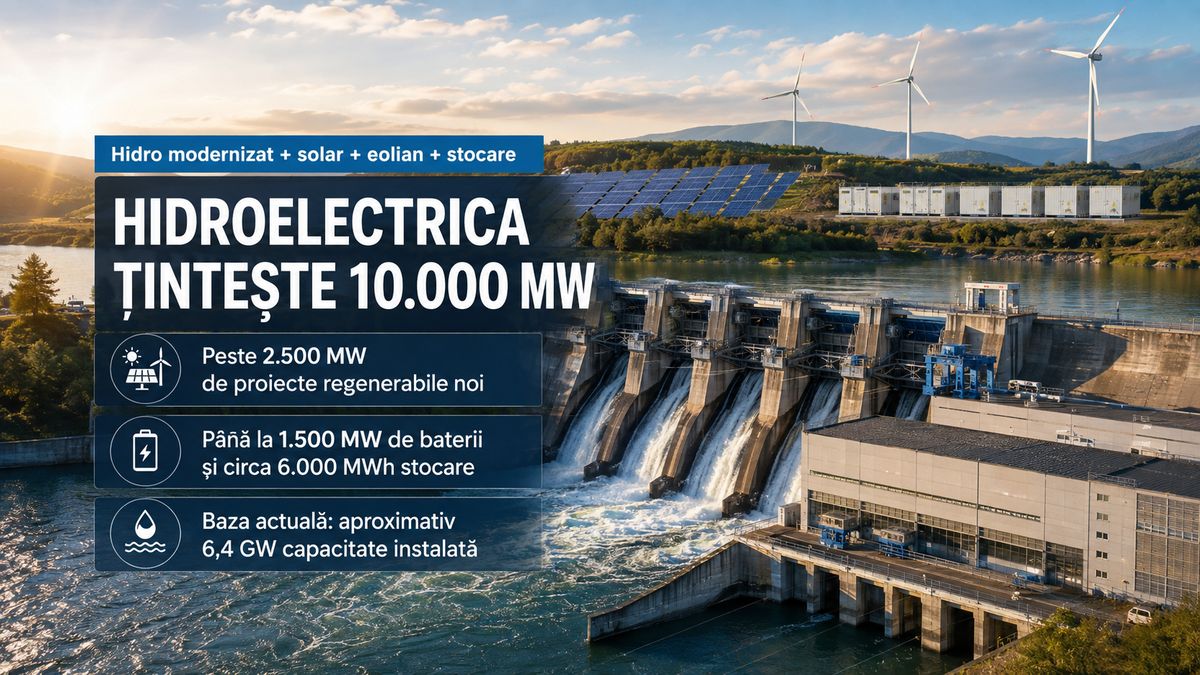
Hidroelectrica starts from approximately 6.4 GW of installed generation capacity and is building its next development phase around a much more ambitious threshold: 10,000 MW . The company operates 188 hydropower and micro-hydro plants, including five pumping stations, with approximately 6.3 GW of installed hydro capacity, plus the 108 MW Crucea wind farm. Bogdan Badea, Management Board Member and Chief Investment Officer, publicly indicated in July that reaching the 10 GW threshold is a key objective of the strategic plan. Arithmetically compared to current generation capacity, the transition to 10 GW requires adding approximately 3.6 GW , equivalent to an increase of about 56%. The exact composition and full timeline of the 10 GW are not yet defined in a public document in a way that allows all megawatts to be mapped to specific projects and deadlines. However, the investment direction became much more concrete following the shareholders' decision on July 30. The 2027–2030 Strategy expands Hidroelectrica beyond its almost exclusively hydro model On July 30, Hidroelectrica's shareholders approved the Ministry of Energy's vision regarding the company's investment strategy. For the 2027–2030 period, the document calls for the development, installation, operation, or acquisition of a portfolio of over 2,500 MW of new renewable projects , which may include hydro—including pumped-storage hydropower plants—onshore wind, and solar PV. In parallel, the strategy plans for the development or acquisition of up to 1,500 MW of BESS systems , with a storage capacity of approximately 6,000 MWh . The refurbishment and modernization of existing hydropower plants complement these two directions. The two units used for batteries describe different metrics: the 1,500 MW indicates the maximum power at which the systems can absorb or deliver electricity, while the 6,000 MWh indicates the energy they can store. Based on the ratio between these two values, the target corresponds to a duration of approximately four hours. Battery power is thus distinct from new generation capacity in hydro, solar, or wind, and cannot be mechanically added to the 2,500 MW to calculate the company's total generation capacity. The transformation has a clear economic and operational logic. Hidroelectrica's first-half report describes the transition from the traditional hydropower-based model to a more balanced structure, where new generation technologies are complemented by storage. The company directly links this diversification to mitigating risks arising from variable hydrological conditions. Old hydropower plants become strategic assets once again through refurbishment The expansion into solar, wind, and batteries does not push hydropower to the margins of Hidroelectrica. On the contrary, modernizing existing plants remains one of the central pillars of the strategy. The Râul Mare–Retezat case demonstrates the scale of the impact that refurbishing an existing asset can have. On May 21, 2026, Hidroelectrica signed the modernization contract for the plant, valued at EUR 188.5 million excluding VAT , with the consortium of Andritz Hydro GmbH and COBRA Instalaciones y Servicios. The investment is designed to recover approximately 135 MW of available capacity by modernizing main equipment and implementing new technological solutions. These are megawatts recovered through refurbishment, not a new 135 MW plant built from scratch. The pipeline of projects in progress also includes refurbishment or modernization projects at Stejaru, Vidraru, and the Petrimanu, Lotru Aval, and Jidoaia pumping stations. This direction continues the 2025 program, when Hidroelectrica made total investments of RON 781 million , 32% above the 2024 level. Of this amount, approximately RON 428 million went toward refurbishment and modernization, RON 208 million toward development projects, and RON 113 million toward capitalized maintenance. However, the value of a modernized hydropower plant exceeds the annual energy it produces. Hidroelectrica is Romania's main provider of ancillary services, and dispatchable hydro capacities can rapidly adjust generation to respond to variations between consumption and generation. As the system integrates more solar and wind, this flexibility becomes a resource distinct from the simple volume of MWh produced in a year. Solar and batteries are already entering the concrete project portfolio Diversification has moved past the declaration stage. On May 25, Hidroelectrica signed the EPC contract for the Tudor Vladimirescu solar PV plant in Brăila County, valued at RON 151.2 million . The project will have an installed capacity of 45.94 MWp and an estimated annual generation of 59.21 GWh. By the end of the first half of the year, the notice to proceed had been issued, and the documentation for the building permit was under preparation. The 8.9 MWp Țara Hațegului solar park had its design and construction contract underway, while the 10 MWp Nufărul…
Ioana Buzoaica — Independent Editorial Board
The NRG-IA newsroom continuously monitors Romanian energy markets, ANRE regulatory decisions, and national grid telemetry (SEN/SNT). We deliver independent intelligence anchored exclusively in official primary data.
Editorial Charter, Ethics & Verification Methodology →