Hydrogen and fresh water from seawater: 250 kW system — NRG-IA
Tehnologie & Inovație Author: Ioana BuzoaicaA 250 kW system produced 48 Nm³/h of hydrogen and 31.6 kg/h of fresh water from seawater by recovering waste heat, offering a solution for coastal areas.
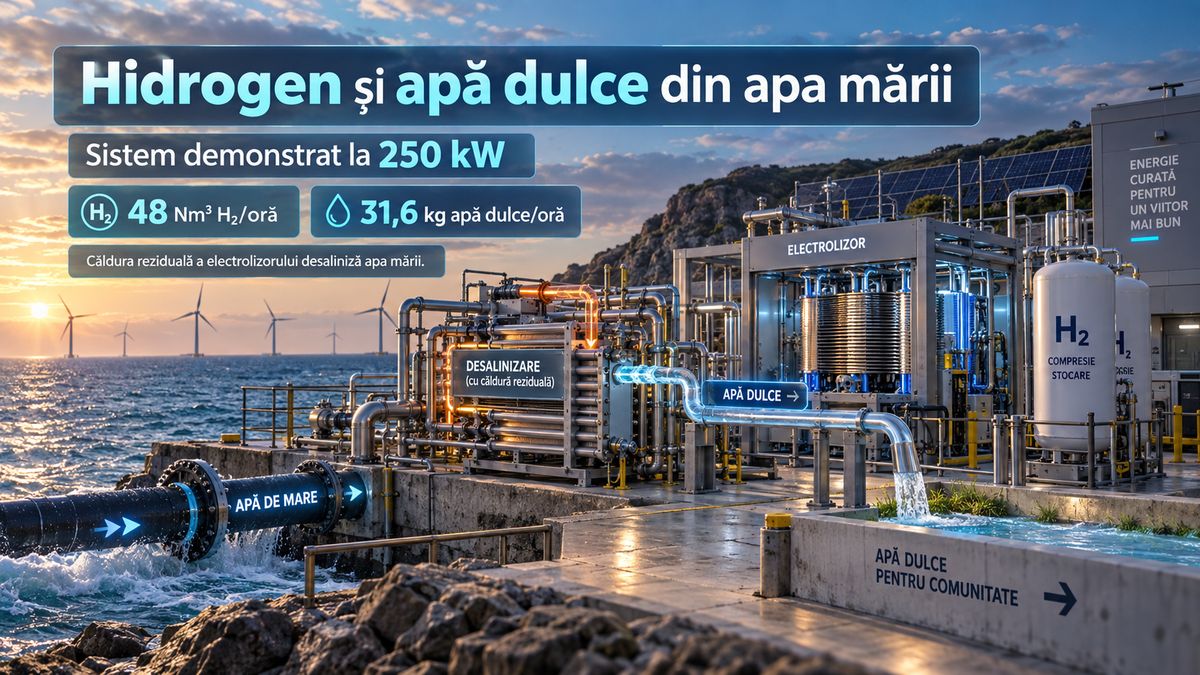
A 250 kW facility has demonstrated that seawater can simultaneously serve as a feedstock for hydrogen production and a source of fresh water, without feeding saltwater directly into the electrolyzer. Developed by researchers at the Dalian Institute of Chemical Physics of the Chinese Academy of Sciences, the system achieved 48 Nm³ of hydrogen per hour and 31.6 kg of fresh water per hour , with the findings published on September 15, 2026, in Nature Energy . The innovation is not a spectacular new type of electrode, but rather how the entire system recovers its energy. Alkaline electrolysis generates heat that, in conventional systems, must be dissipated to maintain operating temperatures. The new architecture uses this waste heat for low-temperature, vacuum distillation of seawater . The resulting fresh water is then fed into the electrolyzer, and the process can also generate water for external use. In practice, the system produces its own water for hydrogen production by utilizing an energy resource that would otherwise be discarded. The electrolyzer turns its own waste heat into a resource Hydrogen production via electrolysis requires electricity and sufficiently pure water. Near the sea, water is virtually unlimited in volume, but its composition makes it difficult to feed directly into an electrolyzer. Chlorides promote unwanted reactions and corrosion, while other salts and minerals can damage system components. The researchers' solution avoids confronting these issues directly. Seawater is first desalinated, and the electrolyzer receives fresh water. The difference from conventional plants lies in the energy source used for this separation. Instead of a separate desalination unit consuming energy to prepare the water, the process—dubbed STHW (seawater to hydrogen and fresh water) —recovers low-grade heat generated during alkaline electrolysis and transfers it to a vacuum distillation system. Lowering the pressure allows water to evaporate at temperatures well below its normal boiling point, making the thermal energy available in the electrolyzer sufficient for the process. The result is an elegant energy integration: the same system produces hydrogen, cools itself, and desalinates seawater . From 20 kW to 250 kW, moving beyond laboratory-scale cells The technology has already moved past multi-watt experiments. Researchers first built a 20 kW industrial pilot system, which achieved an output of 3.8 Nm³ of hydrogen per hour and 1.2 kg of fresh water per hour . According to the study, the system operated stably over a 100-day testing period. Scaling up to 250 kW increased production to 48 Nm³ H₂/h , alongside 31.6 kg/h of fresh water . The Dalian Institute of Chemical Physics reports a hydrogen purity of 99.9999% . The leap from 20 to 250 kW is significant precisely because one of the main hurdles for new energy technologies is translating a laboratory-scale mechanism into an industrial circuit with heat exchangers, pumps, pressure controls, continuous water treatment, and stable output. Here, the principle has been demonstrated in a multi-hundred-kilowatt system. System electrical efficiency increased by 14.4% At the 250 kW configuration, the researchers report a 14.4% improvement in system-level electrical efficiency compared to conventional alkaline electrolysis fed with fresh water. This gain does not mean the electrochemical reaction itself became 14.4% more efficient via a new catalyst. Instead, it results from integrating the entire system and recovering energy that would otherwise be dissipated as heat. This difference is economically vital. In the hydrogen industry, electricity is one of the dominant cost components. Meanwhile, production in water-scarce regions requires additional infrastructure for treatment or desalination. STHW attempts to address both challenges simultaneously, using the waste energy of one process to meet the requirements of the other. The techno-economic analysis published alongside the study indicates higher profitability for the integrated process compared to the traditional configuration where desalination is performed separately prior to electrolysis. While this is an economic modeling result, the 250 kW facility provides the physical demonstration of the process. Water becomes an asset, not just a consumption factor Hydrogen produced via electrolysis is often associated almost exclusively with electricity requirements. However, a large-scale hydrogen industry also requires significant volumes of treated water. In water-scarce areas, using fresh water to produce an industrial fuel can become an economic and social issue. The water needed for the electrolyzer competes with agriculture, industry, and municipal consumption in the very regions that possess exceptional solar resources. The system developed in Dalian changes this dynamic. The feedstock is seawater , and desalination is not an additional energy burden but an integrated part of the electrolyzer's thermal…