Hormuz De Facto Blockade: LNG Piles Up, Brent Tops $90 — NRG-IA
Geopolitică & Energie Author: Ioana BuzoaicaThe Strait of Hormuz remains formally open, but military risk is slashing commercial traffic, turning loaded LNG carriers into floating storage.
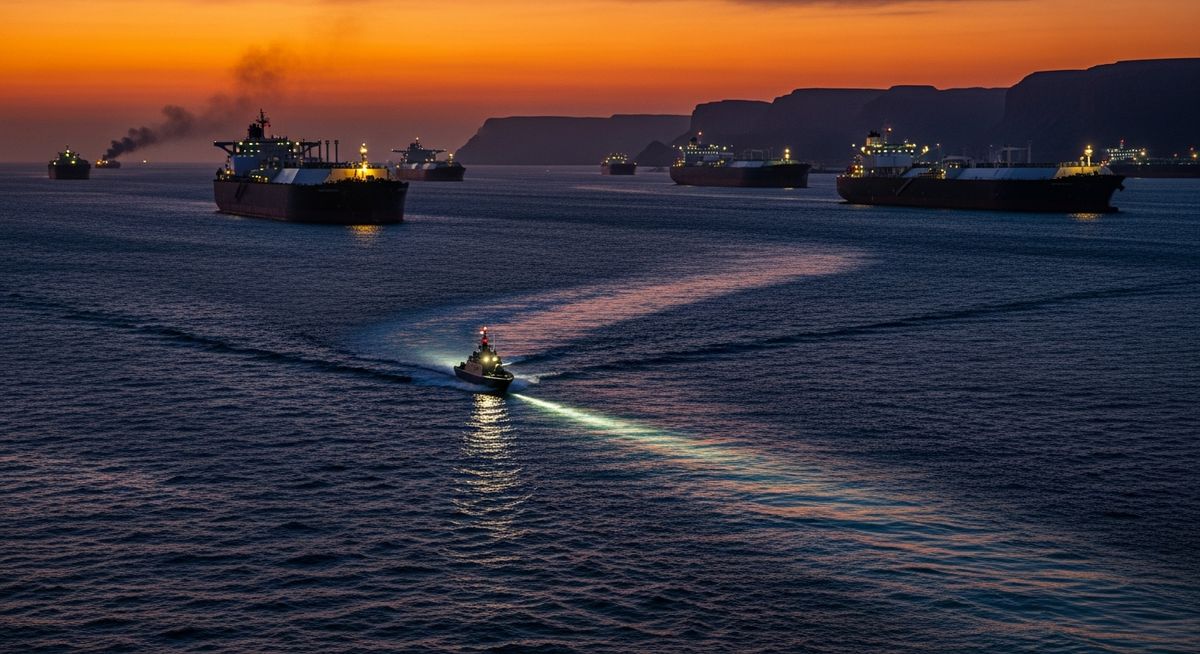
The Strait of Hormuz is not completely closed, but it is once again functioning as a risk-blocked energy corridor. The number of vessels observed transiting the passage fell to four on Sunday, down from eight the previous day, while no liquefied natural gas (LNG) carriers have been spotted passing through the strait since Thursday. Inside the Gulf, LNG production and loading continue, but fewer and fewer vessels are managing to depart. By mid-July, seven loaded Qatari carriers were holding approximately 570,000 tonnes of LNG, while vessels with a total carrying capacity of nearly 1.9 million tonnes were stationed in the region. Meanwhile, Brent crude rose to $90.87 per barrel on Monday morning, its highest level since June 11. These developments demonstrate how an energy artery can be disrupted without the installation of a physical barrier or an absolute halt to navigation. Attacks, threats, contested routes, insurance costs, and risks to crews can reduce traffic enough to render a legally open strait virtually impassable commercially. Formally open, but commercially paralyzed LSEG data shows that only four vessels transited Hormuz on Sunday, compared to eight on Saturday. At least three product tankers and one very large crude carrier (VLCC) entered the strait after Friday to load oil. However, tracking data does not provide an absolute picture. Some vessels turn off their AIS transponders to conceal their position or route, particularly in high-risk military zones. Consequently, the absence of a vessel from commercial monitoring systems does not automatically prove it has not transited. Yet the general trend remains clear. The ten-day moving average of loaded LNG shipments transiting Hormuz fell to 0.2 cargoes per day by July 15, down from approximately 0.8 cargoes per day at the end of June. Only a single LNG cargo was known to have exited the Gulf during the preceding week. The issue is not just the reduced number of transits, but their unpredictability. A shipowner must simultaneously assess the risk of attack, conditions imposed by military authorities, insurance availability, crew safety, and the potential for the vessel to become stranded in the region. Even when passage remains technically possible, the risk can render the voyage commercially unacceptable. Produced LNG turns into floating storage LNG facilities in Qatar and the United Arab Emirates have continued to produce and load vessels at a relatively steady pace, despite the difficulties of exiting the Gulf. The gap between loadings and departures has begun to transform carriers into floating storage. The approximately 570,000 tonnes refers to the LNG estimated to already be loaded onto seven Qatari vessels. The 1.9 million tonnes figure represents the total capacity of LNG carriers positioned in the Gulf, not a confirmed volume of gas fully on board. This capacity is equivalent to about eight days of exports at the typical pre-war peak levels for Qatari and UAE projects. Onboard storage can temporarily absorb the gap between production and exports. However, it is not a sustainable solution. The number of available carriers is limited, and every vessel held up in the Gulf is missing from other segments of the global commercial supply chain. If transit normalizes, the LNG already produced and loaded can return to the market relatively quickly. If the bottleneck persists, floating storage capacity could fill up, loadings may be scaled back, and the disruption would ultimately feed back into production. For LNG, Hormuz has no real substitute Approximately 20% of global LNG trade passed through the Strait of Hormuz in 2024, primarily from Qatar. The UAE contributed smaller volumes, but through the same maritime corridor. About 83% of the LNG transported through the strait was delivered to Asian markets, with China, India, and South Korea together accounting for over half of these flows. The vulnerability of LNG differs from that of oil. Saudi Arabia can reroute a portion of its crude via the East-West pipeline to the Yanbu terminal on the Red Sea, and the UAE possesses infrastructure that allows for exports from outside the strait. While alternative capacities are limited and cannot fully replace Hormuz, they do offer some degree of flexibility. Qatar has no comparable route for its LNG exports. The gas is liquefied at facilities in Ras Laffan, loaded onto vessels, and must transit the strait to reach international buyers. For these volumes, bypassing Hormuz is not a matter of choosing a longer maritime route, but a geographical impossibility. The International Energy Agency estimates that each month without LNG transits through the strait could remove approximately 10 billion cubic meters from the global market's available supply. While the effects could be mitigated by new liquefaction capacity outside of Qatar, they cannot be absorbed without price and consumption adjustments. Oil breaks past $90 in a still-fragile market Brent crude futures…