Oil Nears $100 Amid Hormuz Restrictions and US-Iran Tensions — NRG-IA
Geopolitică & Energie Author: Ioana BuzoaicaRather than a total shutdown, the oil market is pricing in the gradual decay of Hormuz. As Iran restricts vessels, Brent rallies toward $100/bbl.
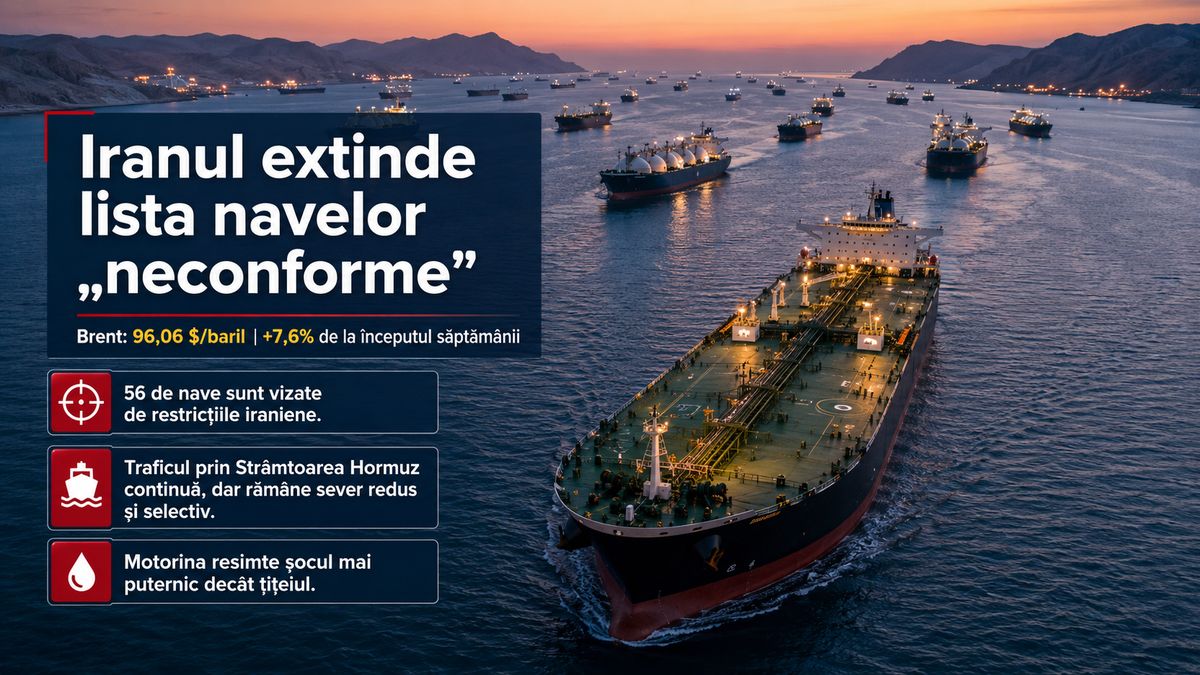
Oil is heading for its strongest weekly gain since July, but the price action tells only part of the story. On the morning of September 4, Brent was trading at around $96.06/barrel , up 0.6% on the session and 7.6% since the start of the week , while WTI had reached $92.10/barrel , a weekly gain of 10.4% . However, what is driving the market upward is not a complete shutdown of the Strait of Hormuz. Vessels continue to transit. Instead, the risk has shifted to a more complex, harder-to-manage territory: traffic is heavily reduced, shipping attacks have returned, and Iran is attempting to selectively dictate which vessels can use the route and under what conditions. Tehran has expanded its list of "non-compliant" vessels, as designated by the Persian Gulf Strait Authority, from 45 to 56 vessels . The list includes Very Large Crude Carriers (VLCCs), LNG and LPG carriers, and product tankers. According to rules announced by the Iranian side, these vessels could face fines, cargo seizure, or detention if they attempt to cross. The impact is already moving beyond political rhetoric. Reuters reported that several Indian refiners and a major global energy company plan to avoid vessels on the Iranian blacklist due to security concerns. Hormuz is becoming an increasingly selective route The current situation changes the nature of the risk in the strait. In a classic scenario, the market focused on a simple question: is Hormuz open or closed? The reality of recent weeks has become far more fragmented. Iraq provides one of the clearest examples. Its oil exports rose from approximately 1.35 million barrels/day in July to 2.34 million barrels/day in August , supported in part by Iran allowing certain Iraqi tankers to pass through Hormuz. Thus, flows are not disappearing uniformly. Some vessels continue to transit, others are avoided by operators, and certain cargoes benefit from specific clearances. For the oil market, this means risk can no longer be measured solely through a binary scenario of a total blockade. Tracking data confirms that traffic is severely restricted. According to Kpler, six commercial cargo vessels transited the strait on Wednesday, September 2, following 11 the previous day, compared to a ten-day average of about 13 vessels in the same dataset. These figures are preliminary, as some vessels turn off their AIS transponders during transit. Prior to the conflict, Reuters estimated that roughly 130–140 vessels of all types crossed Hormuz daily. While the two datasets are not directly comparable methodologically, the discrepancy highlights how severely the normal functioning of the corridor has deteriorated. The strait is not completely blocked, but it is far from normal commercial operations. A fifth of global oil consumption used to pass through this strait The scale of the risk only becomes clear when measured against the role of Hormuz in the global energy system. In the first half of 2025, an average of 20.9 million barrels/day of oil and other petroleum liquids flowed through the strait, according to the EIA. This volume was equivalent to roughly 20% of global petroleum liquids consumption and nearly a quarter of globally seaborne-traded oil. Of this total, approximately 14.7 million b/d was crude oil and condensate, and another 6.1 million b/d consisted of petroleum products. Physical alternatives are far smaller than the normal flow through the strait. Saudi Arabia's East-West pipeline and the Abu Dhabi pipeline to Fujairah offer a combined bypass capacity of about 4.7 million barrels/day . Even if fully utilized, they can only absorb a fraction of the volumes that normally transit Hormuz. The risk also extends beyond oil. In the first half of 2025, approximately 11.4 billion cubic feet/day of LNG passed through the same strait, accounting for over 20% of global liquefied natural gas trade. Further deterioration in navigation would therefore not just impact a single commodity, but simultaneously hit crude oil, refined products, and a major portion of the global LNG market. Shipping attacks have brought the risk premium back into prices The latest oil rally follows a resurgence of military confrontations between the US and Iran. US strikes targeted Iranian assets once again, and this week's exchanges were the most intense since July. In parallel, the security of commercial vessels has deteriorated. Two supertankers carrying Saudi crude were hit by projectiles while exiting Hormuz on the night of August 31. In the case of the vessel Sidr, operated by Saudi shipping company Bahri, the company later confirmed the deaths of two Filipino seafarers. Meanwhile, Washington has directly linked shipping security to diplomatic prospects. US Vice President JD Vance stated on September 3 that the US does not intend to negotiate with Iran as long as attacks on commercial vessels continue. Safe passage through the Gulf has thus become a core condition for any potential de-escalation, rather than just a…
Ioana Buzoaica — Independent Editorial Board
The NRG-IA newsroom continuously monitors Romanian energy markets, ANRE regulatory decisions, and national grid telemetry (SEN/SNT). We deliver independent intelligence anchored exclusively in official primary data.
Editorial Charter, Ethics & Verification Methodology →