Hormuz Disruption: Asian Refiners Buy US & African Crude — NRG-IA
Piața de Energie Author: Ioana BuzoaicaThe Hormuz disruption is reshaping global supply. Asian refiners are buying US and West African crude, while Gulf producers turn to alternative routes.
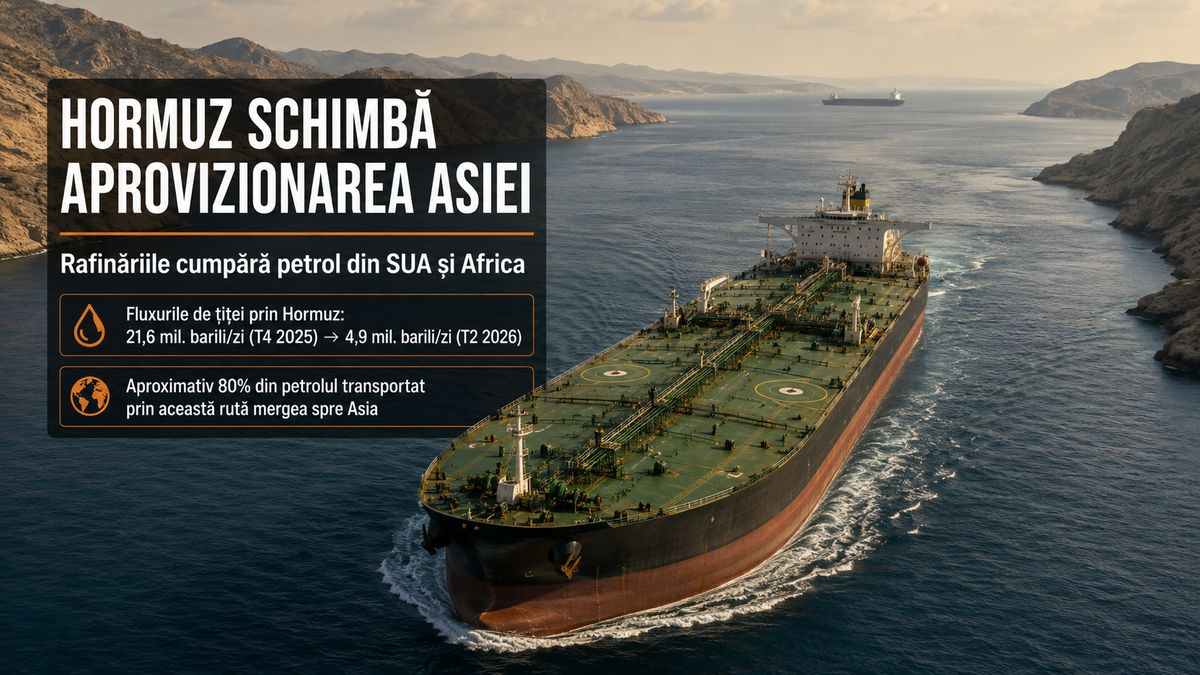
The Strait of Hormuz has entered a new phase of the oil crisis. On Friday, August 14, Kpler data cited by Reuters showed no visible crude oil shipments crossing the strait, with only two vessels of other types making the passage. At the same time, some of Asia's largest refiners are already purchasing US and West African crude for the coming months, replacing a portion of the barrels they would normally source from the Gulf. The shift runs deeper than just another move in Brent prices. Military risk has spilled over into the physical logistics of the market: vessels are being attacked, shipping capacity is harder to secure, costs are rising, exporters are using alternative routes, and buyers are seeking alternative origins for their raw material. However, tracking data must be read precisely. The absence of visible crude shipments in Kpler does not prove that not a single barrel crossed Hormuz. Some vessels may sail with their Automatic Identification System (AIS) turned off. What can be stated with certainty is that observable activity has once again dropped to an extremely low level. Asia is already buying non-Gulf barrels The reaction of refiners is turning the disruption of traffic into a concrete commercial shift. South Korea's GS Caltex purchased two million barrels of Mars, a US Gulf of Mexico grade, from Shell for November delivery. According to traders cited by Reuters, the transaction was concluded at a premium of approximately $13–$14 per barrel over the October Dubai benchmark. Japan's Cosmo Energy also purchased Mars from Trafigura, while Eneos, Japan's largest refiner, contracted two million barrels of WTI for November. Taiwan's CPC bought another two million barrels of WTI and added West African crude. In India, Hindustan Petroleum and Mangalore Refinery and Petrochemicals have launched new supply tenders. These transactions are significant precisely because they are not hypothetical scenarios of what refiners might do if the Hormuz issue persists. These are purchases being made right now to secure feedstock for the coming months. Kpler estimated that Asian imports of US crude rose to a record of approximately 2.35 million barrels per day in July. In a market where route security is becoming as crucial as the price of the grade, the Atlantic basin is capturing a portion of the demand that would normally go to Gulf producers. The world's most vital oil artery is operating at a fraction of its former level The scale of the shift becomes clear in the structural data. According to the Energy Information Administration, approximately 21.6 million barrels per day of oil and other petroleum liquids flowed through Hormuz in the fourth quarter of 2025. By the second quarter of 2026, the average had plummeted to just 4.9 million barrels per day. This represents a reduction of approximately 77%. The International Energy Agency indicates that, prior to the conflict, nearly a quarter of the world's seaborne oil trade passed through the strait. Approximately 80% of the oil and petroleum products transported along this route were destined for Asia, with China and India together receiving 44% of the crude and condensate volumes. This Asian exposure explains the speed with which refiners are now seeking alternatives. For Japan, South Korea, China, or India, Hormuz is not a distant geopolitical risk, but the critical infrastructure through which an essential portion of the fuel needed for their economies arrives. Bypass pipelines recover only a fraction of the volumes Some Gulf oil can exit via alternative routes, but the bypass capacity is far smaller than the historical flows through the strait. Saudi Arabia uses the East-West pipeline, also known as Petroline, to transport crude to Yanbu on the Red Sea. The effect is already visible in the statistics: the EIA estimates that oil flows through Bab el-Mandeb rose from 5.4 million barrels per day in the final quarter of 2025 to 8.1 million barrels per day in the second quarter of 2026. The United Arab Emirates can utilize the Abu Dhabi–Fujairah pipeline to bypass Hormuz. However, the IEA estimates that Saudi Arabia and the UAE combined have only about 3.5 to 5.5 million barrels per day of available capacity to bypass the strait. The gap compared to the more than 20 million barrels per day that crossed the route prior to the conflict is immense. Iraq, Kuwait, Qatar, Bahrain, and Iran have far fewer options to bring their exports to the global market without Hormuz. While bypass capacity mitigates the shock, it cannot fully substitute for the strait. Exporters are also changing how they ship oil The reconfiguration is not just happening in the portfolios of Asian buyers. During the conflict, ADNOC has adapted both its marketing and shipping of crude, utilizing shuttle operations and ship-to-ship transfers to move cargoes through the high-risk zone. The company has sold tens of millions of barrels through spot tenders since June, at a time when logistical…
Ioana Buzoaica — Independent Editorial Board
The NRG-IA newsroom continuously monitors Romanian energy markets, ANRE regulatory decisions, and national grid telemetry (SEN/SNT). We deliver independent intelligence anchored exclusively in official primary data.
Editorial Charter, Ethics & Verification Methodology →