Hormuz, US-Iran Deal & $90+ Oil: Crisis Shifts to Refineries — NRG-IA
Geopolitică & Energie Author: Ioana BuzoaicaBrent trades near $92/bbl as the US-Iran deal expires. With Hormuz traffic disrupted, a global refining crisis is making diesel tighter than crude.
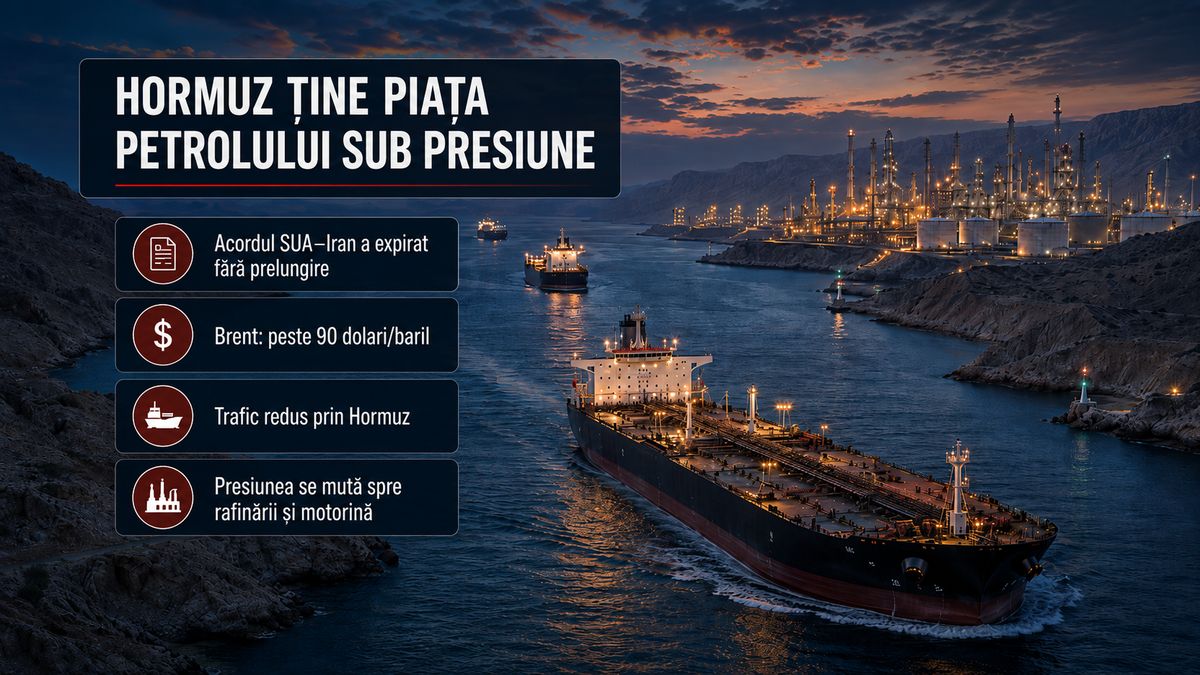
The interim agreement between the United States and Iran has concluded its 60-day window without an extension, negotiations to halt the war are stalled, and the Strait of Hormuz remains severely disrupted. On the morning of August 20, Brent crude for October delivery was trading at around $91.87 per barrel, following four consecutive sessions of gains and reaching its highest level since July 24. The market is no longer pricing in just the risk of a one-off incident in the Gulf, but rather the possibility that the ongoing disruption of one of the world's most critical energy transit routes will persist. Tracking data from Kpler highlights the stark disconnect between political rhetoric and the actual flow of goods. On Wednesday, August 19, only nine commercial cargo vessel transits were identified through Hormuz, matching the previous day's figure. While some ships may be sailing with transponders turned off and are thus missing from the statistics, observable traffic remains well below pre-war levels. The June agreement expired without a new deal The deal signed in June was intended to provide Washington and Tehran with a maximum 60-day window to negotiate a broader solution regarding the war, the nuclear dossier, and sanctions. The deadline expired on August 17, and the Trump administration explicitly ruled out extending the interim agreement. Iran has taken a different stance: its officials argue that the United States must first return to compliance with the memorandum and that no negotiations regarding its extension have taken place. Donald Trump stated on August 18 that there are no ongoing or scheduled negotiations with Iran. Tehran, conversely, maintains that the Strait of Hormuz remains closed and conditions any normalization of the situation on Washington's compliance with the interim agreement. The two sides no longer differ merely on the terms of peace, but also on the status of the very agreement meant to pave the way for it. The diplomatic impasse also carries a military dimension. A senior Iranian official told Reuters that Iran will shift to a "fully offensive" military posture following the failure of negotiations for a permanent ceasefire. Meanwhile, Washington asserts that Hormuz is open, while Tehran claims the route remains closed. For the energy market, however, the verdict does not come from statements, but from the actual number of vessels returning to the corridor. Hormuz is starting to be priced in as a prolonged crisis Brent closed the August 17 session at $90.87 per barrel, up 2.65% from the previous level, amid fading hopes for a diplomatic solution. By August 20, the October contract stood at $91.87 per barrel. This movement is significant precisely because oil remains well below the peaks reached during the most tense phases of the war, yet refuses to return to pre-conflict levels. The IEA describes a market where the effects of the Hormuz disruption have become structural. In its August report, the agency estimates that global oil production in July was 6.3 million barrels per day (bpd) below the level of a year ago, while approximately 8.3 million bpd of Gulf production remained offline. Regional exports, including those routed to bypass Hormuz, fell to around 15 million bpd after the strategic passage once again became virtually inaccessible to a significant portion of commercial traffic. Inventories have absorbed some of the shock, but the buffer is thinning. The IEA estimates that observed global oil inventories fell by 69 million barrels in July alone, and by approximately 410 million barrels since the start of the war. For the third quarter, the agency projects a global supply deficit of around 1.8 million bpd, more than double its estimate from the previous month. A second crisis is taking shape in refineries The disruption of Hormuz no longer affects only access to crude oil. It is also reducing the availability of refined petroleum products, and this segment of the market has become tighter than the raw material itself. Global refineries processed approximately 80.9 million barrels of crude oil per day in July, nearly 5 million bpd less than in the same month of 2025. The IEA estimates that global refinery throughput will fall by an average of 2.5 million bpd in 2026. Disruptions to Middle Eastern exports and attacks on Russian refineries have prompted the agency to further cut its third-quarter forecast by 370,000 bpd. The consequence is visible in the trade of refined products. Seaborne volumes of petroleum products fell in July by approximately 3.8 million bpd compared to the previous year. Diesel exports from Russia, the Middle East, and Asia were down by about 1.3 million bpd, equivalent to roughly 20% of global seaborne diesel trade. For jet fuel, the reduction of around 670,000 bpd represents about 34% of global seaborne trade for this product. The difference from a classic crude supply crisis is fundamental. A barrel of crude can, within certain limits, be…
Ioana Buzoaica — Independent Editorial Board
The NRG-IA newsroom continuously monitors Romanian energy markets, ANRE regulatory decisions, and national grid telemetry (SEN/SNT). We deliver independent intelligence anchored exclusively in official primary data.
Editorial Charter, Ethics & Verification Methodology →