Romania Power Prices Top RON 1,100/MWh on Outages — NRG-IA
Piața de Energie Author: Ioana BuzoaicaRomania faces its third straight day of high day-ahead power prices due to offline nuclear capacity, drought-hit hydro, and costly regional imports.
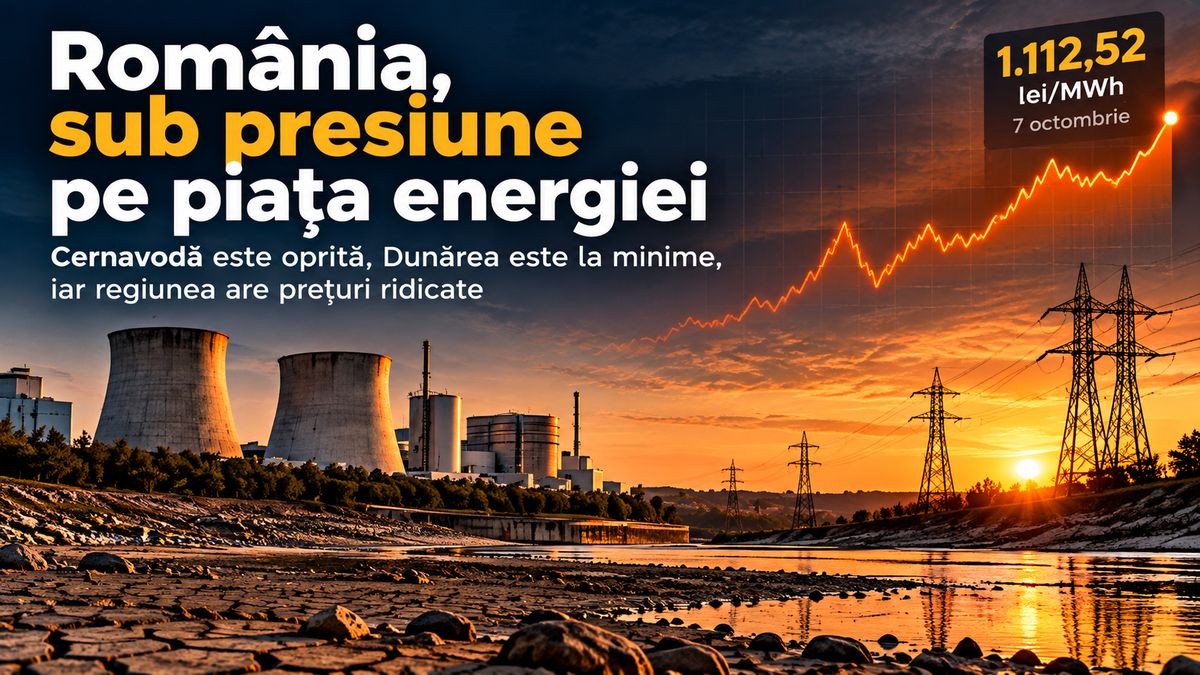
The average electricity price for October 7 stands at RON 1,112.52/MWh on Romania's day-ahead market, with peak-hour prices climbing past RON 1,500/MWh . This is no isolated spike. Romania has been grappling with exceptionally high prices for three consecutive days, at a time when two of its primary domestic generation sources—nuclear and hydropower—are severely constrained. OPCOM data for October 7 shows a baseload price of RON 1,112.52/MWh , a traded volume of 38,875 MWh , and a peak of RON 1,545.38/MWh during one of the evening's 15-minute intervals. For comparison, the weighted average market price for the entire month of September was RON 917.36/MWh . The October 7 level is thus roughly 21% above this monthly benchmark, even though the two indicators are calculated differently. Prices Have Remained Above €200/MWh for Three Days The issue is not that October 7 marks a new record. On the contrary, the average price is lower than in the previous two days. However, European market data reveals a clear shift compared to the beginning of the month: Romania went from around €155/MWh on October 3 and €161/MWh on October 4 to €227/MWh on October 5 , €223/MWh on October 6 , and approximately €209/MWh on October 7 . In other words, this is no longer about a few expensive hours in a single evening, but rather several consecutive days where the Romanian market is operating above €200/MWh. This surge comes at a time when the domestic generation mix is unusually vulnerable. Romania Has Lost Around 1,400 MW of Nuclear Generation The two reactors at Cernavodă have an installed capacity of approximately 700 MW each and typically provide near-continuous baseload power to the grid. Unit 1 was shut down in late July due to extremely low Danube water levels, and Unit 2 underwent a controlled shutdown on the morning of August 13 for the same reason. On October 6, following a meeting of the Energy Command, State Secretary in the Ministry of Energy Cristian Bușoi confirmed that both reactors remain offline and that the hydrological outlook for the next ten days remains unfavorable. According to him, Danube water inflows at the border are projected to hover near historic lows, and water levels at Cernavodă have continued to drop. In a market where peak demand can climb toward 7,000–8,000 MW, the absence of roughly 1,400 MW of constant nuclear capacity severely disrupts the balance between domestic generation and power demand. While Cernavodă alone does not explain the price levels, its absence removes one of the most stable and cost-effective generation sources normally available to Romania. Drought Also Hits Hydropower The same water scarcity that forced the nuclear reactors offline is also impacting hydropower plants. Authorities warned as early as summer that the Danube had dropped to unprecedented historical lows, and the situation has persisted far longer than initially estimated. On October 6, the Ministry of Energy confirmed that extremely low river flows are also significantly curtailing hydro generation. Hydropower plays a crucial role not only in terms of volume but also because of its ability to respond rapidly to demand spikes or drops in wind and solar output. It is precisely this flexibility that becomes critical during evening hours. On October 7, the highest prices emerge after solar generation drops off, with the market reaching RON 1,545.38/MWh during the evening peak. During these hours, the system must rely more heavily on hydropower, gas- and coal-fired plants, wind generation (if resources allow), and imports. Romania Has Begun Importing More Electricity Than It Generates The scale of the imbalance became starkly visible on the evening of October 3. Around peak demand, domestic generation had fallen to approximately 2,900 MW , while imports neared 3,400 MW . For a brief period, Romania was importing more electricity than it was generating domestically. This situation unfolded as solar output faded at dusk, wind generation was minimal, and both hydro and coal-fired plants were generating under 1,000 MW each. Imports are the standard mechanism through which interconnected European markets cover generation deficits. The challenge arises when Romania requires massive volumes at a time when neighboring states also lack cheap power. High Power Prices Are Not Just a Romanian Issue For October 7, Romania's average price is around €209/MWh . Hungary stands at approximately €211/MWh , Serbia is near €198/MWh , and Bulgaria is also hovering around the €200/MWh threshold. This regional context is essential to understanding Romanian prices. Imports are not coming from areas where electricity costs €70 or €80/MWh. Romania is trying to cover its deficit in a region that is itself experiencing a high-price episode. Interconnection ensures access to power and mitigates the risk of domestic shortages turning into supply disruptions, but it does not guarantee cheap energy. When multiple regional markets simultaneously…
Ioana Buzoaica — Independent Editorial Board
The NRG-IA newsroom continuously monitors Romanian energy markets, ANRE regulatory decisions, and national grid telemetry (SEN/SNT). We deliver independent intelligence anchored exclusively in official primary data.
Editorial Charter, Ethics & Verification Methodology →