Industry Urges ANRE to Cut Battery Guarantees to €5k/MW — NRG-IA
Legislație & Reglementări Author: Ioana BuzoiacaRenewable groups urge ANRE to cut standalone battery guarantees from €30k to €5k/MW to free up capital and accelerate Romania's 1 GW+ storage market.
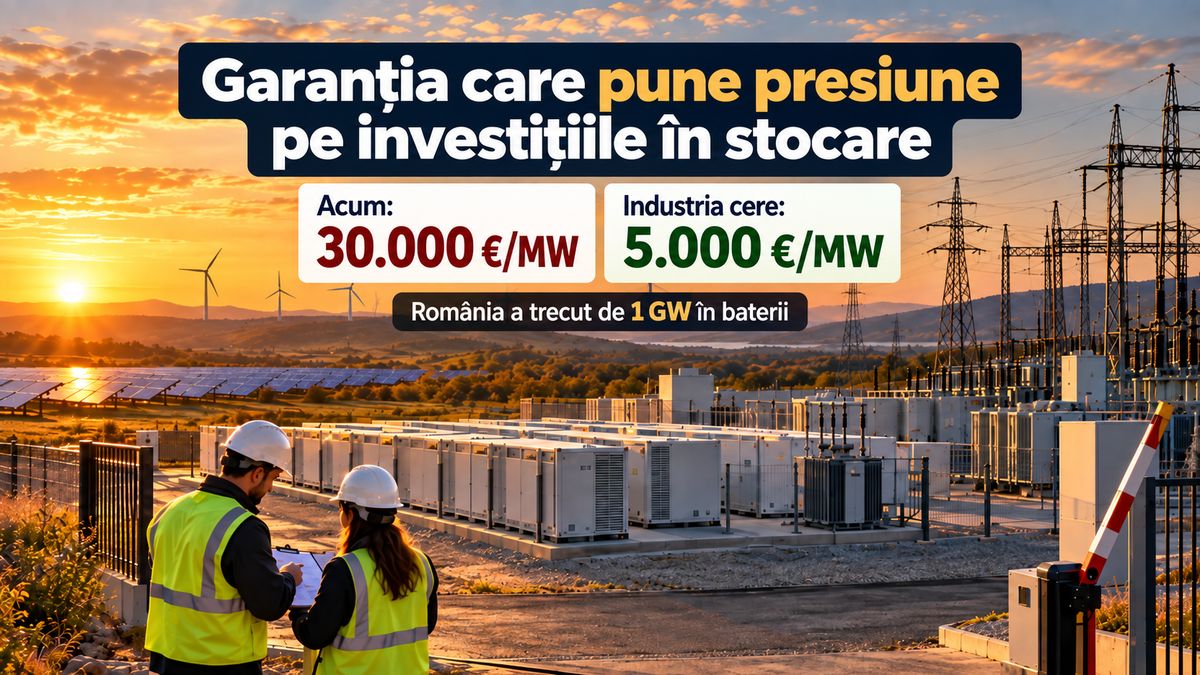
Industry Demands Guarantee Reduction from €30,000 to €5,000/MW RWEA and RPIA, two of Romania's leading renewable energy industry associations, have called on the energy regulator (ANRE) to amend the financial guarantee required for standalone energy storage projects. The proposal aims to reduce the amount from €30/kW to €5/kW , translating to a drop from €30,000 to €5,000 per installed MW —a sixfold reduction. The request primarily targets standalone battery storage facilities that are not co-located or developed alongside solar, wind, or other generation capacities. The industry is not seeking to eliminate the guarantee entirely; the proposal maintains a financial filter for investors, but at a level deemed more appropriate for the specific economics of storage projects. What the €30,000/MW Guarantee Means in Practice The guarantee was introduced by ANRE in 2026 for projects applying for an establishment authorization. Set at €30/kW of installed capacity (equivalent to €30,000/MW), the guarantee must be maintained until the works are officially commissioned. Crucially, this sum is not a permanent fee paid to ANRE. It can be established via bank guarantee letters, instruments issued by financial institutions or insurance companies, or by depositing cash into a designated regulatory account. However, the financial impact on developers is substantial: projects require capital, collateral, or additional bonding capacity throughout the development phase. For a 100 MW project, the current rate translates to a €3 million guarantee. If the industry's proposal is accepted, this would drop to €500,000 . For a 500 MW project, the gap widens from €15 million to €2.5 million . For large-scale developments, this is no longer a minor administrative detail, but a matter of millions of euros in financial capacity. ANRE Introduced Guarantees to Weed Out Speculative Projects The regulator's rationale, however, is compelling. In recent years, the Romanian market has faced a massive influx of energy projects that reserved grid capacity or advanced through the permitting process without ever reaching construction. This phenomenon artificially blocks available grid capacity and hinders projects that are fully funded and ready for execution. In 2026, ANRE introduced several financial filters specifically to separate viable projects from speculative ones. In addition to the establishment authorization guarantee, the current framework includes guarantees related to grid connection and the grid capacity allocation mechanism. However, these instruments serve different purposes and should not be conflated. The €30,000/MW guarantee currently under review is strictly tied to project authorization. Industry Argues Batteries Require a Different Approach RWEA and RPIA argue that batteries operate under a fundamentally different economic model compared to power plants. While a power plant generates electricity from a primary source, a battery draws power from the grid, stores it, and discharges it later—primarily during peak demand and high-price periods, or when the grid requires balancing. The revenue of such projects depends on hourly price spreads, balancing services, and other ancillary services the battery can provide to the system. The industry contends that applying the same €30,000/MW guarantee to batteries ties up a disproportionate amount of capital relative to the economic profile of these investments. In this view, the proposed €5,000/MW threshold would still serve as an effective barrier against non-viable projects while significantly easing the financial burden on developers. Co-located Batteries May Face Different Rules There is also a key distinction between project configurations. Under the draft procedure released for public consultation by ANRE, storage facilities added to existing generation assets may receive different treatment when sharing the same production or consumption site. The logic is that for a project that already includes a power plant and has an active guarantee, imposing an additional full guarantee for the co-located battery would create an unnecessary double financial barrier. The industry's current petition primarily concerns standalone batteries , which are developed independently and connect directly to the grid. For these, the industry proposes keeping the guarantee requirement but lowering it to €5,000/MW. Romania Has Already Surpassed 1 GW of Installed Battery Capacity This debate comes at a time when storage is one of the fastest-growing segments in the Romanian energy system. By early October 2026, Romania had approximately 1,162 MW of installed battery capacity and around 2,312 MWh of storage capacity , according to Transelectrica data cited in the financial press. The distinction between these two metrics is key: MW represents the power output batteries can deliver at any given moment, while MWh represents the total energy they can store. This growth has been remarkably rapid. In March 2025,…
Ioana Buzoiaca — Independent Editorial Board
The NRG-IA newsroom continuously monitors Romanian energy markets, ANRE regulatory decisions, and national grid telemetry (SEN/SNT). We deliver independent intelligence anchored exclusively in official primary data.
Editorial Charter, Ethics & Verification Methodology →