Romania Opens Green House Batteries with Up to RON 15k Grant — NRG-IA
Ghid Consumator Author: Ioana BuzoaicaRomania launches its battery subsidy program on Nov 20 with grants up to RON 15k, as official data shows 394,868 prosumers with 4,390 MW installed.
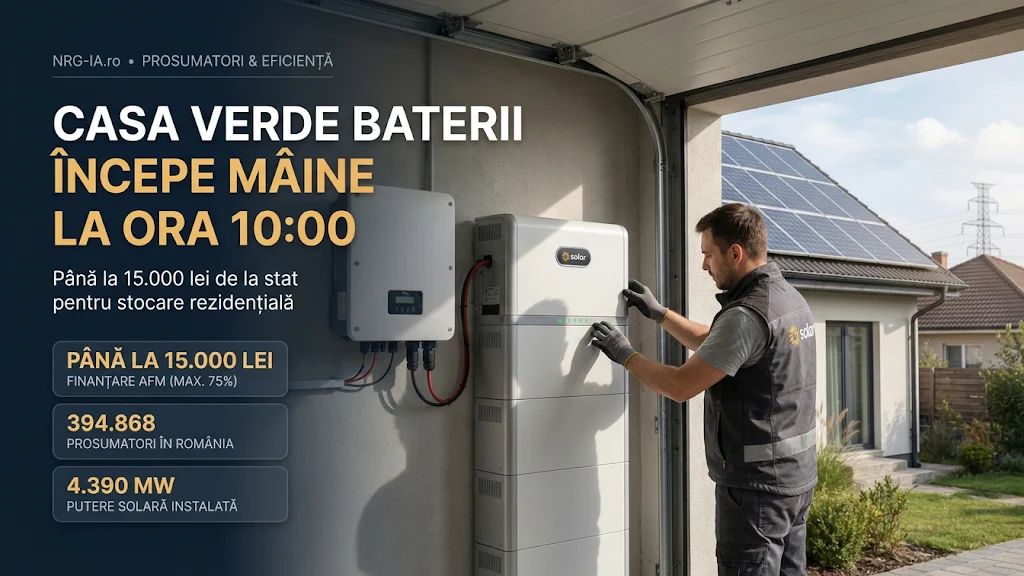
Romania's Environment Fund Administration (AFM) is opening the official application window for individuals under the "Green House Batteries" program tomorrow, November 20, 2026, at 10:00 AM. The scheme offers state subsidies covering up to 75% of residential energy storage investments, capped at RON 15,000 per beneficiary. Applications remain open until November 25, 2026, at 11:59 PM. The launch coincides with the latest figures released by the National Energy Regulatory Authority (ANRE), confirming that Romania has reached 394,868 grid-connected prosumers. Aggregated ANRE data indicates that the cumulative installed capacity of small-scale energy producers has reached 4,389.69 MW—a nominal capacity equivalent to more than six nuclear reactors the size of those at Cernavodă. The expansion pace remains rapid even toward year-end, recording a surge of 9,077 new prosumers in a single month, as rooftop photovoltaic installations across residential households and businesses have become the most dynamic investment segment in the Romanian energy sector. The immediate focus of the AFM call addresses the substantial gap between total solar PV installations and deployed battery storage capacity. Of the 394,868 officially registered prosumers, 156,548 already own storage systems—following a monthly addition of 5,508 units. This leaves a pool of 238,320 existing battery-less prosumers who are directly incentivized to boost self-consumption rather than depending entirely on injecting surplus power back into the public grid. New AFM scoring criteria lowers maximum capacity threshold to 15 kWh and rewards co-financing Unlike traditional application rounds awarded purely based on document upload speed in the opening seconds, selection under "Green House Batteries" operates over a six-day open window—from November 20, 10:00 AM, to November 25, 11:59 PM—where eligible files are ranked using a technical and financial scoring system. In the final version of the funding guidelines, authorities adjusted evaluation parameters so that systems realistically sized for an average household can achieve the maximum score under technical criteria. The threshold required to score the maximum 40 points for storage capacity was lowered from 20 kWh to 15 kWh. This adjustment removes artificial pressure on applicants to purchase oversized packages merely to stay competitive in the rankings. It also aligns the maximum RON 15,000 grant with current market prices for residential lithium iron phosphate (LFP) modules, where a 15 kWh capacity fully covers the evening and overnight power needs of an average household. The second decisive pillar for ranking is the co-financing committed by the beneficiary beyond the mandatory 25% minimum threshold of eligible investment value, a criterion that can add up to 35 extra points in the evaluation. This mechanism turns selection into a financial optimization exercise for households: an applicant selecting a storage capacity of at least 15 kWh secures 40 technical points, while increasing their out-of-pocket contribution above the minimum required percentage becomes the primary leverage tool to improve selection odds within the overall allocated budget without losing the non-reimbursable ceiling if total system costs are higher. Why battery storage redefines billing economics for unbuffered prosumers The high demand for adding batteries to existing PV installations stems directly from the physical and financial realities of self-consumption. A solar PV system without storage generates peak power around noon—precisely when household consumption is low—and injects surplus generation into the distribution grid at the raw active energy price, excluding grid fees and taxes. In the evening, when residents return home and power up household appliances or heating systems, the household draws electricity from the grid or settles through quantitative/financial net metering rules, remaining exposed to regulated tariffs and delayed settlement cycles. Furthermore, in residential neighborhoods and suburban districts where hundreds of prosumers feed solar power simultaneously into low-voltage grids on sunny days, local voltage levels frequently reach the upper threshold of 253 volts, triggering automatic inverter disconnections to protect grid equipment. During those hours, unbuffered prosumers lose free power generation despite clear skies, whereas a battery-equipped system routes surplus generation straight into localized energy storage, keeping the inverter online while safeguarding household appliances against unexpected blackouts. The fact that 5,508 prosumers installed batteries in a single month ahead of the AFM program launch underscores that storage economics are becoming commercially viable in their own right, driven by falling global battery cell prices. State subsidies of up to RON 15,000 further compress payback periods to just a few years, effectively turning daytime solar power into evening electricity at…
Ioana Buzoaica — Independent Editorial Board
The NRG-IA newsroom continuously monitors Romanian energy markets, ANRE regulatory decisions, and national grid telemetry (SEN/SNT). We deliver independent intelligence anchored exclusively in official primary data.
Editorial Charter, Ethics & Verification Methodology →