Kuwait oil facility hit, Yanbu alert: Risk extends beyond Hormuz — NRG-IA
Geopolitică & Energie Author: Ioana BuzoaicaThe US-Iran conflict no longer just threatens Hormuz. Strikes on Kuwaiti energy assets and the Yanbu alert extend risk to onshore bypass infrastructure.
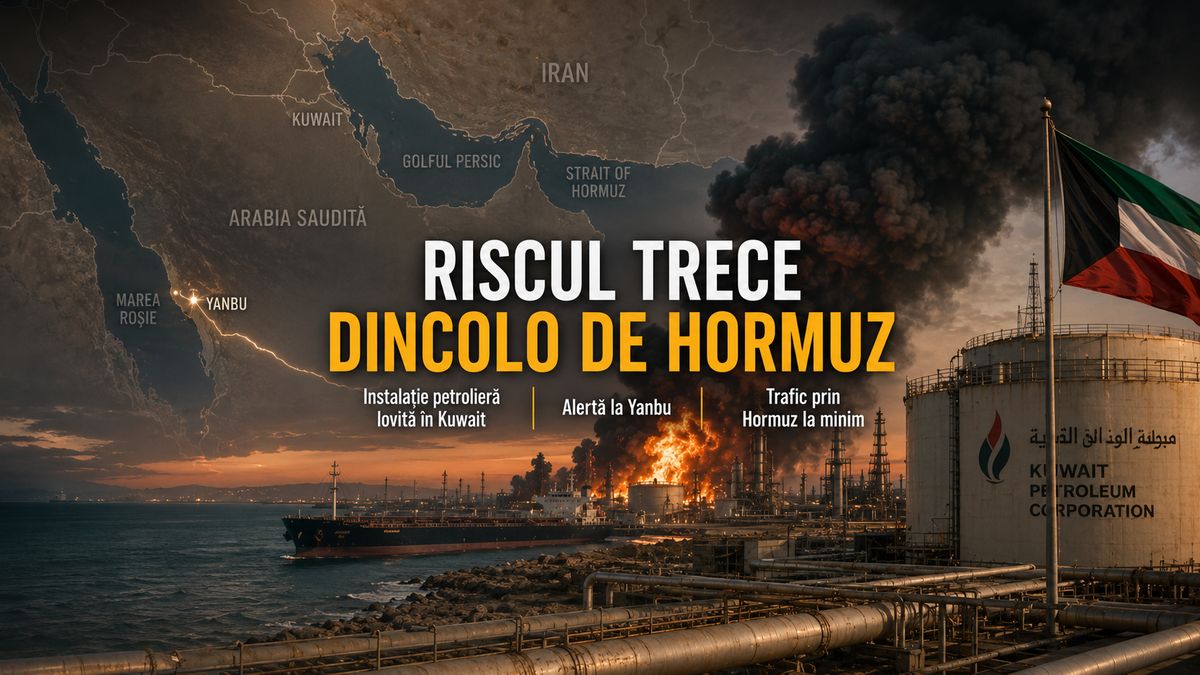
The confrontation between the United States and Iran has entered a phase where the Gulf's energy vulnerability is no longer concentrated solely in the Strait of Hormuz. Kuwait Petroleum Corporation has confirmed that one of its key facilities was hit in repeated Iranian attacks, resulting in casualties and significant material damage. On the same day, Saudi authorities issued a civil defense warning for Yanbu, the port city through which Saudi Arabia now exports most of its crude redirected away from Hormuz. There is no confirmation that the Yanbu oil terminal was attacked or damaged. The alert targeted a "potential danger," and authorities later announced that the threat had passed, reporting no damage. The significance of the episode lies not in an unproven strike, but in the fact that one of the most critical export points for Saudi oil has come within the scope of a security warning. This distinction is essential. In Kuwait, there is a confirmed attack on an oil facility. In Yanbu, there is a confirmed alert, but no confirmation of an attack on energy infrastructure. Together, however, the two episodes show that risk is beginning to shift from vessels in the strait to onshore facilities and the routes used to bypass the conflict zone. Eighth night of US strikes on Iran United States Central Command announced the completion of its eighth consecutive nightly wave of strikes on Iran. According to CENTCOM, the operations targeted coastal surveillance facilities, air defense systems, maritime capabilities, missile and drone depots, as well as Revolutionary Guard structures associated with attacks against US forces. The stated objective of the operations is to degrade Iran's capability to attack commercial vessels and militarily control traffic around the Strait of Hormuz. Assessments of the extent of the damage come primarily from the US side and cannot be fully verified by independent sources. Iran responded with attacks on US and allied targets in Jordan, Kuwait, and Bahrain. Some of the Revolutionary Guard's claims, including the destruction of radar systems or aircraft, have not been independently confirmed. However, missile and drone interceptions, casualties among military and emergency personnel, and damage to civilian and energy facilities in the region are confirmed. The escalation followed the collapse of a temporary truce and the deaths of two US service members in an Iranian attack on a facility in Jordan. A third service member was declared missing. The US response once again expanded operations into Iranian territory, while Tehran intensified pressure on states hosting US military bases and infrastructure. Kuwait confirms strike on oil facility Kuwait Petroleum Corporation reported that one of its key oil sector facilities was hit in repeated Iranian attacks. The company reported significant material damage, injuries, site evacuation, and the deployment of emergency services. The exact identity and function of the facility have not been made public. In the absence of official confirmation, the target cannot be characterized as a refinery, export terminal, storage depot, or production unit. Neither Kuwait Petroleum Corporation nor Kuwaiti authorities have announced a halt to oil production or exports as a result of the attack. This caveat limits conclusions regarding the immediate effect on the physical market. While damage is confirmed, the operational impact remains unknown. The difference between damaging an auxiliary facility and knocking out a refinery or terminal can mean millions of barrels in regional flows, which is why identifying the facility is critical. The attack on the KPC facility is not an isolated incident, however. The previous day, a Kuwaiti power and desalination plant was hit, causing a fire, material damage, and the shutdown of several production units. In the Gulf states, electricity and water desalination are components of the same critical infrastructure. Thermal power plants frequently co-generate electricity and potable water, and their fuel supply depends on gas and petroleum products. A strike on such a facility can affect not only the power grid but also water supply, industrial operations, and municipal services. The succession of attacks shows the expansion of the confrontation toward the systems that support the regional economy: oil facilities, power plants, desalination units, ports, radar installations, and military bases located near industrial zones. The Yanbu alert reaches the main route bypassing Hormuz Yanbu is located on the Saudi Red Sea coast and serves as the terminus of the East-West Pipeline, which transports crude oil from eastern Saudi Arabia, near the Abqaiq area, to terminals outside the Persian Gulf. This infrastructure has become essential following the severe reduction in traffic through Hormuz. Saudi Arabia has redirected over 70% of its normal export volume to Yanbu, and loadings from the port have climbed in recent weeks to approximately…
Ioana Buzoaica — Independent Editorial Board
The NRG-IA newsroom continuously monitors Romanian energy markets, ANRE regulatory decisions, and national grid telemetry (SEN/SNT). We deliver independent intelligence anchored exclusively in official primary data.
Editorial Charter, Ethics & Verification Methodology →