AI Identifies 9,389 Reactions in CO2-to-Methanol Conversion — NRG-IA
Tehnologie & Inovație Author: Ioana BuzoaicaIndian Institute of Science researchers used AI to expand analyzed CO2-to-methanol reactions from 152 to 9,389, unlocking new synthetic fuel catalysts.
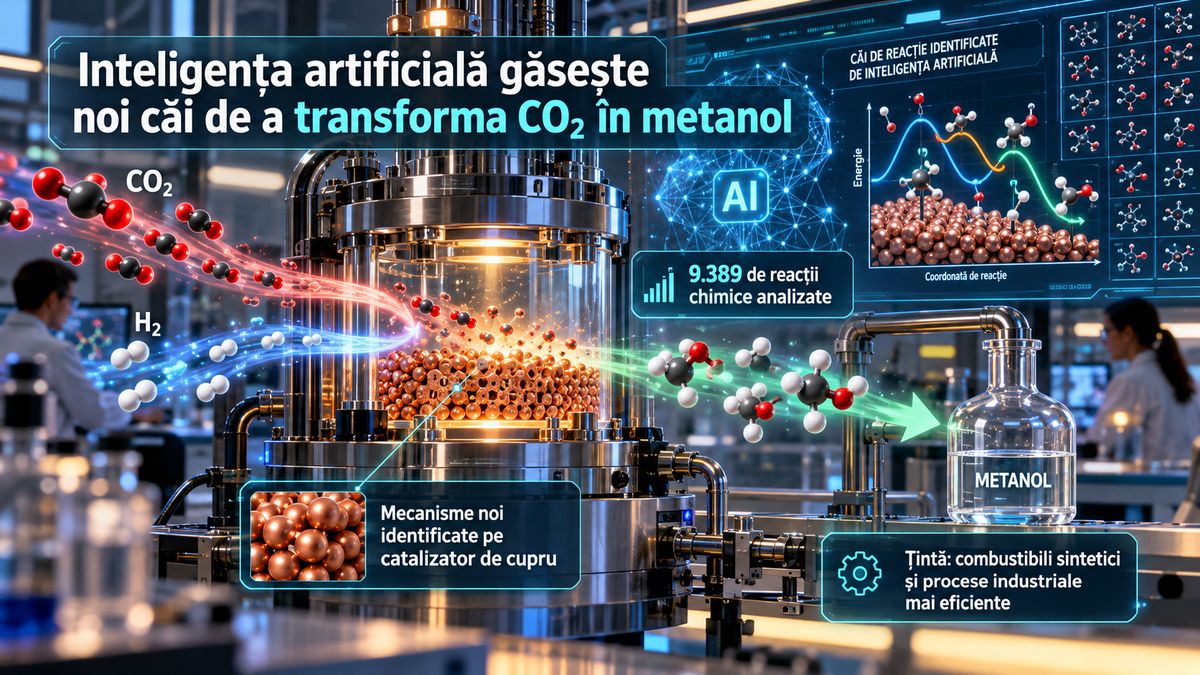
Artificial intelligence has enabled researchers at the Indian Institute of Science (IISc) to identify overlooked chemical mechanisms in the conversion of carbon dioxide into methanol. Using quantum simulations, machine learning algorithms, and advanced chemical modeling, the team expanded an initial network of 152 reactions to 9,389 elementary reactions, discovering that some previously ignored pathways can radically alter predictions regarding the products obtained from CO₂ and hydrogen. The findings, published on September 17, 2026, in the journal Nature Communications, demonstrate how vital artificial intelligence can become in synthetic fuel development. Conventional modeling erroneously pointed to formic acid as the primary product of the process. After incorporating thousands of additional reactions, the simulation accurately identified methanol and carbon monoxide among the key products, aligning with experimental observations. The most intriguing discovery concerns how hydrogen participates in chemical reactions. Researchers identified pathways through which molecular hydrogen can participate directly in hydrogen transfer to chemical intermediates without requiring a separate, prior step of dissociation into individual atoms. Subsequent quantum calculations confirmed that some of these transformations can be energetically more favorable than traditionally accepted mechanisms. A 152-Reaction Model Provided a Flawed Explanation of the Process Converting carbon dioxide into methanol involves a complex sequence of reactions occurring on a catalyst's surface. CO₂ and hydrogen molecules interact with the metallic surface, form intermediate compounds, and undergo numerous transformations before yielding final products. Each step carries its own energy requirements, while the rate and probability of reactions determine the quantity and type of substances produced. To describe these processes, researchers rely on models constructed from elementary reactions. Traditionally, a few dozen or hundred transformations deemed most likely are selected, as calculating thousands of individual possibilities using quantum methods requires immense computational resources. The problem is that an omitted reaction can skew the entire process. If it offers a faster pathway to a specific product or alters the availability of a chemical intermediate, the model's outputs can diverge significantly from the catalyst's actual behavior. This precise issue was highlighted by the IISc team. The initial 152-reaction network, built on quantum calculations, indicated formic acid as the dominant product and underestimated carbon dioxide conversion. Expanding the model to 9,389 reactions substantially altered the results, identifying methanol and carbon monoxide as major products. CO₂ conversion estimated by the expanded simulation was roughly 40 times higher than that calculated by the initial model. This disparity reflects a shift in the outcome predicted by modeling rather than a 40-fold experimental increase in reactor output. Its significance, however, is considerable: by incorporating previously ignored reactions, researchers achieved a representation far closer to observed chemical behavior. AI Expanded Analysis to 9,389 Reactions Across 105 Chemical Species To overcome the limitations of traditional modeling, the researchers combined several methodologies. The first phase involved calculating the energetic properties of the initial 152 reactions using density functional theory (DFT), a quantum mechanical method used to study electronic structure and molecular behavior. The resulting data was then used to train machine learning models capable of estimating energy barriers for other reactions. These barriers indicate the energy required for a specific chemical transformation to occur and strongly influence reaction rates. An automated framework explored potential transformations among 105 chemical species adsorbed on the catalyst surface, identifying reactions consistent with established chemical and structural rules. As a result, the network was expanded by 9,237 additional reactions, bringing the total to 9,389. To predict activation barriers, the team also deployed the CatBoost algorithm, trained on data obtained through quantum calculations. In reported evaluations, the model achieved a mean absolute error of approximately 0.13 electronvolts, offering a far faster method for estimating energy parameters than individually recalculating each possibility via quantum chemistry. The resulting network was fed into a microkinetic model capable of simulating how reactions interact and contribute to final product formation. The 9,389 transformations represent computationally generated and evaluated reactions, not 9,389 individually observed laboratory processes. The advantage of this method extends beyond merely increasing the number of analyzed reactions. Artificial intelligence enables the exploration of combinations researchers might…
Ioana Buzoaica — Independent Editorial Board
The NRG-IA newsroom continuously monitors Romanian energy markets, ANRE regulatory decisions, and national grid telemetry (SEN/SNT). We deliver independent intelligence anchored exclusively in official primary data.
Editorial Charter, Ethics & Verification Methodology →