Iran Proposes Reopening Strait of Hormuz in 7 Days — NRG-IA
Geopolitică & Energie Author: Ioana BuzoaicaIran proposed a 7-day plan to restore Hormuz shipping. The strait previously handled 20M bpd of oil and 20% of global LNG trade.
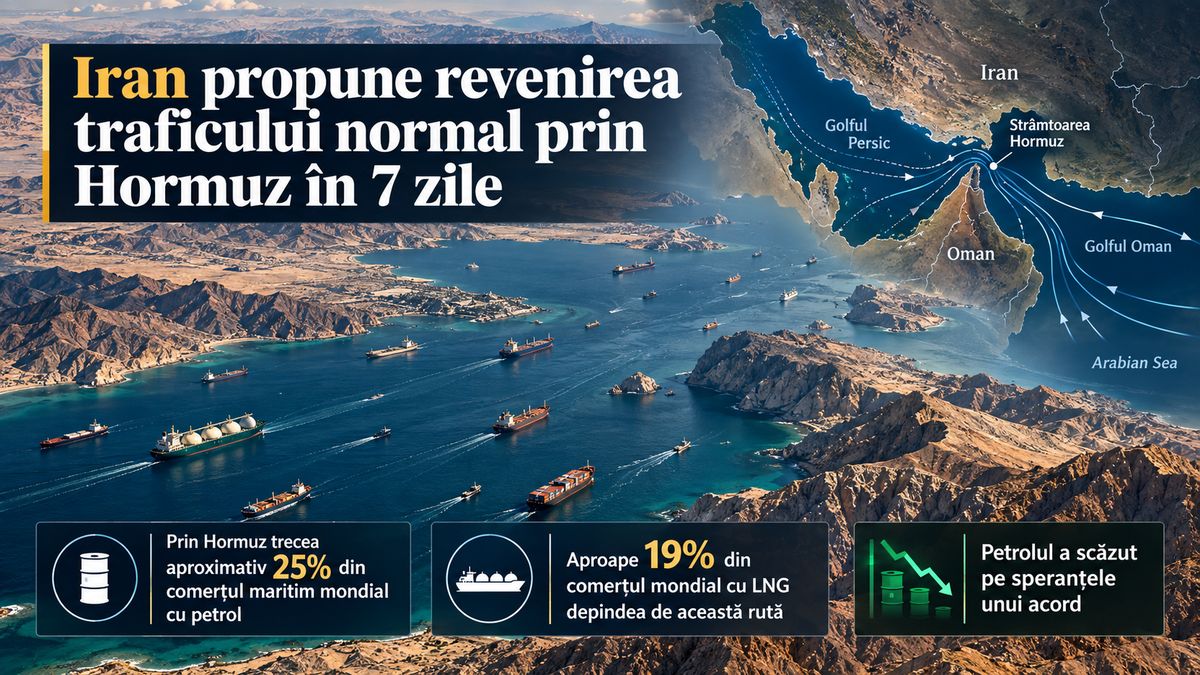
Iran has presented the United States with a precise timeline for one of the global energy market's most critical issues: seven days to restore normal shipping through the Strait of Hormuz. Iranian Foreign Minister Abbas Araghchi stated on Friday at the UN that Tehran has transmitted a "concrete" plan to Washington, with the countdown set to begin as soon as the American side accepts the conditions. However, as of the morning of September 26, no agreement has been publicly announced by Washington. The weight of the proposal stems from the geography of global energy. In 2025, an average of approximately 20 million barrels per day of crude oil and petroleum products flowed through Hormuz, equivalent to about 25% of global seaborne oil trade. The strait also accounted for roughly 19% of global LNG volumes, primarily from Qatar and the United Arab Emirates. For liquefied natural gas from this region, there is no comparable alternative route capable of rapidly absorbing these volumes. Iran Condenses June Agreement Mechanism into One Week The new plan largely revives the architecture of the memorandum agreed upon by the United States and Iran in June, but condenses the timeline. Araghchi noted that the actions required of Washington are not new, but stem from the previous understanding. Associated Press reports indicate the lifting of the naval blockade on Iranian ports, the easing of sanctions on oil exports, and adherence to a cessation of hostilities that would also include the Lebanese front. The June 17 memorandum provided for the cessation of military operations and a mechanism to normalize shipping through Hormuz, alongside U.S. measures regarding the blockade, Iranian oil exports, and subsequent negotiations. The agreement briefly provided a framework for de-escalation but later collapsed with the resurgence of clashes and maritime disputes. The new formula attempts to bridge the gap between political agreement and physical market impact. If Washington accepts the terms, Iran's proposed timeline would lead to the restoration of normal shipping within seven days, after which broader negotiations between the two sides would continue. Full details of the document have not been published, leaving the exact implementation and verification mechanism as one of the decisive elements. Hormuz Is Not at Zero, but Flows Are Far From Normal The term "reopening" must be viewed through the lens of the physical situation in the strait. Shipments have not ceased entirely, but traffic has been drastically reduced compared to pre-conflict levels, with the International Energy Agency describing the situation in 2026 as a de facto closure of the strait for a significant portion of energy trade. Energy Information Administration data highlights the scale of the shift. Total oil flows through Hormuz dropped from 21.6 million barrels per day in Q4 2025 to 4.9 million barrels per day in Q2 2026 . Over the same period, LNG flows fell from 10.5 to 0.8 billion cubic feet per day . The discrepancy is large enough to explain why any credible signal of a return to normal shipping triggers an immediate reaction in oil and gas markets. A functional reopening would not just mean more tankers crossing the strait, but the gradual recovery of access to volumes that, prior to the conflict, constituted a major share of global energy trade. A Quarter of Global Seaborne Oil Depended on This Passage Few geographical chokepoints concentrate such a vast amount of energy. Hormuz is only about 39 kilometers wide at its narrowest point, with the actual shipping lanes measuring approximately two nautical miles each. In 2025, nearly 15 million barrels of crude oil per day, along with additional volumes of petroleum products, passed through this passage, mostly destined for Asia. China and India combined received 44% of the crude oil exports transiting the strait. Physical alternatives are far smaller than the normal flow through Hormuz. The IEA estimates that the infrastructure available to bypass the strait can reroute approximately 3.5 to 5.5 million barrels per day. Even under intense utilization, this cannot replace the roughly 20 million barrels per day that normally transited the area. For LNG, the constraint is even more severe. Approximately 93% of Qatar's LNG exports and 96% of those from the United Arab Emirates passed through Hormuz in 2025. The IEA estimates these volumes represented about 19% of global LNG trade and warns that no alternative route exists capable of transporting them to the global market. Oil Reacted Before an Agreement Even Existed Markets began pricing in the possibility of a de-escalation before Washington accepted the plan. On Friday, Brent futures fell by $2.28, or 2.1%, to $104.32 per barrel , while WTI shed $2.20, or 2.3%, to $92.41 per barrel . Reuters attributed the decline to growing hopes for a phased exit from the conflict, while risks from Houthi attacks on Saudi infrastructure continued to cap market optimism.…
Ioana Buzoaica — Independent Editorial Board
The NRG-IA newsroom continuously monitors Romanian energy markets, ANRE regulatory decisions, and national grid telemetry (SEN/SNT). We deliver independent intelligence anchored exclusively in official primary data.
Editorial Charter, Ethics & Verification Methodology →