Iran and Oman Agree on Joint Hormuz Corridor and Demining — NRG-IA
Geopolitică & Energie Author: Ioana BuzoaicaIran and Oman agree on a joint temporary corridor and demining in the Strait of Hormuz, aiming to restore a route vital to 25% of global oil trade.
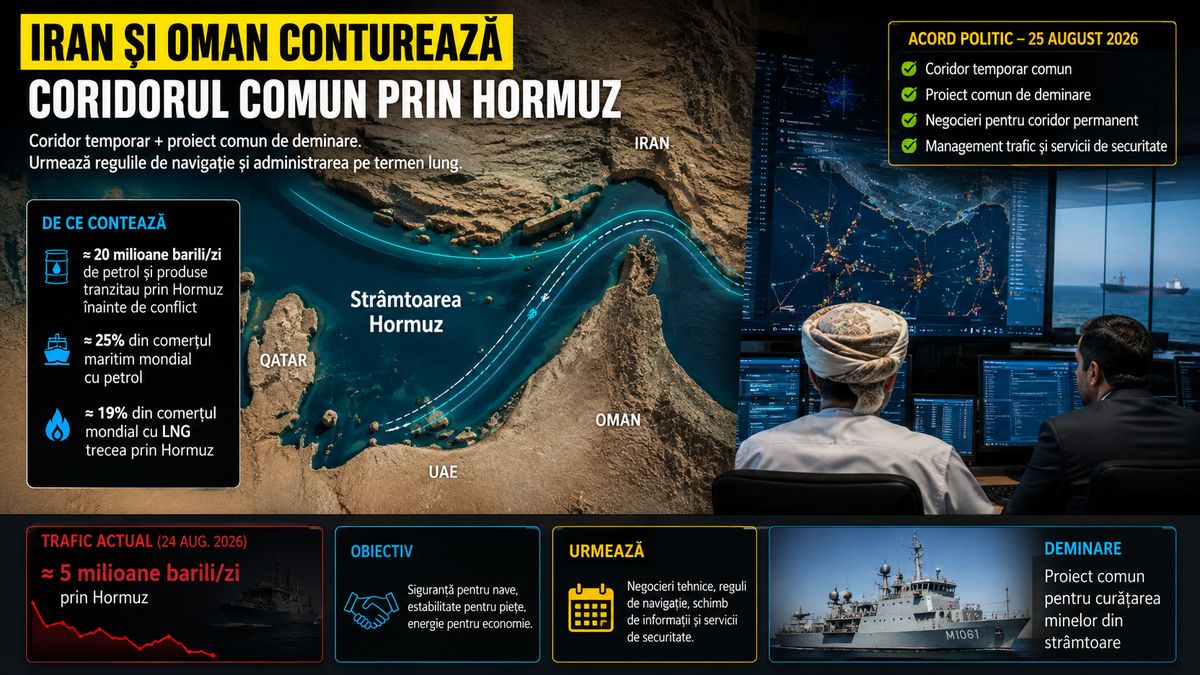
Iran and Oman have agreed to establish a joint temporary maritime corridor through the Strait of Hormuz and to implement a joint demining project , in an effort to restore commercial traffic to one of the world's most critical energy routes. The agreement was announced on August 25, following consultations in Tehran between Foreign Ministers Abbas Araghchi and Sayyid Badr bin Hamad Al Busaidi. The joint statement describes a phased framework for the safe resumption of navigation and outlines the next step: technical negotiations on a permanent corridor, the future administration of the strait, information sharing, traffic management, and the provision of navigation and security services. The temporary corridor has not yet been declared operational. Its coordinates, activation date, and the commercial rules governing its use by vessels have not been published. However, the agreement fundamentally alters the negotiating framework: after months of Iran and Oman backing different transit systems, the two littoral states are now attempting to jointly build a single temporary route. The economic stakes are enormous. Prior to the conflict, approximately 20 million barrels per day of crude oil and petroleum products passed through Hormuz, equivalent to about 25% of global seaborne oil trade , according to the International Energy Agency. On Monday, August 24, the estimated oil flow through the strait was approximately 5 million barrels per day , according to Vortexa data cited by Reuters. The gap between these two levels highlights how far navigation remains from normalcy. A Single Corridor Attempts to Replace Two Rival Transit Systems The new Iran–Oman formula attempts to resolve an issue that has proven almost as crucial as the physical security of vessels: the lack of a joint navigation regime. In June, Oman, in coordination with the International Maritime Organization, had provided a temporary corridor for vessels stranded in the Gulf. Muscat specified at the time that transit must comply with international law and be free of transit fees. While the scheme allowed some crossings to resume, it did not resolve the dispute over control of the strait. Iran continued to demand that vessels follow routes approved by its authorities and maintained that any new route must be coordinated with Tehran. In early August, their positions remained significantly apart. An Iranian source involved in the negotiations told Reuters that Tehran sought control over traffic entering the Gulf and access to information on outgoing vessels, including the authority to intervene. The new "joint temporary corridor" formula seeks to overcome precisely this dual authority. Instead of an Omani route contested by Iran and separate routes imposed by Tehran, the two states are attempting to create a mechanism accepted by both sides. Negotiations Shift from Vessel Routes to the Administration of Hormuz The strategic portion of the agreement lies beyond the temporary corridor. Iran and Oman have agreed to continue technical negotiations for a permanent corridor and the future administration of the Strait of Hormuz . The discussions will cover information sharing, traffic management, and navigation and security services. Consequently, negotiations are no longer limited to the route vessels can use during the current high-risk period. The two states are beginning to discuss the long-term architecture of one of the global economy's most sensitive maritime infrastructures. Oman and Iran asserted as early as June that their status as littoral states gives them a central role in managing navigation, while simultaneously emphasizing the need to respect international law and keep the strait open to international trade. The August 25 agreement maintains this formula. The joint statement mentions both the sovereign rights of the two coastal states and applicable international law. The two governments also intend to consult with other Gulf littoral states. Saudi Arabia, the United Arab Emirates, Qatar, Kuwait, Bahrain, and Iraq depend to varying degrees on access through Hormuz, meaning that the long-term operation of any new navigation system will require regional cooperation far broader than the bilateral Tehran–Muscat relationship. Demining Becomes Part of the Joint Solution The second concrete component of the agreement is the joint project to clear mines from the strait. This issue emerged on the same day US President Donald Trump declared that mines in the main shipping lane had been cleared or detonated, warning Iran against laying more. However, the US statement and the Iran–Oman project do not necessarily describe the same maritime area. Washington framed its operations in relation to the primary shipping lanes and areas it deems relevant for international navigation, whereas the bilateral statement refers to the Strait of Hormuz as a whole and does not publish an inventory of remaining mines. The explicit inclusion of demining in the agreement…
Ioana Buzoaica — Independent Editorial Board
The NRG-IA newsroom continuously monitors Romanian energy markets, ANRE regulatory decisions, and national grid telemetry (SEN/SNT). We deliver independent intelligence anchored exclusively in official primary data.
Editorial Charter, Ethics & Verification Methodology →