Iran Discovers Takhteh Gas Field: 161 Bcm Recoverable — NRG-IA
Gaze Naturale Author: Ioana BuzoaicaIran adds a major new field to its massive resource base. Takhteh's value depends on how fast Tehran can turn 161 bcm of recoverable gas into production.
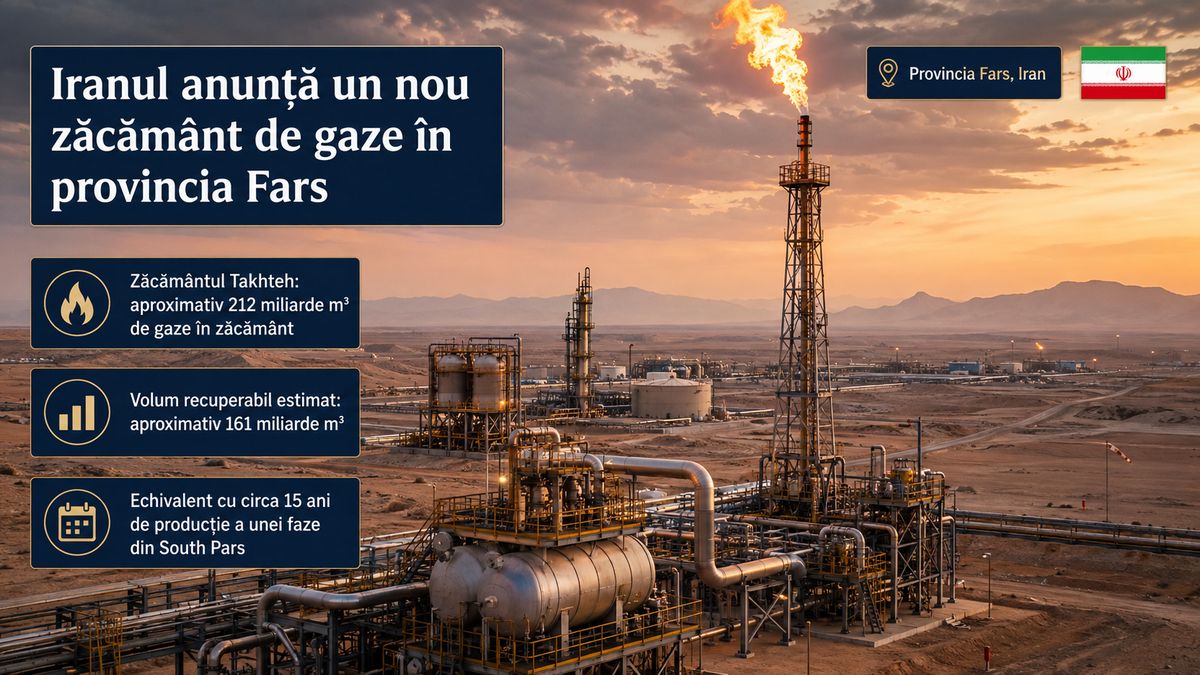
Iran has announced the discovery of the Takhteh gas field in the southern Fars province, holding approximately 7.5 trillion cubic feet of gas in place , equivalent to about 212 billion cubic meters . The Iranian Ministry of Petroleum estimates that approximately 5.7 trillion cubic feet, or 161 billion cubic meters, are recoverable , at a recovery factor of about 72%. The discovery was announced by Petroleum Minister Mohsen Paknejad, with additional data published by the national oil company NIOC placing Takhteh approximately 10 kilometers northwest of the city of Khonj and about 35 kilometers from the Shanul and Homa gas fields. The gas is described as "sweet," with a low sulfur content, which could simplify processing and reduce development and operating costs compared to a sour gas field. The field also contains condensate. The exploration director of the National Iranian Oil Company, Seyed Mohieddin Jafari, estimated the economic value of the field at approximately $45 billion . This is an official Iranian valuation of the resource, not the value of an already approved investment or contracted revenues. The 161 billion m³ of recoverable gas is equivalent to 15 years of production from a single South Pars phase The figure used by Iranian authorities to convey the scale of the discovery is spectacular, but its reference point is essential. The 5.7 trillion cubic feet of recoverable gas is equivalent, according to the Ministry of Petroleum, to approximately 15 years of production from a standard South Pars phase . This does not represent 15 years of consumption for the entirety of Iran. The difference in scale is major. Prior to the production losses caused in 2026 by attacks on the energy sector, Iran was producing approximately 650 million cubic meters of gas per day , according to Reuters. At such a rate, the 161 billion m³ of recoverable gas from Takhteh would represent, in a purely comparative calculation, less than a year of national production, not 15 years. However, the comparison with a South Pars phase shows that Takhteh is a significant field even by the standards of a country that already possesses enormous resources. South Pars is the hub of the Iranian gas system. The offshore field, the geological continuation of Qatar's North Field, accounts for approximately 70–75% of Iran's gas production , according to Reuters. It is precisely this heavy reliance on this area that makes new onshore discoveries relevant, as they can diversify the production base over time. Iran already holds the world's second-largest gas reserves Takhteh does not alter Iran's position in a ranking where the country was already near the top. The U.S. Energy Information Administration estimated Iran's proven gas reserves at approximately 1,200 trillion cubic feet at the end of 2023 , equivalent to about 34 trillion cubic meters. Iran thus held approximately 16% of the world's proven reserves, ranking second only to Russia. The new discovery adds approximately 7.5 Tcf of gas in place to an already massive geological base. From this perspective, the strategic impact of Takhteh does not stem from shifting the global reserve hierarchy, but from the potential to introduce a new production source into a system in need of additional molecules. Iran is one of the world's largest gas producers and consumers, with the vast majority of its production remaining within the domestic economy. Gas fuels heating, industry, petrochemicals, and a large portion of electricity generation, leaving the country exposed during periods of surging domestic demand or falling production. Vast resources have not eliminated the domestic gas deficit The paradox of the Iranian sector is that one of the world's most gas-rich nations periodically faces an imbalance between production and consumption. The EIA notes that most of the gas produced by Iran is consumed domestically, and infrastructure development has been slowed by international sanctions. In 2023, Iran flared or vented approximately 721 billion cubic feet of gas due to oil production and insufficient gathering and processing capacity. Pressure intensified sharply in 2026. Attacks starting in late February at one point reduced Iranian gas production capacity by approximately 230 million cubic meters per day , according to Reuters. In July, Iranian authorities estimated that about 100 million m³/day of the lost capacity could be restored in the coming months. South Pars itself became a target in the conflict. Its importance is difficult to replace quickly: the field supplies the bulk of Iranian gas, and its associated infrastructure supports residential consumption, industrial production, petrochemicals, and the power grid. In this context, an onshore field of Takhteh's size takes on a different value than that suggested merely by an increase in national reserves. It can provide a new foundation for domestic production and ease pressure on a system heavily concentrated around South Pars. 'Sweet'…