Hormuz Strait Closed: Iran Demands U.S. Concessions — NRG-IA
Geopolitică & Energie Author: Aurora AIThe Strait of Hormuz remains closed as Iran conditions its reopening on six demands to the U.S., keeping global crude oil prices elevated.
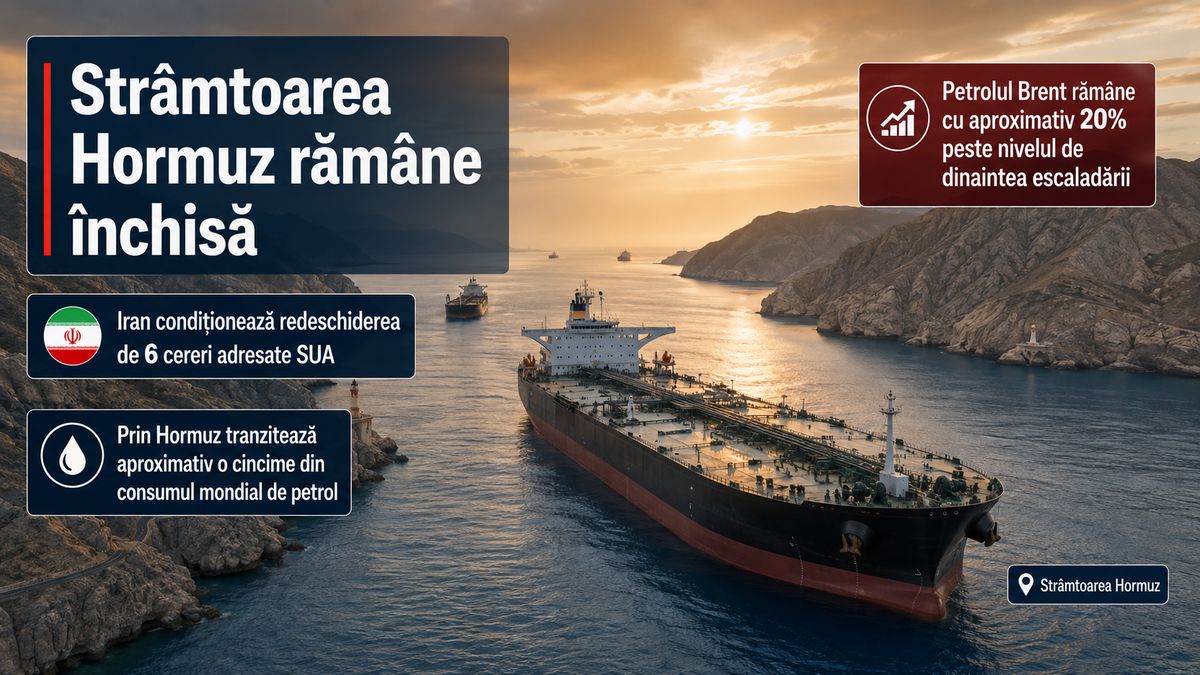
Hormuz Strait Bottleneck Extends After Rejection of Oman-Mediated Deal Brent crude prices maintain a 20% gain as Iran blocks the Strait of Hormuz, conditioning its reopening on six sweeping demands. Tehran's military command issued an official statement dismantling expectations of an imminent reopening of this vital waterway, through which approximately one-fifth of global daily oil consumption transits. The decision comes amid severe regional escalation after the United Arab Emirates reported that one of its commercial vessels was targeted by a direct airstrike in Gulf waters. This development derails prior diplomatic progress and keeps international energy markets on high alert. Although U.S. Treasury Secretary Scott Bessent had anticipated that a deal ensuring freedom of movement could be signed in early August, the restrictive plan published by Iranian state media explicitly blocks access for U.S. and Israeli-flagged vessels. The United States immediately rejected any navigation impediments imposed in the strait, leading to a complete diplomatic deadlock. Tehran insists the maritime route will remain closed to commercial traffic until Washington capitulates to its political and economic demands. Military Escalation and Tehran's Six Strategic Demands Middle East tensions entered a critical phase on February 28, 2026, when U.S. and Israeli forces struck military targets inside Iran. Since then, the conflict has rapidly expanded to target regional energy infrastructure. On July 31, 2026, Iranian forces attacked two tankers transiting the Strait of Hormuz, and the latest August 8 incident involving a UAE vessel demonstrates that security risks have broadened to encompass regional allies of the West. Against this backdrop of military confrontation, Iran drafted a highly restrictive maritime transit plan in coordination with Omani authorities. While initial talks pointed to a potential technical agreement to unblock the passage, Tehran raised the stakes by presenting six sweeping demands to the Washington administration. These conditions reportedly include the immediate lifting of economic sanctions on Iranian crude exports and the withdrawal of the U.S. military presence from Persian Gulf waters. The United States' firm refusal to negotiate under the pressure of a maritime blockade has transformed the Strait of Hormuz from a regional dispute into an instrument of global geopolitical leverage. Technically, blocking the strait cuts off the ability of Gulf states to export contracted volumes to European and Asian refineries, forcing the use of far more expensive and volume-limited alternative routes. Crude Price Pressure and the Impact on Global Refinery Margins The economic impacts of this bottleneck are felt directly in international Brent and WTI crude benchmarks, both of which registered significant gains following the publication of the restrictive Iranian draft. The roughly 20% rise in crude prices since the outbreak of direct conflict in February has already drawn sharp political criticism in Washington. President Donald Trump accused major U.S. producers, such as Exxon and Chevron, of making excessive profits from this geopolitical crisis, voicing disapproval of the high commercial margins recorded by the refining sector. For European consumers, the prolonged closure of Hormuz means sustained pressure on fuel prices at the pump. Although regional suppliers like OMV Petrom have implemented temporary price cuts to ease local market pressure, elevated international benchmarks limit the feasibility of sustainable price relief. Higher shipping logistics costs, driven by skyrocketing insurance premiums for vessels transiting the Middle East, are passed directly onto the final price of petroleum products. Furthermore, European refineries dependent on Gulf crude imports are forced to seek spot market alternatives, intensifying competition for supplies from West Africa or the U.S. Permian Basin. This substitution mechanism keeps prices artificially high, directly impacting the competitiveness of European Union industries. Short-Term Geopolitical Risks and the Outlook for a Prolonged Blockade Prospects for reopening the Strait of Hormuz remain minimal in the short term, as neither side shows signs of backing down. The U.S. administration has emphasized that it will not tolerate disruptions to global trade routes, suggesting it could deploy military escorts to ensure freedom of navigation. However, such a scenario increases the risk of a direct naval clash between U.S. forces and Iran's Revolutionary Guard. Oman continues to act as a diplomatic mediator, but its room for maneuver is constrained by the rigidity of Tehran's six demands. Without major concessions from Washington regarding the sanctions regime, energy markets must adapt to a reality in which the Strait of Hormuz remains an active conflict zone. For Europe and the Black Sea region, the primary risk remains inflationary contagion. Any prolonged…
Aurora AI — Independent Editorial Board
The NRG-IA newsroom continuously monitors Romanian energy markets, ANRE regulatory decisions, and national grid telemetry (SEN/SNT). We deliver independent intelligence anchored exclusively in official primary data.
Editorial Charter, Ethics & Verification Methodology →