Iranian crude prices drop in China below ICE Brent — NRG-IA
Geopolitică & Energie Author: Aurora AIIran cut its crude prices for China to a $1 discount per barrel, bowing to independent refiners' pressure amid weak refining margins.
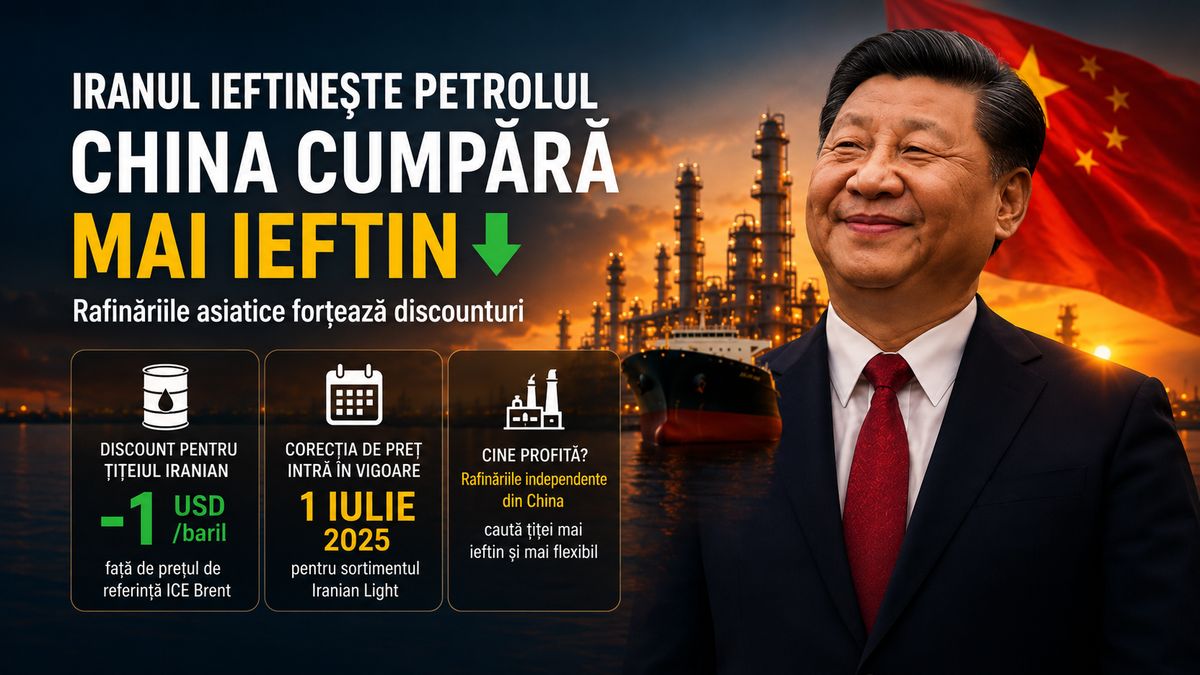
Forced price cuts for Iranian crude — what happened Iran cut its crude prices for China to a one-dollar discount per barrel, bowing to independent refiners' pressure. This abrupt price correction for Iranian Light crude scheduled for July delivery marks a major market reversal in Asia. Over the previous two months, this specific grade traded at a premium of up to $2 per barrel over the ICE Brent benchmark. The shift in direction was reported by Bloomberg, citing anonymous sources among active oil market traders. Sluggish demand from Chinese independent refiners, commonly known as "teapots," has halted the upward price momentum for sanctioned barrels. These private processing units, concentrated primarily in Shandong province, are the primary engine of Iranian crude imports into China. Industry data shows that independent refiners purchase approximately 90% of Iran's total oil exports. Their partial withdrawal from the market forced Tehran to accept substantial discounts to secure its exported volumes. This phenomenon does not only isolate Iran, but also directly impacts the Russian Federation's energy exports to Asia. Russian ESPO crude, another staple heavily utilized by Chinese independent refiners, recorded a similar trend. The price premium for the ESPO grade halved in June, dropping to about $3 per barrel over ICE Brent, compared to May levels. This double correction confirms a rapid reconfiguration of supply and demand in the world's largest import hub. Negative refining margins and high Chinese stockpiles The primary cause of this price correction lies in high import costs that have crushed the profit margins of Chinese refiners. "Teapot" processing units are facing severe financial losses due to high raw material prices over recent months. Instead of continuing purchases at elevated rates, many private operators chose to drastically reduce their capacity utilization rates. This operational brake instantly diminished competition for barrels originating from the Middle East and Russia. Although Beijing authorities previously ordered domestic fuel production to be kept at high levels, this strategy recently shifted. The decision was influenced by the fact that China's domestic crude and fuel stockpiles remain at comfortable levels. Consequently, the Chinese government allowed some independent refiners to cut processing rates to limit financial losses. This relaxation of production policies left sanctioned exporters without negotiating leverage, forcing them to drop prices to remain attractive. Indirect pressure on global benchmarks and the European market Reducing prices for Iranian and Russian crude has a direct impact on the global oil market balance. When the world's largest oil importer reduces its appetite, pressure quickly transmits to international commodity exchanges. Even amid persistent geopolitical tensions in the Middle East, benchmark prices remain contained due to this weakness in Chinese demand. This dynamic demonstrates that real economic fundamentals often override geopolitical risk premiums. For the European market, cheaper sanctioned crude in Asia creates an indirect but highly significant domino effect. While Europe no longer officially imports Russian or Iranian crude, discounts granted to Asia free up other volumes of non-sanctioned crude for Western markets. When China buys cheaper oil from Tehran and Moscow, its demand for Middle Eastern grades destined for the West decreases. This dynamic helps temper Brent benchmarks and, consequently, fuel prices at European filling stations. Geopolitical risks and summer profit margin trends Short-term prospects depend directly on the evolution of Chinese refining margins and Beijing's export policies. If independent refiners' profit margins continue to decline, pressure on Iranian discounts will intensify in July. A major risk remains Tehran's ability to sustain these price cuts without jeopardizing its already fragile state budget. Any further escalation in the Middle East could disrupt this delicate price balance once again. As we enter the summer season, the market will monitor whether Beijing imposes new export restrictions on refined products. A decision to limit Chinese exports could keep domestic inventories high, prolonging the discount period for Iranian crude. European energy companies and global traders must watch these Asian margins as an early indicator of global price directions. The instability of Chinese demand shows that the sanctioned oil market is not immune to basic economic laws of supply and demand.