Iran Imposes Nationwide Power Cuts Amid Gas Shortage — NRG-IA
Geopolitică & Energie Author: Ioana BuzoaicaIran’s Tavanir has begun scheduled power cuts as South Pars war damage leaves plants short of gas, straining global energy markets.
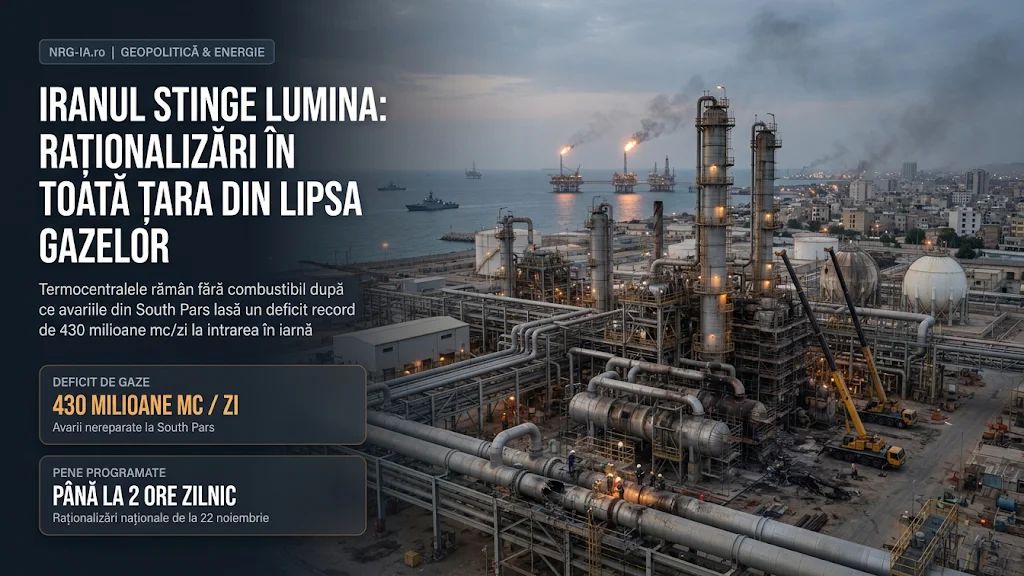
Iran's national power transmission and distribution company, Tavanir, began rolling out scheduled nationwide electricity blackouts on Sunday, November 22, 2026, driven by a severe fuel shortage at thermal power plants. The state operator’s Director General, Mohammad Allahdad, announced that restrictions initially target households and commercial premises through outages of up to two hours every two days, but warned that controlled blackouts will become daily as temperatures drop. The decision formalizes an extreme energy paradox: the country holding the world's second-largest proven natural gas reserves and third-largest crude oil reserves is resorting to rolling blackouts in major cities from the very first day of the cold season in the Iranian calendar. Teheran government spokesperson Fatemeh Mohajerani estimated that the country's daily gas deficit could hit an all-time high of 430 million cubic meters this winter, a steep increase from the roughly 300 million cubic meters shortfall recorded in previous winters. Iranian President Masoud Pezeshkian acknowledged on Saturday that military strikes on energy infrastructure have worsened the domestic supply-demand imbalance, preparing the public for a difficult winter. From the first day of rationing, power cuts left schools in the dark across major urban centers such as Mashhad and disrupted water pumping and internet connectivity, while warnings echoed in Teheran’s Parliament that electricity shortages jeopardize over one million jobs. The South Pars Bottleneck Shows Why Huge Subsurface Reserves Become Useless Without Processing Plants The physical root of the current crisis lies along the Persian Gulf coast, within the infrastructure supporting the giant offshore South Pars field, which accounts for approximately 68% of Iran's total natural gas production. During air strikes on March 17, 2026, amid open military conflict between the United States, Israel, and Iran, four major gas treatment and processing complexes tied to this asset sustained direct hits, initially knocking out roughly 230 million cubic meters per day—equivalent to a quarter of national output. Although the geological reservoir beneath the seabed remained undamaged, the raw gas extracted offshore is rich in condensate and sulfur compounds, rendering it impossible to feed into main pipelines without passing through surface processing refineries. Under Western sanctions and a U.S. naval blockade preventing the import of compressors, turbines, and high-pressure equipment, National Iranian Oil Company engineers managed over eight months of repairs to restore only around 100 million cubic meters per day, leaving 130 million cubic meters per day stranded just as winter sets in. This vulnerability strikes the country's entire power grid, as natural gas accounts for 73% of Iran's primary energy mix and over 80% of its electricity generation. When cold weather triggers a surge in residential heating demand—fueled at heavily subsidized rates—authorities curtail gas deliveries to thermal power plants to prevent leaving citizens in the cold and sparking widespread civil unrest. Left without gas and lacking sufficient diesel reserves, power plants are forced either to burn high-sulfur heavy fuel oil—which has already blanketed major metropolises like Tehran, Karaj, and Mashhad under a dense layer of toxic smog—or shut down generating units altogether. Although Tavanir designed the current residential blackout schedule specifically to preserve industrial operations—where 16% of energy demand went unmet during the last fiscal year—the sheer scale of the deficit threatens to force cascade shutdowns at steel, petrochemical, and cement plants during freezing weeks ahead. From Tehran Blackouts to Oil and Diesel Prices in Europe and Romania The domestic energy crisis coincides with severe economic deterioration, with the International Monetary Fund forecasting a contraction of at least 7.6% for the Iranian economy in 2026 under the weight of war and the maritime blockade imposed on its ports in April and resumed in July. In recent days, truck drivers launched strikes across several provinces amid fuel shortages, while authorities discreetly introduced a card-based rationing system for subsidized bread in at least three regions. Regionally, Iran's inability to cover its domestic consumption has kept pipeline gas exports to Iraq and Turkey suspended or severely curtailed since spring, following the attacks on South Pars. Deprived of Iranian volumes, neighboring states are forced to seek alternative pipeline gas and additional liquefied natural gas (LNG) cargoes on the international market, tightening the supply balance across the Mediterranean basin and Southeast Europe just as European gas benchmarks climbed toward €95 per MWh. Globally, the 2026 edition of the World Energy Outlook, published on November 19 by the International Energy Agency, classifies the Middle East disruption as the largest energy supply…
Ioana Buzoaica — Independent Editorial Board
The NRG-IA newsroom continuously monitors Romanian energy markets, ANRE regulatory decisions, and national grid telemetry (SEN/SNT). We deliver independent intelligence anchored exclusively in official primary data.
Editorial Charter, Ethics & Verification Methodology →