Iran-Oman Hormuz Deal Near: US Conditions & Brent Impact — NRG-IA
Geopolitică & Energie Author: Ioana BuzoaicaIran-Oman talks on new Hormuz shipping lanes are in final stages, but the technical deal doesn't resolve the US-Tehran political dispute over reopening.
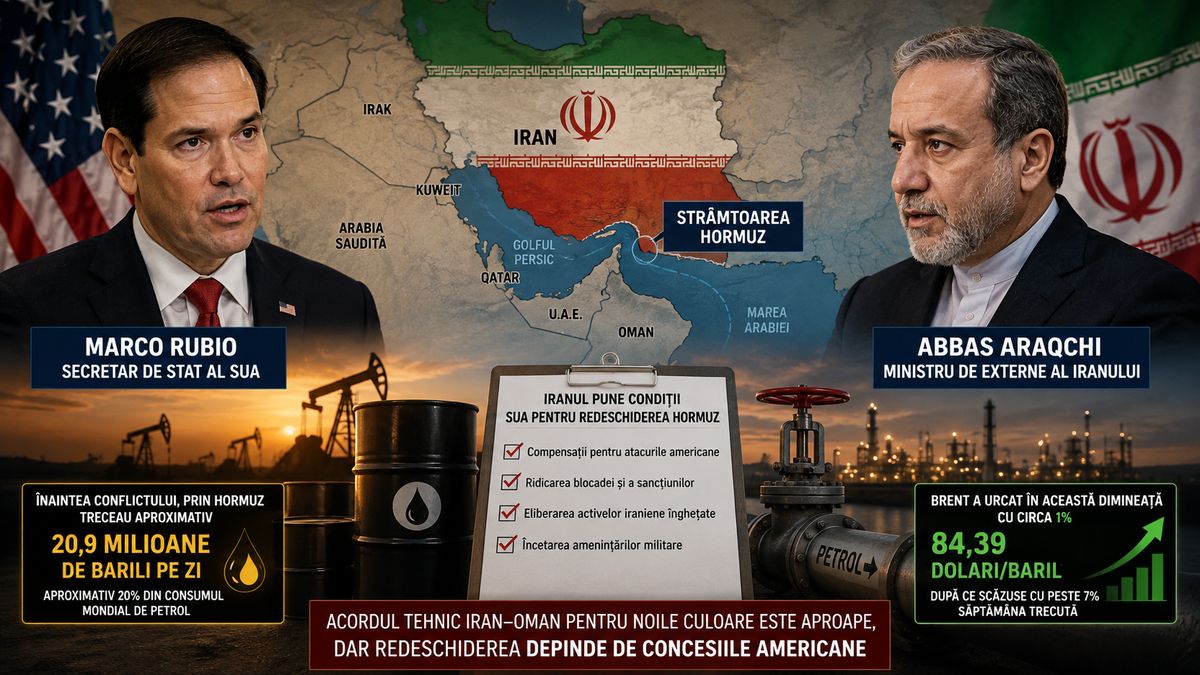
Iran and Oman are nearing an agreement on how vessels could once again transit the Strait of Hormuz, but negotiations have hit a decisive roadblock: establishing maritime corridors does not automatically reopen the world's most critical oil artery. Tehran is conditioning the normalization of traffic on US concessions, while Washington first demands guarantees that commercial shipping will be restored. Iranian Foreign Minister Abbas Araqchi stated that negotiations with Oman regarding the new maritime procedures are in their final stages. The document is expected to establish the routes and conditions under which vessels can use the strait once it reopens. However, Iran explicitly separates this technical agreement from the political decision to return commercial traffic to normal. This divergence was enough to shift the direction of the oil market once again. Brent had lost over 7% the previous week amid hopes that progress in the Iran–Oman talks would allow a rapid normalization of Gulf exports. Following the clarification of Iranian conditions, Brent contracts rebounded on Monday morning to approximately $84.39 per barrel , up about 1%. The reaction underscores how sensitive the market remains to every diplomatic milestone. Investors are not just trading the oil currently transiting the strait, but the probability that millions of barrels blocked or rerouted in recent months will return to the market. Tehran and Washington each want the other side to take the first step Negotiations are stalled over the sequencing of concessions. According to a US official quoted by Reuters, Washington is prepared to lift the blockade on Iranian ports following the announcement of an agreement that restores unimpeded commercial shipping, and as Iran fulfills its commitments. Tehran's position reverses this sequence. Araqchi stated that Iran expects US action first and that the reopening of the strait depends on the fulfillment of conditions formulated by the Iranian side. Among the demands presented by Iranian officials are compensation for damages caused by US strikes, the lifting of the blockade and sanctions, the release of frozen Iranian assets, and an end to military threats against Iran and its regional allies. These conditions represent Tehran's opening position, not an agreement accepted by Washington. Communication continues through intermediaries, with both sides attempting to resolve the exact issue that has hindered normalization so far: who blinks first to make the next step possible. For this reason, the nearing of the Iran–Oman agreement may reduce uncertainty regarding technical navigation procedures, without yet resolving the dispute keeping commercial vessels away from the strait. New corridors could expand Iran's role in traffic control The proposed framework for the future navigation system introduces a far more significant change than a simple rerouting of maritime lanes. According to Reuters reports citing officials involved in the talks, one of the options under consideration would grant Iran a larger role in managing traffic entering the Persian Gulf. Outbound vessels could use a corridor between Iran and Oman under a notification and authorization system in which both states would hold distinct responsibilities. The details of the agreement are still being negotiated and have not been finalized. However, if this architecture is preserved, it would alter the practical balance between international navigation and the control exercised by littoral states over one of the world's most critical energy transit chokepoints. Prior to the conflict, navigation through Hormuz followed an international traffic separation scheme used for decades. The International Maritime Organization has long upheld the principle of non-discriminatory and unimpeded transit through the strait, meaning any new mechanism introducing authorizations or additional conditions would have implications far beyond the Iran–Oman relationship. A 5–7% transit fee would turn passage into a multi-million dollar cost per vessel One of the most sensitive components under discussion is the transit fee. An Iranian official quoted by Reuters indicated that Tehran has demanded a fee equivalent to 5–7% of the cargo value for vessels using the strait. Oman reportedly discussed a level of around 3%, while the US position favors transit free of such tariffs. Pegging the fee to cargo value radically alters the scale of the cost. A Very Large Crude Carrier (VLCC) can transport approximately two million barrels. With oil prices above $80, the cargo can be worth over $160 million, meaning a percentage-based fee could reach several million dollars for a single transit. However, the issue extends beyond cost. The Persian Gulf Strait Authority, the Iranian institution established to manage the strait, is under US sanctions. For operators exposed to US jurisdiction, payments to a sanctioned entity could create severe legal and financial risks. A mechanism…
Ioana Buzoaica — Independent Editorial Board
The NRG-IA newsroom continuously monitors Romanian energy markets, ANRE regulatory decisions, and national grid telemetry (SEN/SNT). We deliver independent intelligence anchored exclusively in official primary data.
Editorial Charter, Ethics & Verification Methodology →