Italy and EU Agree on Gas Cap to Lower Power Prices — NRG-IA
Piața de Energie Author: Ioana BuzoaicaItaly secured EU approval in principle for a temporary mechanism limiting gas price impacts on electricity, using a €59/MWh reference price.
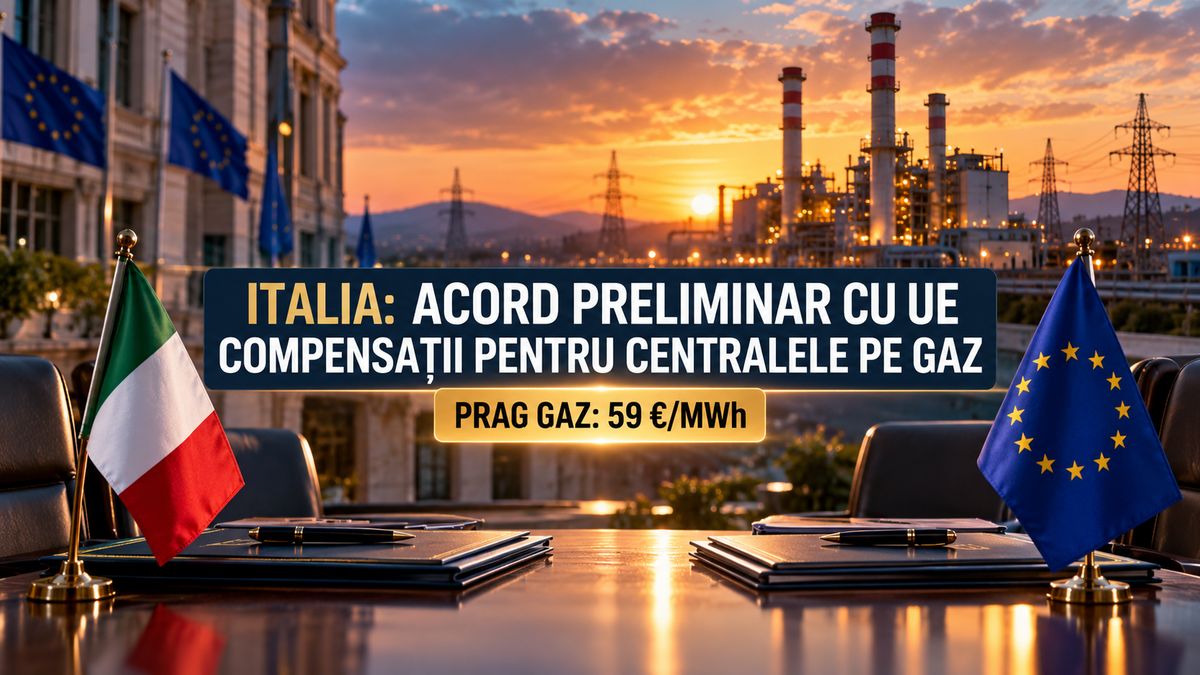
Italy has reached an agreement in principle with the European Commission to introduce a mechanism aimed at lowering electricity prices by offsetting a portion of natural gas costs for thermal power plants. The agreement, announced on October 16, 2026, following negotiations between the government led by Giorgia Meloni and the European executive, marks an important step for an economy heavily exposed to rising fossil fuel prices and the burden of energy costs on industry. The agreed mechanism uses a reference price of €59/MWh for natural gas. When gas prices exceed this threshold, power plants would receive compensation for the eligible difference, preventing high fuel costs from being fully passed through into their electricity supply bids. According to the Financial Times, wholesale gas prices stood at around €90/MWh at the time of the agreement. The Italian government thus aims to curb wholesale electricity prices and, ultimately, the costs borne by businesses and households. While the political understanding sets the framework for intervention, Italy must formally notify the support measures, which the European Commission will then assess under state aid rules. The €59/MWh threshold: How Italy aims to lower power prices In European wholesale electricity markets, clearing prices are set in each trading period based on the bids required to meet demand. When natural gas-fired plants supply the marginal unit of energy needed by the system, their production costs can set the market-clearing price, dictating the remuneration for all accepted generators in that timeframe. This pricing mechanism explains why surging gas prices can drive up electricity rates even in power systems where renewables, hydro, or other low-marginal-cost technologies account for a significant share of output. The overall influence of gas hinges on generation mix, demand levels, cross-border imports, and the availability of alternative generation assets. The Italian scheme aims to mitigate this impact by compensating gas-fired plants for a portion of their fuel expenditure. For instance, with gas at €90/MWh, the spread above the €59/MWh baseline is roughly €31/MWh of gas. This differential serves as the economic baseline for the intervention, rather than an automatic €31/MWh drop in final electricity prices. The subsidy would allow eligible power plants to submit market bids less affected by gas price spikes while maintaining full recovery of approved operational costs through the support mechanism. Should these plants set the marginal price, the intervention could lower wholesale electricity prices and reduce power procurement costs for suppliers. Italian authorities have framed this roughly €30/MWh differential as the primary economic goal pursued in negotiations with Brussels. However, the actual scale of power price reductions will depend on the final architecture of the scheme, gas market trends, and how compensation shapes generator bidding strategies. Italy generates nearly half its domestic electricity from natural gas Reliance on gas-fired power plants remains one of the primary vulnerabilities of the Italian energy system. According to data from TSO Terna, in 2025 Italy generated approximately 126.9 TWh of electricity from natural gas, accounting for nearly 46% of gross domestic electricity output (277.1 TWh). Gas accounted for 79.5% of total thermal generation, with gas-fired output rising by 7.1% year-on-year. At the same time, solar PV generation exceeded 45 TWh, reaching a new national record, demonstrating that renewable expansion has not yet displaced gas-fired plants as essential providers of dispatchable power. This structure exposes Italy to international fuel price volatility. Energy market disruptions amplified by conflict in the Middle East have intensified pressure on natural gas markets, with high costs feeding directly into power prices during intervals when thermal power sets wholesale rates. For Italian industry, the ramifications are significant. Steelmaking, chemicals, ceramics manufacturing, and other energy-intensive sectors compete globally against rivals that often operate under different energy mix structures and cost environments. Elevated power prices risk eroding industrial margins, delaying capital investments, and dampening export competitiveness. Confindustria, Italy's main business federation, has repeatedly warned of the economy's vulnerability to surging energy costs. Against this backdrop, the agreement with Brussels provides the Meloni administration with a mechanism to address a key industrial cost driver without unilaterally altering European internal market rules. Gas subsidies to be funded via consumer bills; ETS costs excluded A pivotal element of the mechanism is how compensations paid to generators will be funded. According to reporting by the Financial Times, the costs of the scheme are expected to be recovered through levies on consumer energy bills. Consequently, any reduction in…
Ioana Buzoaica — Independent Editorial Board
The NRG-IA newsroom continuously monitors Romanian energy markets, ANRE regulatory decisions, and national grid telemetry (SEN/SNT). We deliver independent intelligence anchored exclusively in official primary data.
Editorial Charter, Ethics & Verification Methodology →