Japan Prepares OHISAMA Space Solar Power Test for 2026 — NRG-IA
Tehnologie & Inovație Author: Ioana BuzoaicaJapan is preparing a key space solar test: converting sunlight to power in orbit, beaming it via microwaves, and recovering it as electricity on Earth.
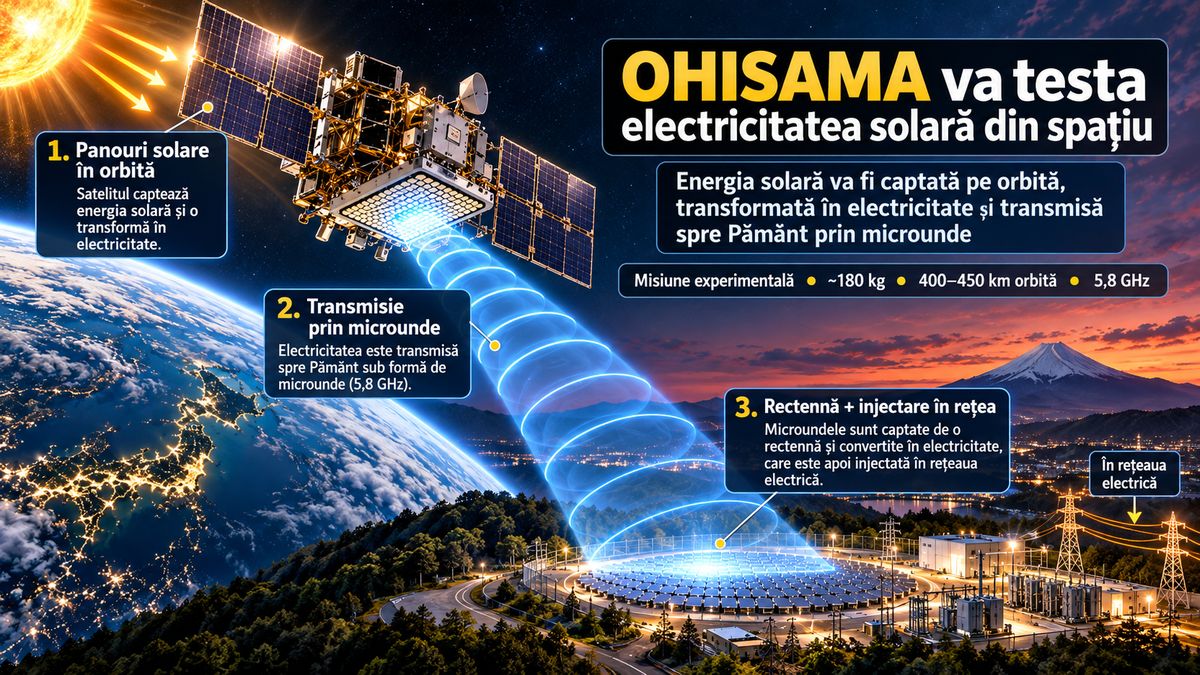
Japan is preparing a satellite weighing approximately 180 kg designed to convert solar energy captured in orbit into a microwave beam and transmit it to Earth, where the radio frequency energy would be converted back into electricity. The project, named OHISAMA , is coordinated by Japan Space Systems under the Japanese space solar power systems research program and is scheduled for fiscal year 2026. Public technical documents reviewed up to September 26 continue to describe the mission as under preparation, without official confirmation of a launch date or any orbital-to-ground transmission results. The stakes go far beyond the modest power output of the demonstrator. If the experiment succeeds, the same sequence that currently exists only in laboratories and partial tests would function in a single energy chain: sunlight is captured in space, converted into electricity, the electricity is turned into microwaves, the beam travels hundreds of kilometers, and a specialized antenna on the ground converts it back into usable electrical current . For consumers, such technology would not mean their homes receive electricity directly from the sky. A future orbital solar power plant would beam energy to large receiving stations, from where the electricity would feed into the conventional power grid. The difference lies in where generation begins: above the clouds and the dense atmosphere, in an environment where solar radiation availability is significantly higher and more predictable than for a ground-based panel. OHISAMA Will Attempt the Complete Chain from Sun to Orbit to Ground Grid The mission concept utilizes a low Earth orbit of around 400–450 km and transmission in the 5.8 GHz band. The energy captured by the satellite's solar array is converted into radio frequency energy and transmitted via a phased-array antenna—an assembly of elements that can electronically steer the beam without mechanically moving the entire antenna. The project's technical documentation includes both transmission to Earth and energy transfer experiments between objects in orbit. The power output of around 1 kW associated with the demonstrator must be understood within the context of the experiment. OHISAMA is not designed to power a city, nor to continuously deliver a kilowatt to the grid. The planned transmissions are controlled experiments conducted in short windows, where researchers must primarily demonstrate that the beam can be formed, steered, and recovered while the satellite travels in orbit at several kilometers per second. A rectenna—short for rectifying antenna —receives electromagnetic energy and converts it into direct current. From an energy perspective, it plays the opposite role of the transmitter: what the satellite converts from electricity to microwaves, the ground station converts back from microwaves to electricity. Success will therefore not be measured by the amount of energy produced, but by whether the energy reaches its exact target and can be recovered on the ground in a usable form. The Hard Part: Hitting Earth with Precision from a Moving Satellite Solar panels have been operating in space for decades; satellites convert sunlight into electricity every day. The problem OHISAMA aims to solve is different: how to transmit controlled power, not just information, from an object moving in orbit to a precise receiver on the surface of a rotating planet . Radio communication solves this problem using relatively low-power signals. However, a power plant must concentrate a much larger amount of energy onto the receiver, turning beam precision into a fundamental issue of efficiency and safety. Phased-array antennas can alter the signal phase of each element to steer the combined output without requiring a giant antenna mounted on a mechanical gimbal. This relies on the same family of principles used in radar and modern communications, but applied here to the actual transport of energy. OHISAMA specifically includes experiments to verify beam control precision over orbital distances. The project also studies the effects of atmospheric and ionospheric propagation, as well as architectures where a ground-transmitted beacon signal helps the satellite determine the correct direction of the receiver. Japan Has Already Tested Transmission from an Aircraft at an Altitude of Around 7.5 Kilometers OHISAMA is not jumping straight from the lab to orbit. In December 2024, Japan Space Systems installed an engineering model of the transmission system on an aircraft and demonstrated the formation and directional control of a 5.8 GHz beam to the ground over a distance of more than 5 km . Subsequent technical documentation describes the aircraft as operating at an altitude of approximately 7.5 km . The experiment tested precisely one of the challenges that becomes far more difficult in space: the transmitter is not stationary. A moving aircraft must be continuously tracked relative to the receiver, and the antenna phases must be…
Ioana Buzoaica — Independent Editorial Board
The NRG-IA newsroom continuously monitors Romanian energy markets, ANRE regulatory decisions, and national grid telemetry (SEN/SNT). We deliver independent intelligence anchored exclusively in official primary data.
Editorial Charter, Ethics & Verification Methodology →