Kazakhstan Oil: Record Exports and New Refinery Plans — NRG-IA
Piața de Energie Author: Aurora AIKazakhstan consolidates its position as the EU's second-largest oil supplier and plans massive refinery expansions to export finished fuels.
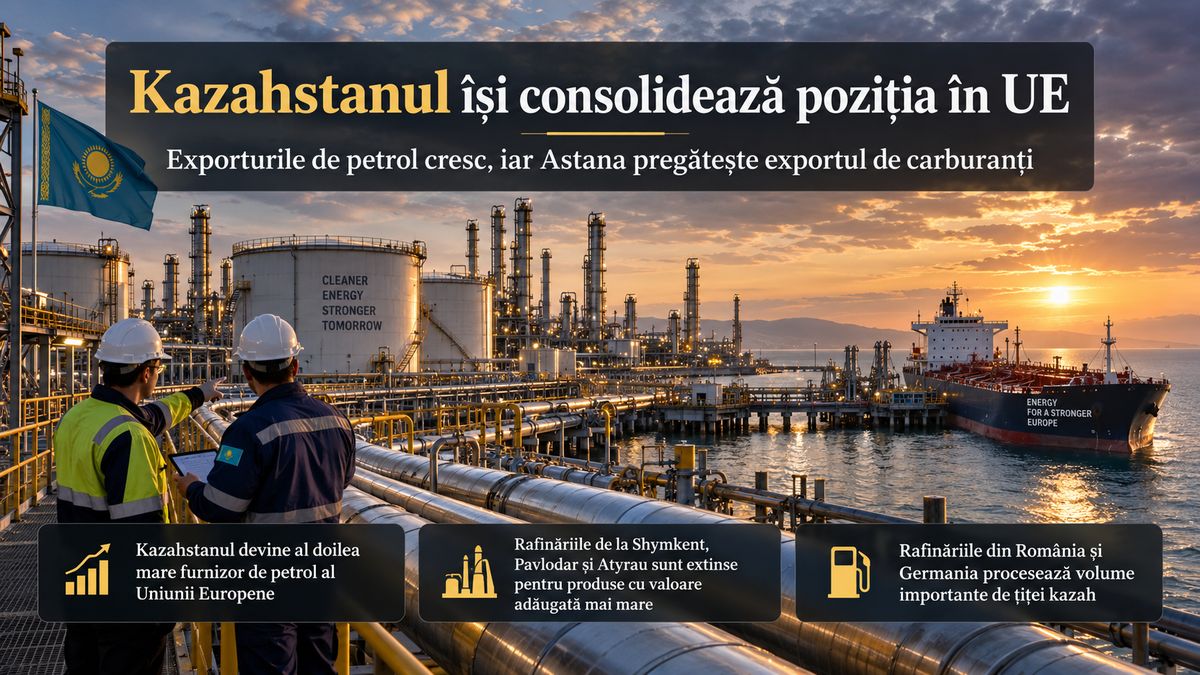
Rerouted Flows and Rising Volumes — How Kazakh Oil Reaches European Refineries Kazakhstan is delivering massive volumes of oil to the European Union, consolidating its position as the bloc's second-largest crude supplier. Despite severe logistical challenges triggered by the conflict in Ukraine, commercial flows from Central Asia to European refineries have not only remained active but have shown steady growth. This dynamic highlights a profound reconfiguration of Europe's energy supply map, which now critically depends on the stability of eastern corridors. According to data published by Economica.net, the Kazakh state has managed to overcome temporary blockades in the Black Sea and maintain a dominant commercial presence in European ports. Refineries in Romania, Germany, and other EU member states process significant volumes of Kazakh crude, imported primarily as KEBCO (Kazakhstan Export Blend Crude Oil). This alternative became vital following the imposition of a total embargo on Russian seaborne crude. Transit has not been without major incidents since the outbreak of the war. Transport infrastructure has been repeatedly affected by storms, technical issues at marine terminals, and direct security risks in the Black Sea basin. Nevertheless, physical flows have been quickly resumed each time, demonstrating the logistical resilience of both Kazakh and European operators. The Vulnerability of the Novorossiysk Terminal and Securing Alternative Routes The main cause of logistical tensions lies in Kazakhstan's historical dependence on Russian infrastructure. Most Kazakh crude is exported through the Caspian Pipeline Consortium (CPC) pipeline to the Yuzhnaya Ozereyevka marine terminal near the Russian Black Sea port of Novorossiysk. This route directly exposes Kazakh exports to regional military risks, drone strikes, and occasional administrative restrictions imposed by Moscow authorities. To counter this strategic vulnerability, Astana has accelerated the diversification of transport routes. The volume of crude directed through the Middle Corridor (Trans-Caspian International Transport Route) has seen controlled growth. This multimodal route crosses the Caspian Sea, Azerbaijan, and Georgia, completely bypassing Russian territory and offering a direct connection to ports in Romania and the rest of Southeastern Europe. Furthermore, e-nergia.ro highlights that Kazakhstan's plans are no longer limited to delivering raw crude. The government in Astana is now pursuing a major industrial paradigm shift: a massive increase in domestic refining capacity. By modernizing and expanding the country's major refineries, such as those in Shymkent, Pavlodar, and Atyrau, Kazakhstan aims to process more crude locally and directly export high-value finished petroleum products. Reconfiguring the European Fuel Market and Protection Against Deficits This strategic transition from exporting crude oil to refined products will have a direct impact on the European Union's fuel market. Europe has been facing a structural diesel deficit since Russian refineries were excluded from the supply chain. The emergence of a major new supplier of diesel and gasoline at the Union's borders will help stabilize pump prices and reduce volatility in regional spot markets. For Romania, this development is highly relevant. The Petromidia refinery, the largest such asset in the country, predominantly uses Kazakh crude to produce fuel for the domestic and regional markets. Increased availability of refined products in the Black Sea basin provides an additional safety net in the event of unplanned shutdowns at local production units or disruptions along traditional maritime routes. However, this strategy also implies increased commercial competition for European refiners. Direct imports of fully processed fuels from Kazakhstan could put pressure on the refining margins of operators in Central and Eastern Europe, forcing them to streamline operational costs to remain competitive against products manufactured with significantly lower utility and production costs in Central Asia. Refinery Modernization and the Capacity Test in the Coming Years The major challenge in the short and medium term remains securing Western financing and technology required to expand Kazakh petrochemical complexes. The refinery expansion projects have ambitious completion deadlines, but their implementation depends on regional geopolitical stability and Astana's ability to maintain a delicate diplomatic balance between Russia, China, and the West. Until the new processing units are finalized, Kazakhstan must manage immediate transport risks in the Black Sea. Any military escalation in the Crimea area or near the port of Novorossiysk could instantly block shipments via the CPC pipeline, putting pressure on European strategic stocks. The Middle Corridor's capacity to handle emergency volumes remains limited by port infrastructure on the Caspian Sea, turning the next two years into a…