Subsea Geothermal Generator Yields Net-Positive Power — NRG-IA
Tehnologie & Inovație Author: Ioana BuzoaicaAn experimental subsea generator deployed 1,500m under the Pacific achieved net-positive power, marking a key milestone for offshore geothermal energy.
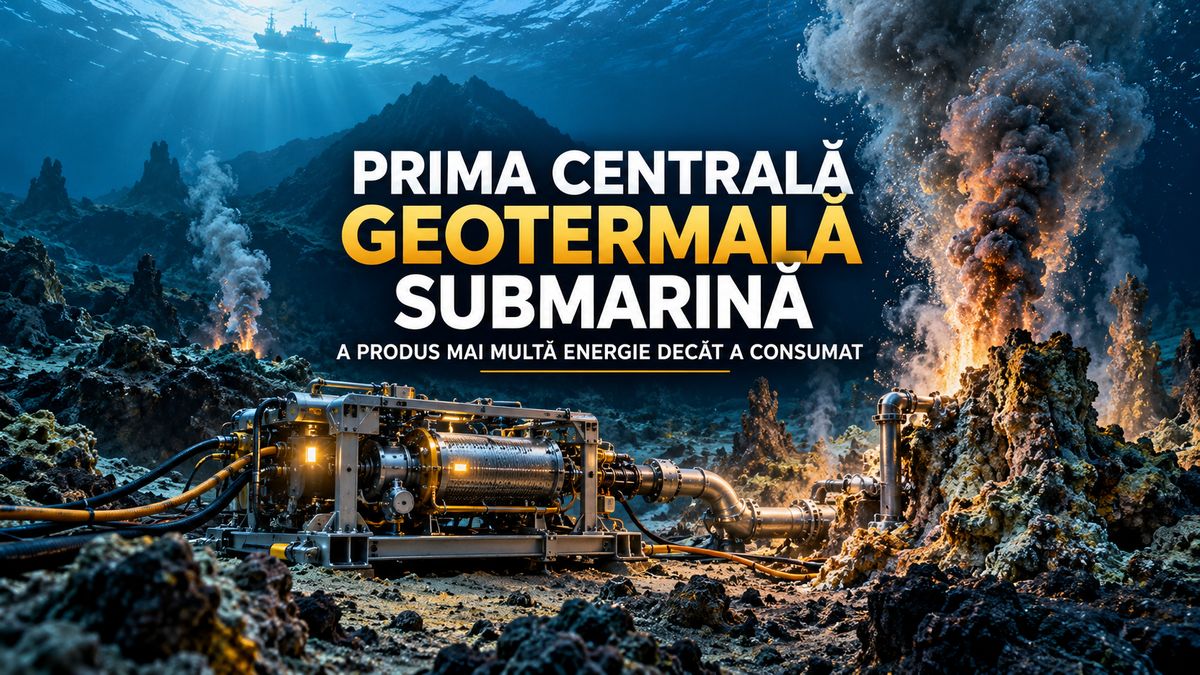
Nearly a mile below the surface of the Pacific Ocean, near an active submarine volcano, an experimental facility has managed to generate more electricity than it consumes for its own operation. US company Endurance Energy announced on October 19, 2026, the results of a test conducted in September, in which a seafloor geothermal generator operated for 8.7 seconds with a net-positive electric power balance. The demonstration opens an unconventional energy pathway: continuous power generation from the heat of volcanoes and subsea hydrothermal reservoirs. The experiment took place at Axial Seamount, a submarine volcano located approximately 480 kilometers off the coast of Oregon. The Adélie prototype—a three-tonne rig designed for a 100 kW capacity—was lowered to a depth of around 1,500 meters and connected to a natural hydrothermal fluid source at 281°C. The turbine reached roughly 26,000 RPM, and the generator recorded a peak net power output of 16.5 kW after powering its onboard auxiliary equipment. The milestone marks a step forward in turning subsea geothermal heat into an industrially viable energy resource. Unlike solar or wind power, a geothermal plant powered by a sufficiently stable reservoir can generate electricity around the clock, unaffected by weather or the day-night cycle. Endurance Energy aims to develop 2 MW commercial generators, targeting an island power grid currently reliant on imported fossil fuels as its first application. How Electricity Was Produced on the Seafloor of a Submarine Volcano The Pacific demonstration represented the company's first attempt to integrate into a single expedition all operations required for a future subsea geothermal system: drilling a well, installing a power plant, tapping heat, generating electricity, and controlling equipment remotely. Operations took place over three weeks using a specialized vessel and remotely operated subsea vehicles. Initially, engineers drilled two boreholes into the ocean floor, both encountering hot hydrothermal fluids. The second hole was cased, cemented, and fitted with a valve, creating a geothermal well approximately 16 meters deep and just five centimeters in diameter. The extracted fluid registered a temperature of about 260°C, high enough for use in a thermal conversion system. However, the well's flow rate proved too low to drive the turbine. Engineers moved the prototype near a natural hydrothermal vent, where hot fluid was already discharging from the oceanic crust at roughly 281°C. This natural source provided the thermal energy required for the September 27 test. The generator operated for approximately 29 seconds, producing a total of about 60 Wh of electricity. Over an 8.7-second window, power generation exceeded the consumption of onboard pumps, control systems, and other auxiliary equipment. The power surplus helped charge the system's battery, proving that a positive net power balance is achievable in the deep ocean environment. Endurance operated the system in real time from Seattle using the Regional Cabled Array, a subsea fiber-optic network managed by the University of Washington under the Ocean Observatories Initiative. This research infrastructure enabled real-time data transmission and command control between the volcano-bound rig and the surface control center. The Ocean Simultaneously Offers the Heat and Cooling Needed for Power Generation The physical principle behind the technology is well known from terrestrial geothermal plants. In volcanically active regions, water seeps through rock fissures, is heated by deep geological structures, and circulates through hydrothermal reservoirs. In certain subsea areas, the temperature of these fluids exceeds 250°C, creating ideal conditions for converting thermal energy into electricity. The Adélie prototype utilizes an Organic Rankine Cycle (ORC)—a thermodynamic system where heat from the geothermal fluid is transferred to a working fluid. The working fluid vaporizes, drives a turbine coupled to an electric generator, and is then cooled and condensed for recirculation. The process converts the temperature differential between the hot source and the cold surroundings into mechanical energy and, ultimately, electricity. A seabed deployment offers major advantages. Near hydrothermal vents, the heat source lies adjacent to the conversion equipment, while cold seawater provides an abundant cooling medium for the thermodynamic loop. Moreover, extreme deep-sea pressure keeps hydrothermal fluids liquid at temperatures that would cause boiling under atmospheric conditions. This combination favors the design of compact systems with high power density relative to their physical footprint. Endurance seeks to tap hydrothermal reservoirs in areas where tectonic plates diverge or where volcanic activity intensely heats the oceanic crust. Such conditions exist across multiple regions of the Pacific, including near island archipelagos and coastal areas in need of stable…
Ioana Buzoaica — Independent Editorial Board
The NRG-IA newsroom continuously monitors Romanian energy markets, ANRE regulatory decisions, and national grid telemetry (SEN/SNT). We deliver independent intelligence anchored exclusively in official primary data.
Editorial Charter, Ethics & Verification Methodology →