UK Limits Power Exports: Interconnection Lessons for Romania — NRG-IA
Geopolitică & Energie Author: Ioana BuzoaicaGreat Britain cut export capacity to zero on key interconnectors in July due to tight margins, a key lesson for Romania's 2,500 MW import scenarios.
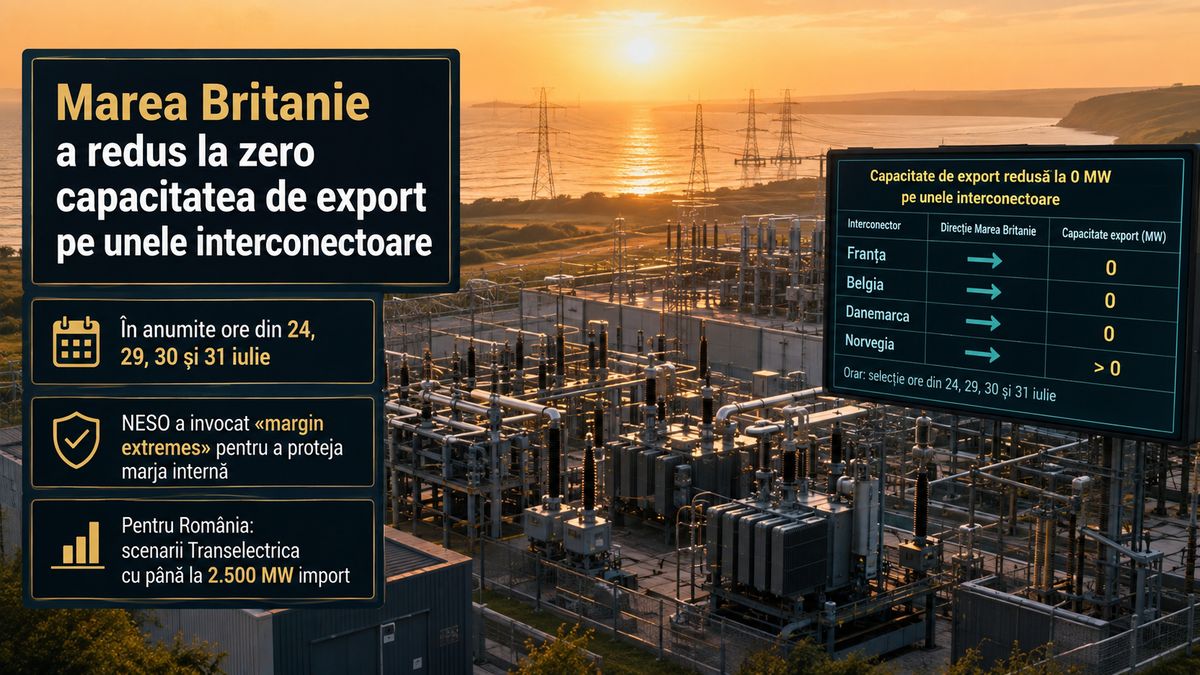
Over four days in July, Great Britain reduced the export capacity available to the market to zero on one or more interconnectors with continental Europe and Scandinavia to preserve sufficient margin in its own electricity system. The interventions targeted specific hours on July 24, 29, 30, and 31, affecting links with Belgium, Denmark, Norway, and France. The reason published by the National Energy System Operator (NESO) was "margin extremes"—the risk of the reserve between available resources and the British system's demand becoming too narrow. The decision did not mean physically decommissioning the interconnectors or halting all British exports. Instead, the operator reduced, during certain intervals, the maximum export capacity that could be made available to the day-ahead market on one or more of the four analyzed cables. This distinction is essential: the infrastructure remained available, but the amount of power the market could schedule outward was limited to protect the security of the British system. The episode highlights a fundamental limit of energy security based on interconnection. A country may have sufficient cables for thousands of megawatts of imports, but the energy must exist in neighboring systems at the exact hour it is needed, and those systems must be able to export it without compromising their own security criteria. For Romania, this issue is not theoretical. Transelectrica's study on the operation of the National Power System (SEN) in the summer of 2026 includes a scenario with 2,000 MW import under windless conditions and with only one nuclear unit in operation, as well as a peak evening scenario with a consumption of 8,500 MW , zero wind and solar production, and a net balance of 2,500 MW import . These are calculation scenarios for system security, not forecasts for specific days, but they demonstrate the scale of dependence that can arise under unfavorable conditions. Great Britain used 'margin extremes' for the first time to reduce exports to zero The Financial Times identified in NESO data four days in which the maximum export capacity in the day-ahead market was reduced to zero on one or more of Nemo Link, Viking Link, North Sea Link, and ElecLink. These connect Great Britain with Belgium, Denmark, Norway, and France. On July 24, restrictions were introduced for several hours in the morning and evening. On July 29, 30, and 31, they appeared during evening intervals. The FT points out that this was the first use of the official "margin extremes" classification to reduce exports to zero. The term has a precise operational meaning. NESO's policy on Net Transfer Capacity (NTC) allows the operator to limit the maximum power that can be imported or exported through an interconnector in a given market interval. Restrictions are applied when necessary for system security and can arise from three categories of reasons: network constraints, managing the largest potential loss of power, and system margin extremes. In the case of "margin extremes", the issue is the power reserve. If additional exports were to push the British system close enough to requiring a capacity margin warning, NESO can restrict the capacity made available to the interconnector. This is the mechanism that turned exportable surplus into a resource temporarily retained within the British system. Heatwaves have shifted system stress from winter to summer evenings The interventions occurred during a summer in which Great Britain was repeatedly forced to manage tighter margins than usual for the season. High temperatures increase air conditioning consumption, while generation availability can be simultaneously affected by maintenance, temperature, low wind, or grid issues. The June precedent shows how quickly pressure can build. During the heatwave in the week of June 22, NESO reported unusually high temperatures, lower-than-expected wind generation and gas plant availability, and tighter-than-normal margins. The operator issued Electricity Margin Notices for the evening peaks on June 24 and 26 and utilized several flexibility tools to maintain balance. An Electricity Margin Notice is not a blackout warning. It is a signal sent to the market when the operator wants additional capacity available to restore the system's reserve. During the June episode, consumer supply continued, and Ofgem stated there were no supply interruptions. However, the conditions of that week are now subject to an official review. Ofgem has requested an examination of the June 23 event and the warnings on June 24 and 26, including system conditions, operational decisions, and compliance with security standards. Separately, the way certain decisions flagged by whistleblowers were made and recorded is being investigated. Conclusions have not yet been established. Power may exist in the system and yet fail to reach where it is needed One of NESO's explanations for the July restrictions touches on a deeper issue than a simple lack of power…
Ioana Buzoaica — Independent Editorial Board
The NRG-IA newsroom continuously monitors Romanian energy markets, ANRE regulatory decisions, and national grid telemetry (SEN/SNT). We deliver independent intelligence anchored exclusively in official primary data.
Editorial Charter, Ethics & Verification Methodology →