800W Plug-in Solar: UK Simplifies, Romania Already Allows — NRG-IA
Prosumatori & Eficiență Author: Ioana BuzoaicaThe UK opens its market to 800W plug-in solar panels. Romania already allows similar systems, but still requires installation by an authorized electrician.
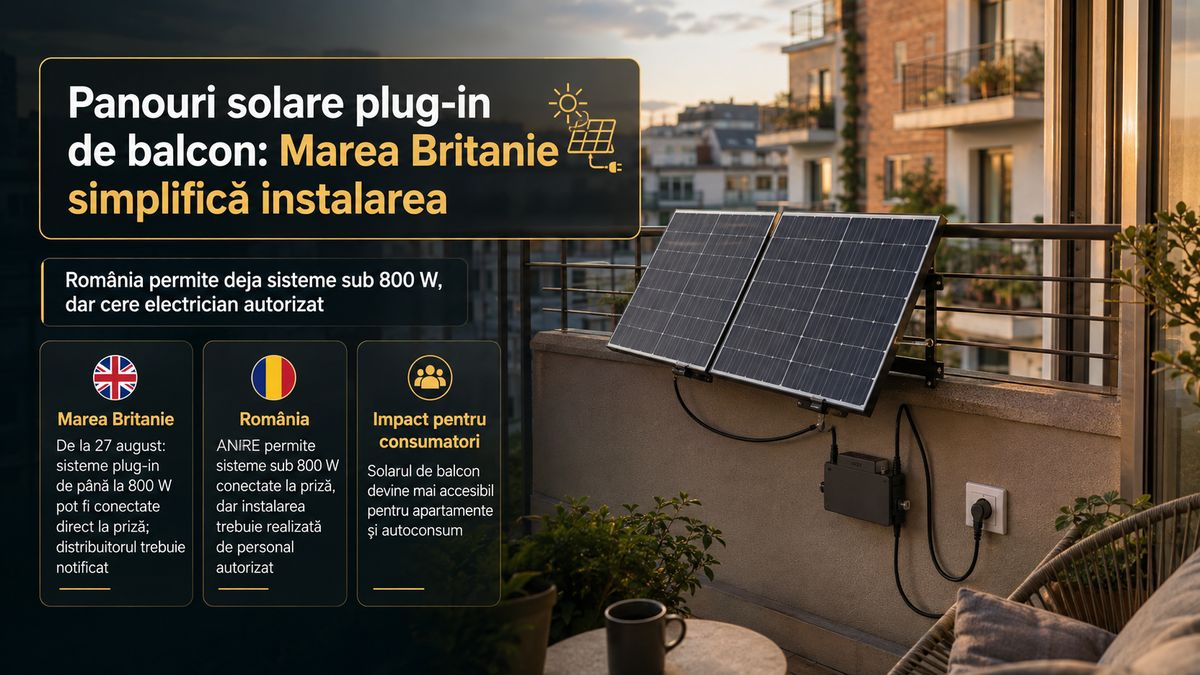
Starting August 27, 2026, the United Kingdom is introducing a new category of household photovoltaic microgeneration: systems of up to 800 W that can be purchased, mounted, and plugged directly into a domestic socket without traditional PV installation in the electrical panel and, for compliant products, without the mandatory intervention of an electrician. The British government estimates that such a system can provide up to 20% of an average household's electricity consumption and reduce bills by up to approximately £110 per year. These values are maximum estimates, dependent on location, panel orientation, sunlight, and how much of the generated energy is consumed directly within the household. However, this change does more than just introduce another solar technology. The UK is attempting to transform an electricity generation installation into a standardized consumer product: you buy a compliant kit, position it correctly, plug it in, and inform the local distribution network operator. For Romania, the comparison brings a surprise. ANRE (the Romanian Energy Regulatory Authority) already clarified in March 2026 that small-scale photovoltaic systems under 800 W can be connected directly to indoor sockets. The difference, therefore, is not between a country where the technology is legal and one where it is banned. The difference lies in two regulatory philosophies: the UK standardizes the product to simplify installation, while Romania keeps the authorized installer in the loop. 800 W means microgeneration, not a balcony solar power plant A plug-in system should not be confused with traditional multi-kilowatt photovoltaic installations mounted on rooftops. In the form currently promoted in the UK, we are typically talking about one or two panels, a microinverter, cabling, a mounting system, and the connection to the home's electrical installation. The electricity generated is primarily used inside the home, reducing the power drawn from the grid at that moment. The British government explains the scale simply: under good generation conditions, 800 W can simultaneously cover the consumption of appliances such as a refrigerator, TV, Wi-Fi router, laptop, charging phone, and a gaming console. The economic value of the system largely depends on self-consumption. Energy produced at midday is of greatest utility to the owner when there is consumption in the home during that same interval. The more solar energy directly replaces grid-purchased power, the more economically efficient the system becomes. The British shift safety from the installer to the product Until now, one of the major issues in the UK was the very principle of connecting a generator to a socket traditionally designed for power-consuming appliances. Prior to changing the regime, the British government commissioned dedicated testing for plug-in systems, including verifying fault behavior, protections, and thermal effects on domestic circuits. Based on these assessments, an interim technical specification was created for products that can benefit from the new simplified route. This is where the structural difference from Romania lies. The UK is trying to transfer part of the safety control from the installer to the product itself. If the equipment meets the required specifications and is used according to the instructions, the consumer can install it without an electrician. If modifications to the electrical installation are required—such as installing a new outdoor socket—that work remains within the scope of competent personnel. The distribution network operator must be informed after installation so that the microgenerator is registered on the grid. Romania already allows plug-in connections under 800 W ANRE explicitly answered in March 2026 whether small-scale photovoltaic systems connected directly to a socket can be used in Romania: yes . The authority describes these devices as micro-installations for electricity generation that connect to an existing consumption point via the internal electrical installation. For capacities under 800 W, connection regulations do not establish additional technical conditions or restrictions specific to this category. However, this is where the similarity with the new British model ends. ANRE specifies that the installation must be carried out by an authorized electrician or a company certified by the authority. The reason is both legal and technical: the equipment is not considered a simple household appliance, as it generates electricity and becomes part of the electrical installation. The user must also inform the distribution network operator about the modification to the installation, communicate the technical characteristics of the system, and specify how the generated energy will be used. Romania thus already has plug-in solar , but does not yet have the same level of plug-and-play solar introduced in the UK. Becoming a prosumer is not mandatory for self-consumption The Romanian regime also…
Ioana Buzoaica — Independent Editorial Board
The NRG-IA newsroom continuously monitors Romanian energy markets, ANRE regulatory decisions, and national grid telemetry (SEN/SNT). We deliver independent intelligence anchored exclusively in official primary data.
Editorial Charter, Ethics & Verification Methodology →